Resembling curling flames from a campfire, a magnificent nebula in a nearby galaxy observed by NASA Hubble Space Telescope provides new insight into the fierce birth of stars as it may have occurred in the early universe.
Hubble-V
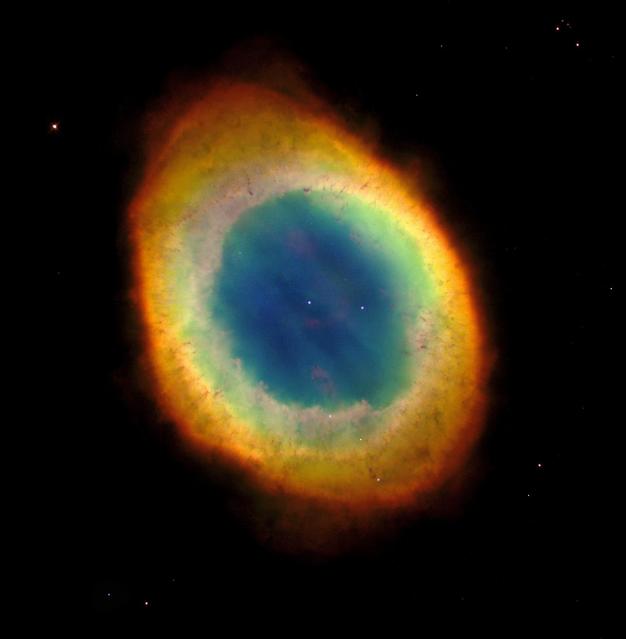
NASA Hubble Space Telescope captured this sharpest view yet of the most famous of all planetary nebulae: the Ring Nebula M57. The colors are approximately true colors.
Looking Down a Barrel of Gas at a Doomed Star
S69-60424 (29 Nov. 1969) --- Astronaut Charles Conrad Jr., commander of the Apollo 12 lunar landing mission, holds two lunar rocks which were among the samples brought back from the moon by the Apollo 12 astronauts. The samples are under sc…
Postflight - Apollo XII - MSC
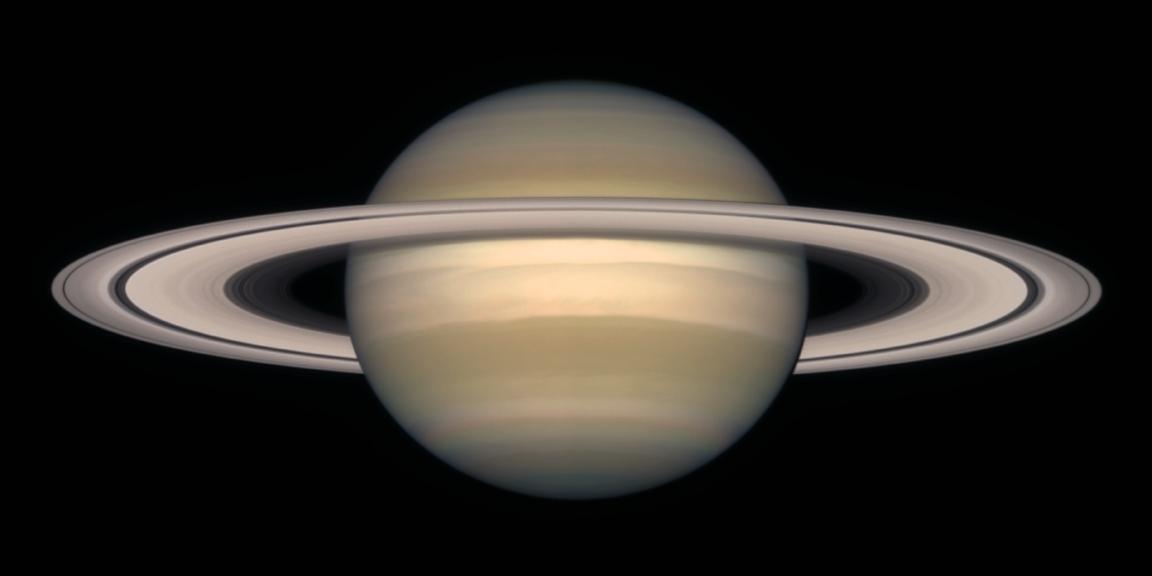
A Change of Seasons on Saturn - October, 1997
Hubble Sharpest View Of Mars
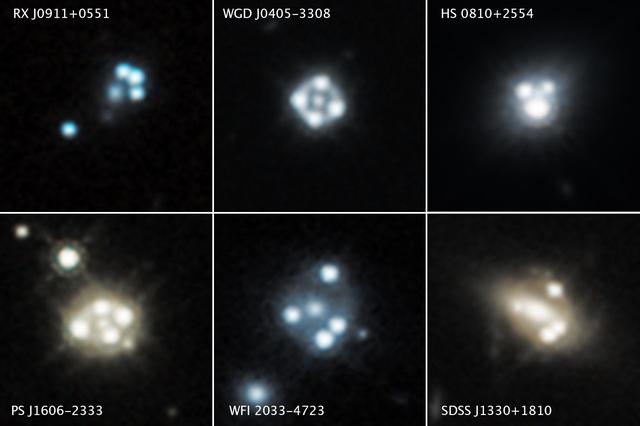
Each of these Hubble Space Telescope snapshots reveals four distorted images of a background quasar (an extremely bright region in the center of some distant galaxies) and its host galaxy surrounding the core of a foreground massive galaxy.…
Quasars' Multiple Images Shed Light on Tiny Dark Matter Clumps
Springtime on Mars: Hubble Best View of the Red Planet
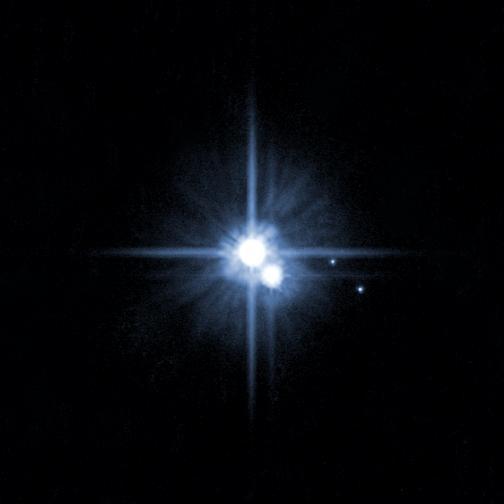
A pair of small moons photographed by NASA Hubble Space Telescope discovered orbiting Pluto in 2005 now have official names: Nix and Hydra.
Pluto and its Moons: Charon, Nix, and Hydra
This Hubble telescope snapshot of MyCn18, a young planetary nebula, reveals that the object has an hourglass shape with an intricate pattern of etchings in its walls. A planetary nebula is the glowing relic of a dying, Sun-like star.
Hubble Finds an Hourglass Nebula around a Dying Star
Moons Around Saturn
Moons Around Saturn
Crater Copernicus
Crater Copernicus
NGC 520 is the product of a collision between two disk galaxies that started 300 million years ago. This image is part of a large collection of images of merging galaxies taken by NASA Hubble Space Telescope.
NGC 520
This illustration depicts a side view of the Hubble Space Telescope (HST). The HST is the product of a partnership between NASA, European Space Agency Contractors, and the international community of astronomers. It is named after Edwin P. H…
History of Hubble Space Telescope (HST)
This photograph shows the Hubble Space Telescope (HST) flight article assembly with multilayer insulation, high gain anterna, and solar arrays in a clean room of the Lockheed Missile and Space Company. The HST is the first of NASA's great o…
History of Hubble Space Telescope (HST)
In this Hubble observation, astronomers used the massive galaxy cluster MACS J0647+7015 as the giant cosmic telescope. The bright yellow galaxies near the center of the image are cluster members.
Astronomers Spot Most Distant Known Galaxy
Hubble Clicks Images of Io Sweeping Across Jupiter
Hubble measured the size, shape and rotational period of the Rosetta mission backup target, comet 67P/Churyumov-Gerasimenko 67P/C-G.
3-D Models of Comet 67P/Churyumov-Gerasimenko Nucleus
Jupiter G Impact Evolution
NGC 454 is galaxy pair comprising a large red elliptical galaxy and an irregular gas-rich blue galaxy. This image is part of a large collection of images of merging galaxies taken by NASA Hubble Space Telescope.
NGC 454
This artist's concept depicts the Hubble Space Telescope (HST) being positioned for release from the Space Shuttle orbiter by the Remote Manipulator System (RMS). The HST is the product of a partnership between NASA, European Space Agency C…
History of Hubble Space Telescope (HST)
Decay of a Martian Dust Storm
This image illustrates the overall Hubble Space Telescope (HST) configuration. The HST is the product of a partnership between NASA, European Space Agency Contractors, and the international community of astronomers. It is named after Edwin…
History of Hubble Space Telescope (HST)
This NASA Hubble Space Telescope image of the planet Uranus reveals the planet rings and bright clouds and a high altitude haze above the planet south pole.
Hubble Observes the Planet Uranus
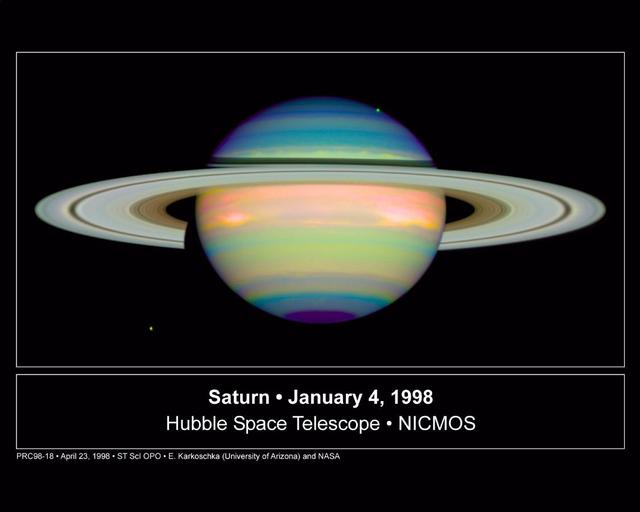
An Infrared View of Saturn
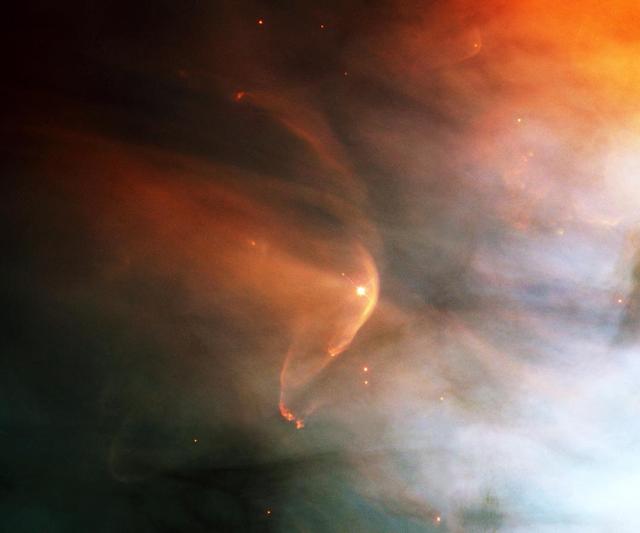
This image, taken by the Hubble Space Telescope, shows a bow shock around a very young star, LL Ori. The bow shock shows where the star's heliosphere collides with the interstellar medium. Our star, the Sun, is also surrounded by a heliosph…
Bow Shock Around Young Star
This image-based surface map of Pluto was assembled by computer image processing software from four separate images of Pluto disk taken with the European Space Agency Faint Object Camera aboard NASA Hubble Space Telescope.
Map of Pluto Surface
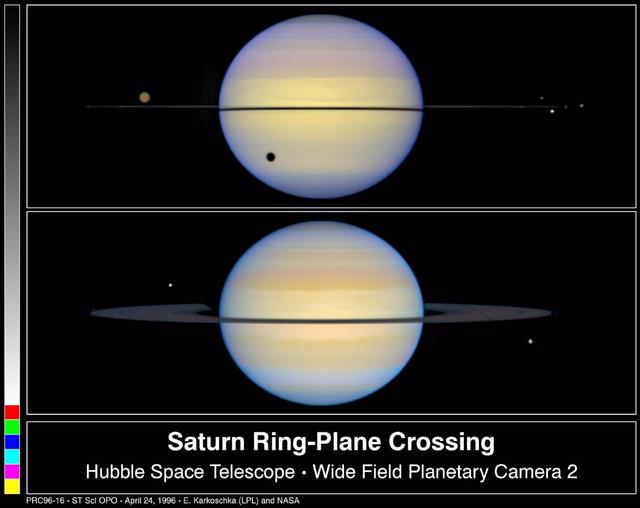
Edge-on View of Saturn Rings
NASA Hubble Space Telescope peered deep into Uranus atmosphere to see clear and hazy layers created by a mixture of gases. Using infrared filters, Hubble captured detailed features of three layers of Uranus atmosphere.
Hubble Captures Detailed Image of Uranus Atmosphere
The real monster black hole is revealed in this image from NASA Nuclear Spectroscopic Telescope Array of colliding galaxies Arp 299.
Tale of Two Black Holes
AM 0500-620 consists of a highly symmetric spiral galaxy seen nearly face-on and partially backlit by a background galaxy. This image is part of a large collection of images of merging galaxies taken by NASA Hubble Space Telescope.
AM 0500-620 - Spiral Arms and Bright Knots
Saturn from Far and Near Hubble Space Telescope
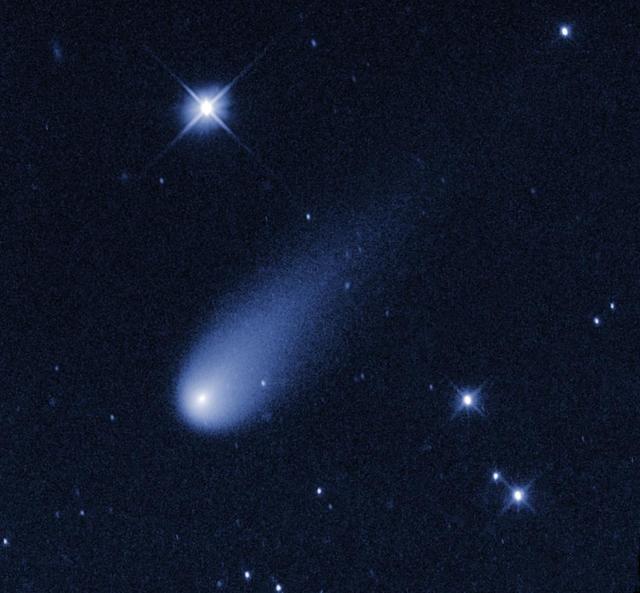
Superficially resembling a skyrocket, Comet ISON is hurtling toward the Sun at a whopping 48,000 miles per hour in this still from a Hubble animation.
Comet ISON Brings Holiday Fireworks
Hubble Images Reveal Jupiter Auroras
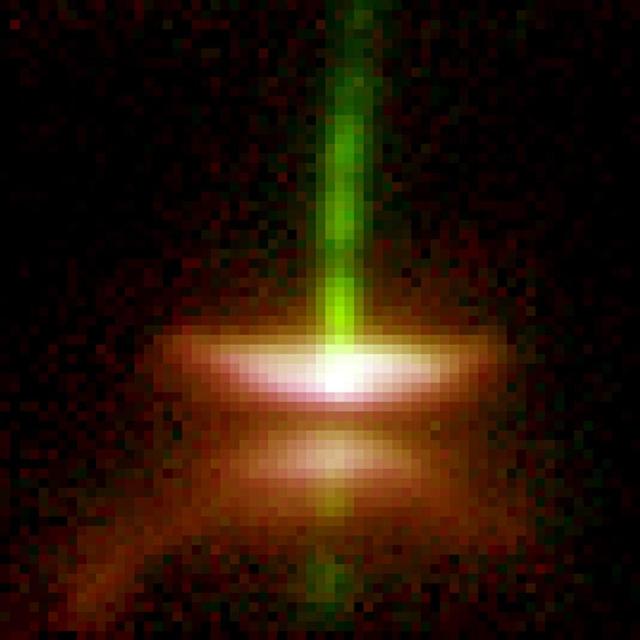
This image from NASA Hubble Space Telescope shows Herbig-Haro 30, the prototype of a gas-rich young stellar object disk around a star.
Dark Disks Around Young Stars
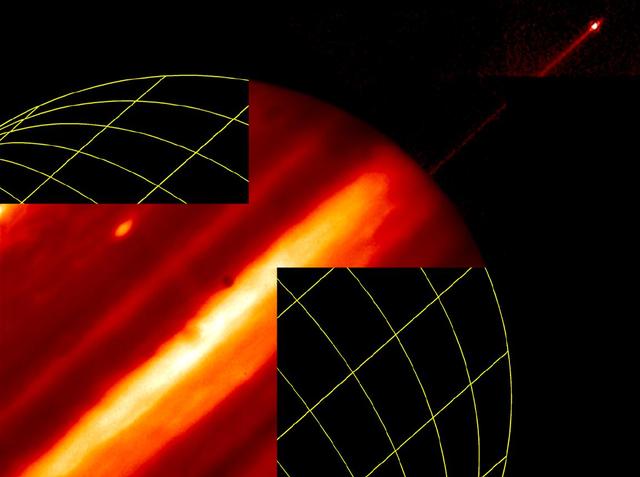
This is a composite photo, assembled from separate images of Jupiter and comet Shoemaker-Levy 9, as imaged by the NASA/ESA Hubble Space Telescope in 1994.
Comet Shoemaker-Levy 9 Approaching Jupiter in 1994
AM 1316-241 is made up of two interacting galaxies—a spiral galaxy on the left of the frame in front of an elliptical galaxy on the right of the frame. This image is part of a large collection of images of merging galaxies taken by NASA Hub…
AM 1316-241
Hubble Views Ancient Storm in the Atmosphere of Jupiter - April, 1997
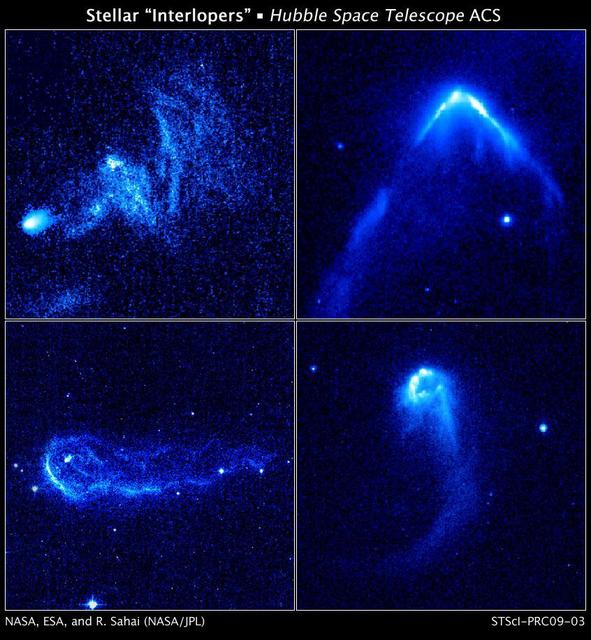
Stellar Interlopers Caught Speeding Through Space
This is the most detailed view to date of the entire surface of the dwarf planet Pluto, as constructed from multiple NASA Hubble Space Telescope photographs taken from 2002 to 2003.
Hubble Maps of Pluto Show Surface Changes
Hubble Provides Infrared View of Jupiter Moon, Ring, and Clouds
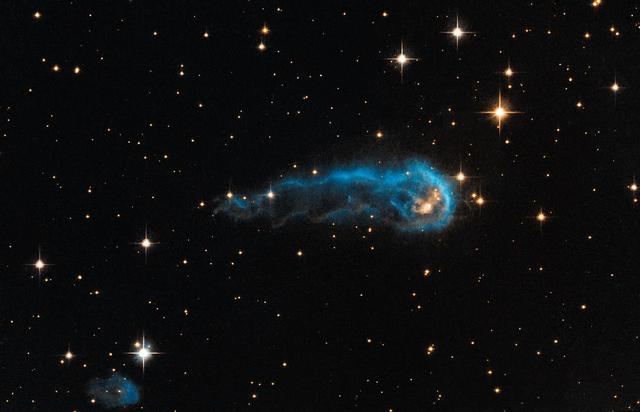
A bright blue tadpole appears to swim through the inky blackness of space. Known as IRAS 20324+4057, but dubbed "the Tadpole," this clump of gas and dust has given birth to a bright, "protostar," one of the earliest steps in building a star…
The Tadpole and the Wriggler
Scientists produced new global maps of Jupiter using the Wide Field Camera 3 on NASA Hubble Space Telescope. One color map is shown here, projected onto a globe and as a flat image.
Spinning Jupiter and Global Map
Hubble Look at Mars Shows Canyon Dust Storm, Cloudy Conditions for Pathfinder Landing
Using powerful ground-and space-based NASA telescopes, scientists have obtained a moving look at some of the wildest, weirdest weather in the solar system.
Neptune Stormy Disposition
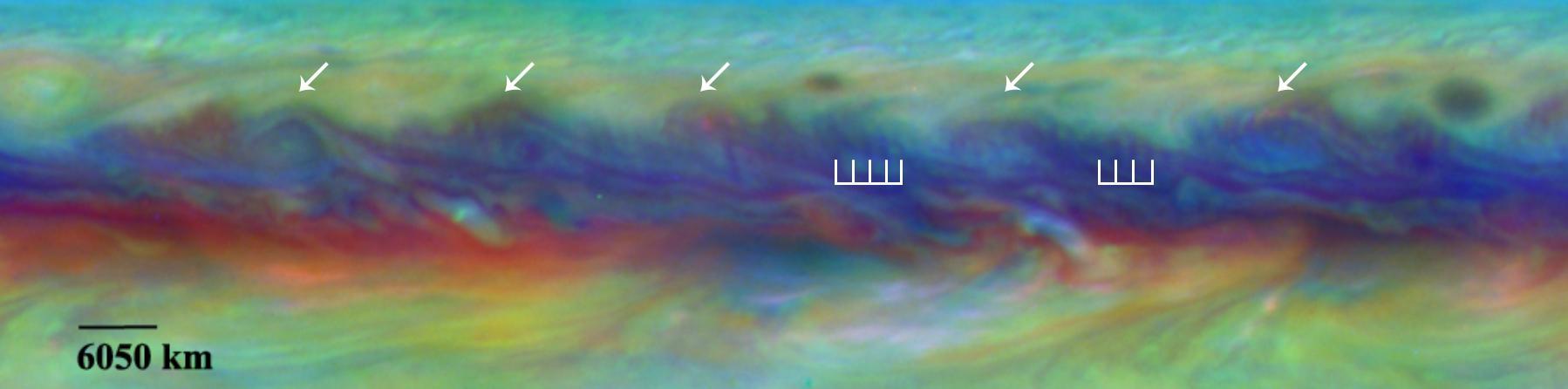
Scientists spotted a rare wave in Jupiter North Equatorial Belt that had been seen there only once before in this false-color close-up from NASA Hubble Telescope.  In Jupiter's North Equatorial Belt, scientists spotted a rare wave that had…
Jupiter Wave
This artist diagram shows the Smith Cloud as it arcs out of the plane of our Milky Way galaxy, then returning like a boomerang. Hubble Telescope measurements that it came out of a region near the edge of the galaxy disk of stars 70 million…
Monstrous Cloud Boomerangs Back to Our Galaxy Artist Concept
NASA Hubble Space Telescope shows detailed analysis of two continent-sized storms that erupted in Jupiter atmosphere in March 2007 shows that Jupiter internal heat plays a significant role in generating atmospheric disturbances .
Jupiter Eruptions
Hubble Provides Clear Images of Saturn Aurora