
This is an overhead view of NASA's New Horizons full trajectory; the spacecraft has entered a hibernation phase on April 7 that will last until early September. The full article is available at https://photojournal.jpl.nasa.gov/catalog/PIA…
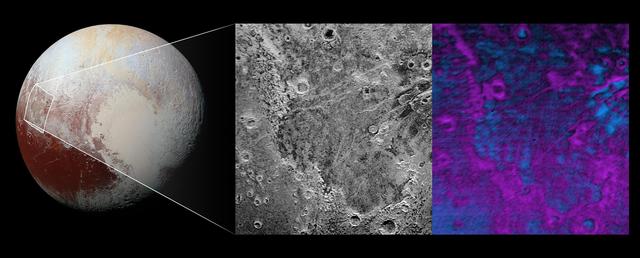
Scientists on NASA's New Horizons mission have discovered what looks like a giant bite-mark on the planet's surface. In this image, north is up. The southern portion of the left inset above shows the cratered plateau uplands informally nam…

This image contains the initial, informal names being used by NASA's New Horizons team for the features on Pluto's Sputnik Planum (plain). Names were selected based on the input the team received from the Our Pluto naming campaign. Names ha…
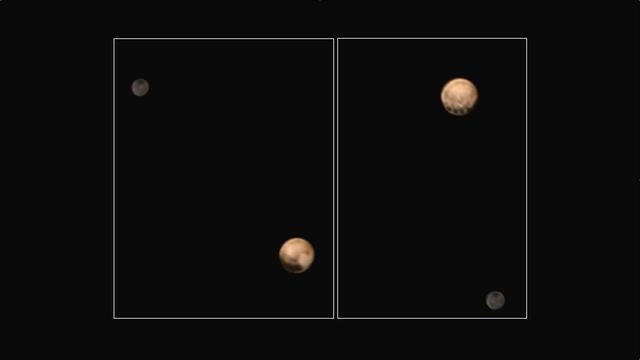
Pluto shows two remarkably different sides in these color images of the planet and its largest moon, Charon, taken by NASA New Horizons on June 25 and June 27, 2015. http://photojournal.jpl.nasa.gov/catalog/PIA20292

NASA's New Horizons spacecraft took this stunning image of Pluto only a few minutes after closest approach on July 14, 2015. The image was obtained at a high phase angle -- that is, with the sun on the other side of Pluto, as viewed by New…

These two images of Pluto and Charon were collected separately by NASA New Horizons during approach on July 13 and July 14, 2015. The relative reflectivity, size, separation, and orientations, and colors are approximated in this composite i…
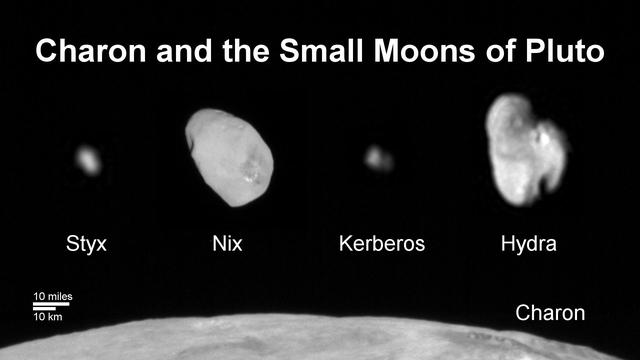
This composite image shows a sliver of Pluto large moon, Charon, and all four of Pluto small moons, as resolved by the Long Range Reconnaissance Imager (LORRI) on the New Horizons spacecraft. All the moons are displayed with a common intens…
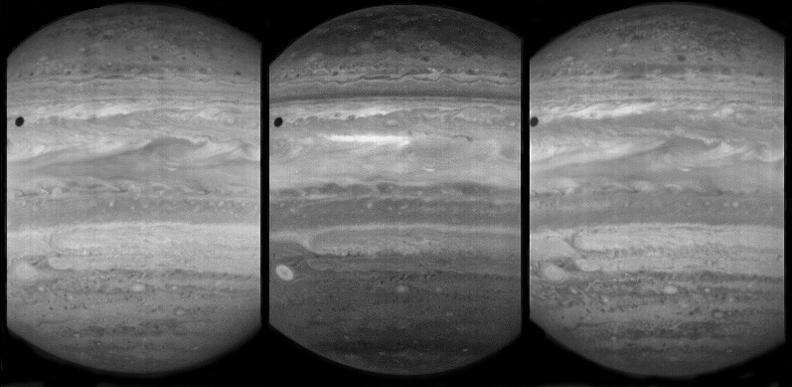
A Look from LEISA

KENNEDY SPACE CENTER, FLA. - In the Payload Hazardous Servicing Facility, the two fairing sections close in around the New Horizons spacecraft to encapsulate it. The fairing protects the spacecraft during launch and flight through the atmos…
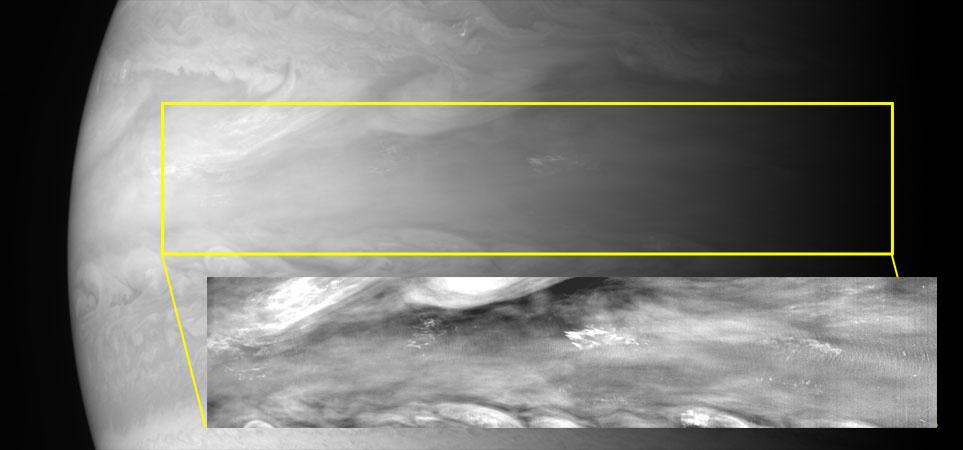
With its Multispectral Visible Imaging Camera MVIC, half of the Ralph instrument, New Horizons captured several pictures of mesoscale gravity waves in Jupiter equatorial atmosphere.

On Approach: Jupiter and Io

NASA New Horizons scientists have spotted an expanse of terrain they describe as fretted bright plains divided into polygon-shaped blocks by a network of dark, connected valleys in Pluto informally named Venera Terra region.

This image of Pluto and its largest moon, Charon, was taken by the Ralph color imager aboard NASA New Horizons spacecraft on April 9 and downlinked to Earth the following day.

This image of haze layers above Pluto limb was taken by NASA New Horizons spacecraft. About 20 haze layers are seen.
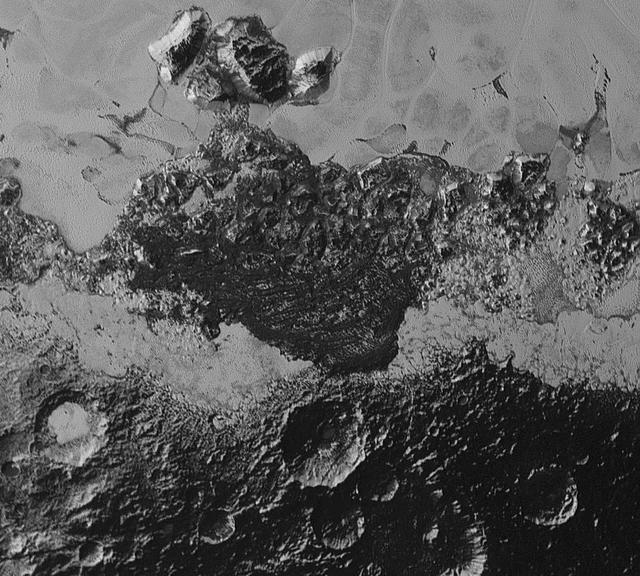
This 220-mile (350-kilometer) wide view of Pluto from NASA's New Horizons spacecraft illustrates the incredible diversity of surface reflectivities and geological landforms on the dwarf planet. The image includes dark, ancient heavily crate…

This artist conception shows NASA Phoenix Mars Lander during its more than 9-month journey to Mars.
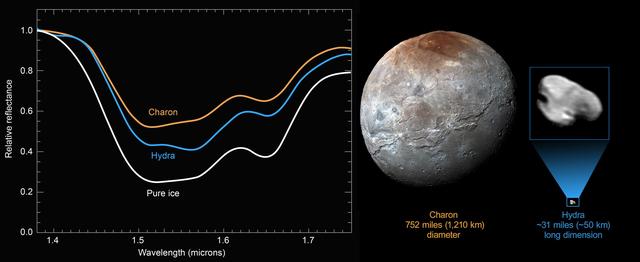
The surface of Hydra, Pluto outermost small moon, is dominated by nearly pristine water ice confirming hints that scientists picked up in NASA New Horizons images showing Hydra highly reflective surface.
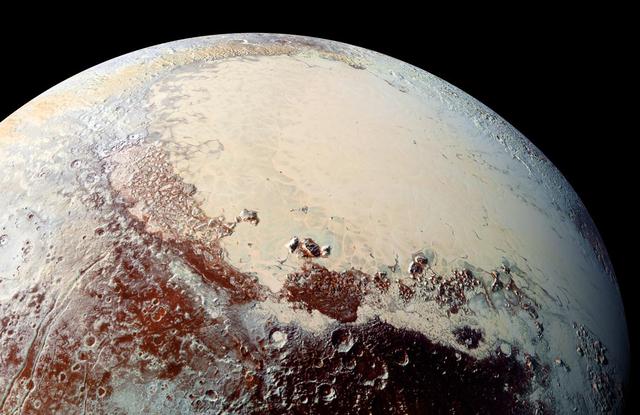
This high-resolution image captured by NASA's New Horizons spacecraft combines blue, red and infrared images taken by the Ralph/Multispectral Visual Imaging Camera (MVIC). The bright expanse is the western lobe of the "heart," informally ca…

This shaded relief view from NASA New Horizons of the region surrounding the left side of Pluto heart-shaped feature, informally named Sputnik Planum, shows that the vast expanse of its icy surface.
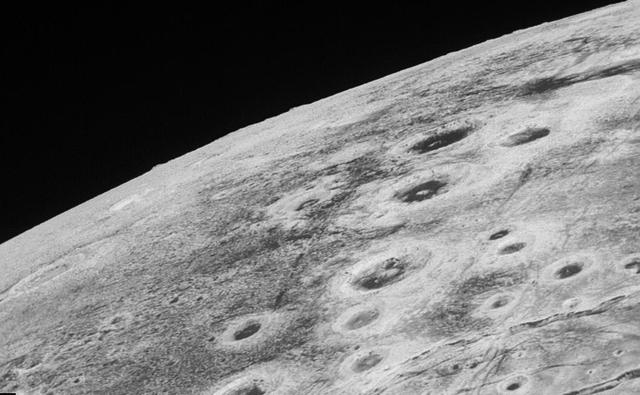
This high-resolution swat of Pluto sweeps over the cratered plains at the west of the New Horizons' encounter hemisphere and across numerous prominent faults, skimming the eastern margin of the dark, forbidding region informally known as Ct…

NASA New Horizons data indicates that at least two and possibly all four of Pluto small moons may be the result of mergers between still smaller moons. If this discovery is borne out with further analysis, it could provide important new clu…
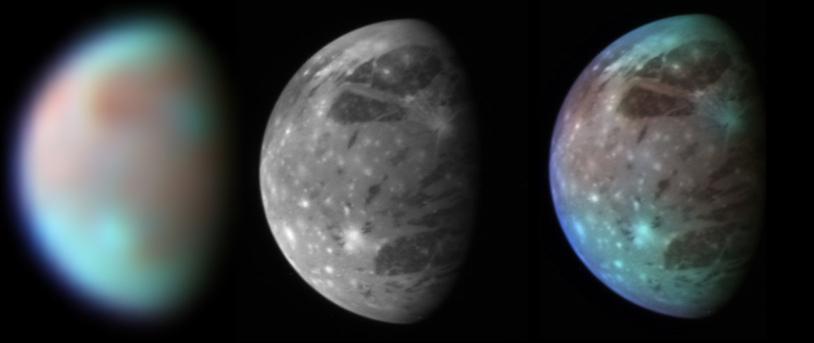
Ganymede in Visible and Infrared Light

This enhanced color mosaic combines some of the sharpest views of Pluto that NASA's New Horizons spacecraft obtained during its July 14 flyby. The pictures are part of a sequence taken near New Horizons' closest approach to Pluto, with reso…

NASA New Horizons had an exciting flyby encounter with Jupiter in early 2007, and the spacecraft has been rapidly moving away from the giant planet ever since.

Alice Views Jupiter and Io

In September, NASA's New Horizons team released a stunning but incomplete image of Pluto's crescent. Thanks to new processing work by the science team, New Horizons is releasing the entire, breathtaking image of Pluto. This image was made…
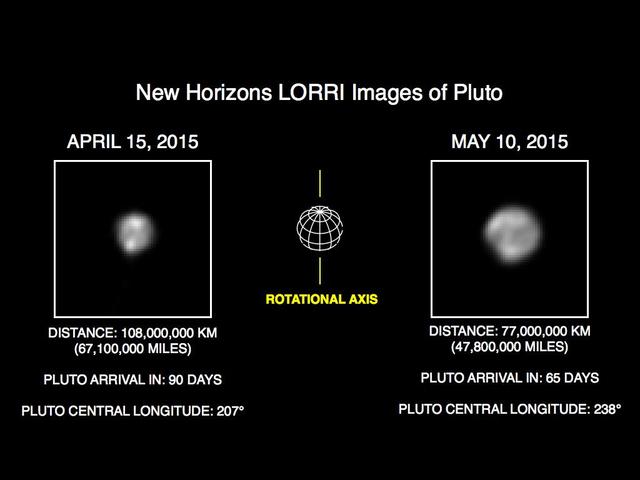
This image of Pluto is part of series of New Horizons Long Range Reconnaissance Imager LORRI photos taken May 8-12, 2015; the image at left shows LORRI view of Pluto just one month earlier.
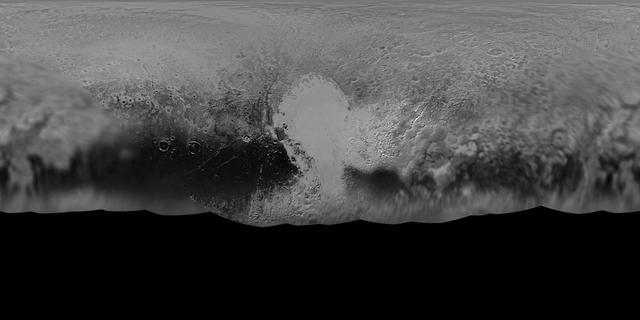
NASA New Horizons mission science team has produced this updated panchromatic black-and-white global map of Pluto. The map includes all resolved images of Pluto surface acquired between July 7-14, 2015.

Since its discovery in 2005, Pluto's moon Hydra has been known only as a fuzzy dot of uncertain shape, size, and reflectivity. Imaging obtained during NASA's New Horizons' historic transit of the Pluto-Charon system and transmitted to Earth…

This geological map from NASA New Horizons covers a portion of Pluto surface and includes the vast nitrogen-ice plain informally named Sputnik Planum and surrounding terrain.

Mosaic of high-resolution images of Pluto, transmitted by NASA's New Horizons spacecraft from Sept. 5 to 7, 2015. The image is dominated by the informally-named icy plain Sputnik Planum, the smooth, bright region across the center. This ima…

Most inner moons in the solar system keep one face pointed toward their central planet; this frame from an animation by NASA New Horizons shows that certainly isnt the case with the small moons of Pluto, which behave like spinning tops. Plu…
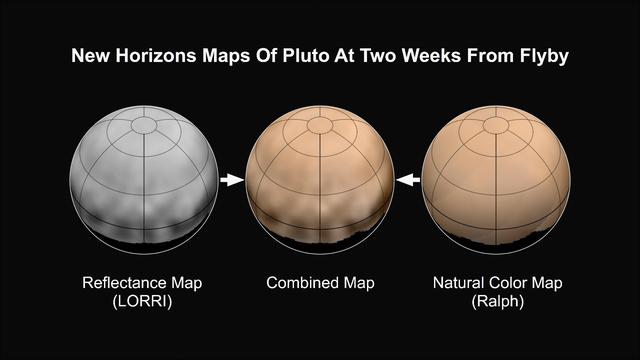
What color is Pluto? The answer, revealed in the first maps made from New Horizons data, turns out to be shades of reddish brown. The mission's first map of Pluto is in approximate true color -- that is, the color you would see if you were…

Pluto nearly fills the frame in this image from the Long Range Reconnaissance Imager (LORRI) aboard NASA’s New Horizons spacecraft, taken on July 13, 2015, when the spacecraft was 476,000 miles (768,000 kilometers) from the surface. This is…
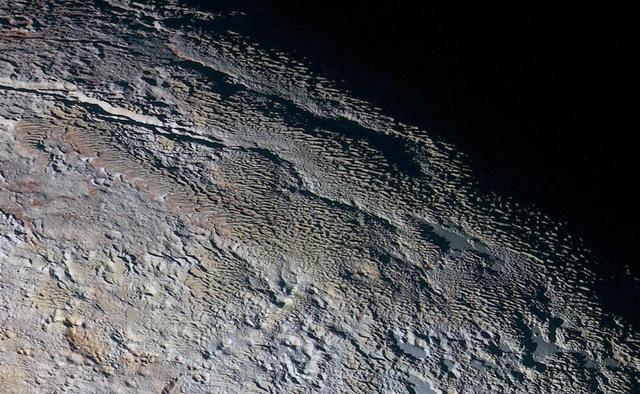
In this extended color image of Pluto taken by NASA New Horizons spacecraft, rounded and bizarrely textured mountains, informally named the Tartarus Dorsa, rise up along Pluto's day-night terminator and show intricate but puzzling patterns…

This highest-resolution image from NASA's New Horizons spacecraft shows how erosion and faulting has sculpted this portion of Pluto's icy crust into rugged badlands. The prominent 1.2-mile-high cliff at the top, running from left to upper r…
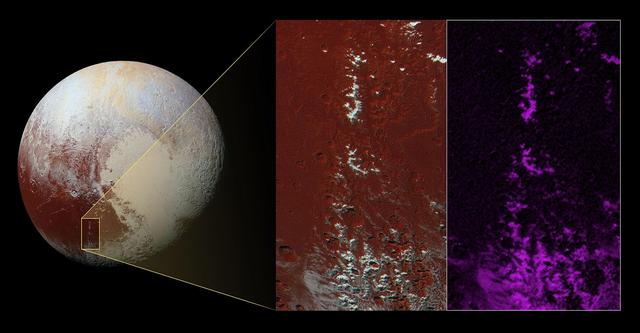
NASA New Horizons spacecraft captured this image of a chain of snow-capped mountains stretching across the dark expanse on Pluto informally named Cthulhu Regio.

Images from NASA New Horizons mission suggest that Pluto largest moon, Charon, once had a subsurface ocean that has long since frozen and expanded, pushing out on the moon surface.
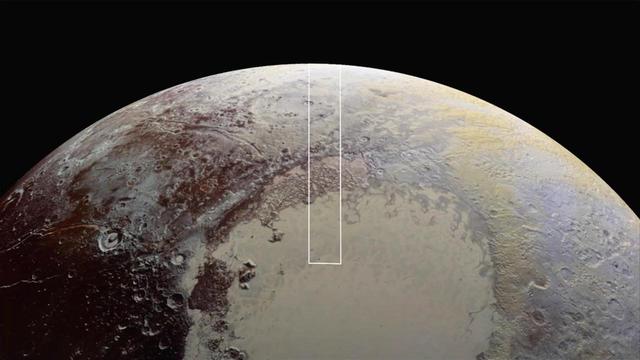
This frame from a movie is composed of the sharpest views of Pluto that NASA's New Horizons spacecraft obtained during its flyby of the distant planet on July 14, 2015. The pictures are part of a sequence taken near New Horizons' closest ap…

This montage demonstrates New Horizons ability to observe the same target in complementary ways using its diverse suite of instruments.

Europa

This image contains the initial, informal names being used by NASA's New Horizons team for the features and regions on the surface of Pluto. Names were selected based on the input the team received from the Our Pluto naming campaign. Names…

KENNEDY SPACE CENTER, FLA. - In the Payload Hazardous Servicing Facility, clean-suit garbed workers secure the fairing sections around the New Horizons spacecraft for encapsulation. The fairing protects the spacecraft during launch and flig…

Jupiter Ahoy!
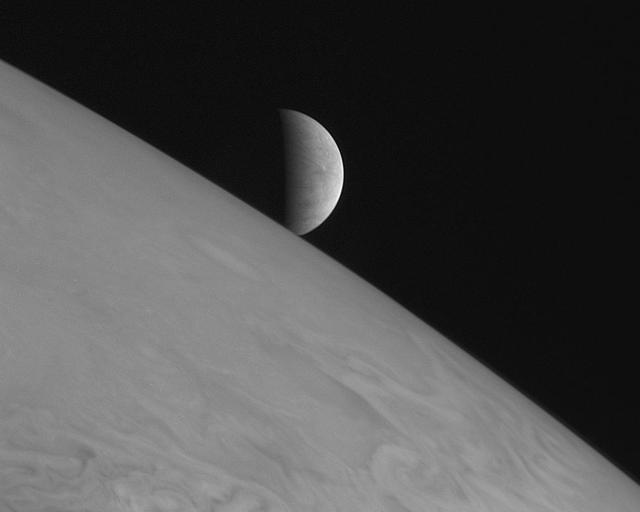
New Horizons took this image of the icy moon Europa rising above Jupiter cloud tops with its Long Range Reconnaissance Imager LORRI at 11:48 Universal Time on February 28, 2007, six hours after the spacecraft closest approach to Jupiter.

KENNEDY SPACE CENTER, FLA. - At their consoles in the Atlas V Spaceflight Operations Center on Cape Canaveral Air Force Station, members of the New Horizons team take part in a dress rehearsal for the launch scheduled in mid-January. New H…

This image of Pluto from NASA's New Horizons spacecraft, processed in two different ways, shows how Pluto's bright, high-altitude atmospheric haze produces a twilight that softly illuminates the surface before sunrise and after sunset, allo…
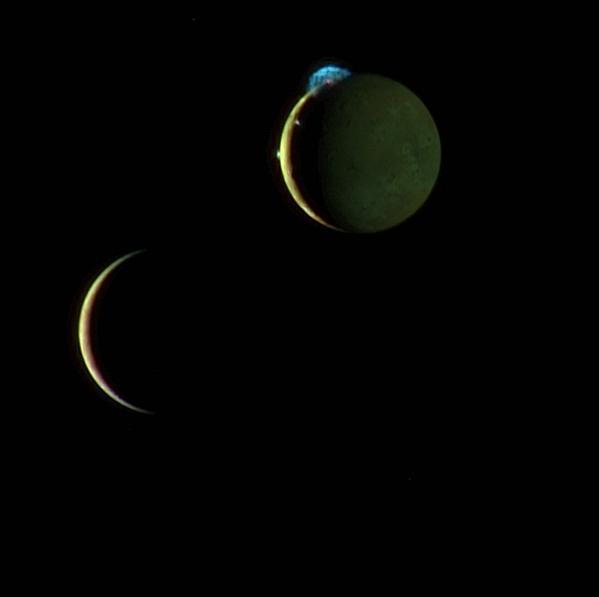
This beautiful image of the crescents of volcanic Io and more sedate Europa is a combination of two New Horizons images taken March 2, 2007, about two days after New Horizons made its closest approach to Jupiter.