The family of High Energy Astronomy Observatory (HEAO) instruments consisted of three unmarned scientific observatories capable of detecting the x-rays emitted by the celestial bodies with high sensitivity and high resolution. The celestial…
High Energy Astronomy Observatory (HEAO)
This illustration is a schematic of the High Energy Astronomy Observatory (HEAO)-2 and its experiments. It shows the focal plane instruments (at the right) plus the associated electronics for operating the telescope as it transmitted its ob…
High Energy Astronomy Observatory (HEAO)
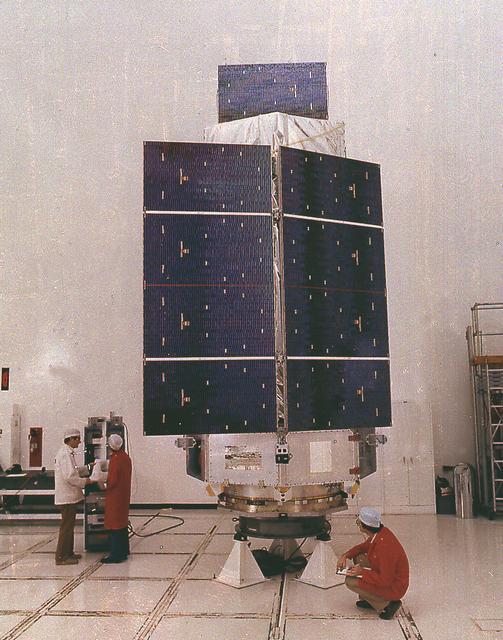
This photograph shows the High Energy Astronomy Observatory (HEAO)-3 being prepared for encapsulation. Designed and developed by TRW, Inc. under the direction of the Marshall Space Flight Center, the objectives of the HEAO-3 were to survey…
High Energy Astronomy Observatory (HEAO)
This artist's concept depicts the third observatory, the High Energy Astronomy Observatory (HEAO)-3 in orbit. Designed and developed by TRW, Inc. under the direction of the Marshall Space Flight Center, the HEAO-3's mission was to survey an…
High Energy Astronomy Observatory (HEAO)
This photograph was taken during the assembly of the High Energy Astronomy Observatory (HEAO)-2 at TRW, Inc., the prime contractor for the HEAOs. The HEAO-2, the first imaging and largest x-ray telescope built to date, was capable of produc…
High Energy Astronomy Observatory (HEAO)
Managed by the Marshall Space Flight Center and built by TRW, the third High Energy Astronomy Observatory was launched September 20, 1979. HEAO-3 was designed to study gamma-rays and cosmic ray particles.
High Energy Astronomy Observatory (HEAO)
This is an x-ray image of the Crab Nebula taken with the High Energy Astronomy Observatory (HEAO)-2/Einstein Observatory. The image is demonstrated by a pulsar, which appears as a bright point due to its pulsed x-ray emissions. The stronges…
High Energy Astronomy Observatory (HEAO)
This photograph is of the High Energy Astronomy Observatory (HEAO)-2 telescope being evaluated by engineers in the clean room of the X-Ray Calibration Facility at the Marshall Space Flight Center (MSFC). The MSFC was heavily engaged in the…
High Energy Astronomy Observatory (HEAO)
Both of the High Energy Astronomy Observatory (HEAO) 2/Einstein Observatory imaging devices were used to observe the Great Nebula in Andromeda, M31. This image is a wide field x-ray view of the center region of M31 by the HEAO-2's Imaging P…
High Energy Astronomy Observatory (HEAO)
This artist's conception depicts the High Energy Astronomy Observatory (HEAO)-1 in orbit. The first observatory, designated HEAO-1, was launched on August 12, 1977 aboard an Atlas/Centaur launch vehicle and was designed to survey the sky fo…
High Energy Astronomy Observatory (HEAO)
This photograph shows the High Energy Astronomy Observatory (HEAO)-1 being assembled at TRW Systems of Redondo Beach, California. The HEAO was designed and developed by TRW, Inc. under the project management of the Marshall Space Flight Cen…
High Energy Astronomy Observatory (HEAO)
This photograph shows the High Energy Astronomy Observatory (HEAO)-3 being assembled at TRW, Inc. Designed and developed by TRW, Inc. under the direction of the Marshall Space Flight Center, the objectives of the HEAO-3 were to survey and m…
High Energy Astronomy Observatory (HEAO)
The launch of an Atlas/Centaur launch vehicle is shown in this photograph. The Atlas/Centaur, launched on November 13, 1978, carried the High Energy Astronomy Observatory (HEAO)-2 into the required orbit. The second observatory, the HEAO-2…
High Energy Astronomy Observatory (HEAO)
The Atlas-Centaur-52 launch vehicle on the launch pad. The Atlas-Centaur-52 placed the High Energy Astronomy Observatory-2 (HEAO-2) in orbit on November 13, 1978.
Launch Vehicles
This photograph is of the High Energy Astronomy Observatory (HEAO)-2 telescope being checked by engineers in the X-Ray Calibration Facility at the Marshall Space Flight Center (MSFC). The MSFC was heavily engaged in the technical and scient…
High Energy Astronomy Observatory (HEAO)
This supernova in the constellation Cassiopeia was observed by Tycho Brahe in 1572. In this x-ray image from the High Energy Astronomy Observatory (HEAO-2/Einstein Observatory produced by nearly a day of exposure time, the center region app…
High Energy Astronomy Observatory (HEAO)
This image is an observation of Quasar 3C 273 by the High Energy Astronomy Observatory (HEAO)-2/Einstein Observatory. It reveals the presence of a new source (upper left) with a red shift that indicates that it is about 10 billion light yea…
High Energy Astronomy Observatory (HEAO)
This image of the suspected Black Hole, Cygnus X-1, was the first object seen by the High Energy Astronomy Observatory (HEAO)-2/Einstein Observatory. According to the theories to date, one concept of a black hole is a star, perhaps 10 times…
High Energy Astronomy Observatory (HEAO)
This artist's concept depicts the High Energy Astronomy Observatory (HEAO)-2 in orbit. The HEAO-2, the first imaging and largest x-ray telescope built to date, was capable of producing actual photographs of x-ray objects. Shortly after laun…
High Energy Astronomy Observatory (HEAO)
This Atlas/Centaur launch vehicle, carrying the High Energy Astronomy Observatory (HEAO)-3, lifted off on September 20, 1979. The HEAO-3's mission was to survey and map the celestial sphere for gamma-ray flux and make detailed measurements…
High Energy Astronomy Observatory (HEAO)
This picture is of an Atlas/Centaur launch vehicle, carrying the High Energy Astronomy Observatory (HEAO)-1, on Launch Complex 36 at the Air Force Eastern Test Range prior to launch on August 12, 1977. The Kennedy Space Center managed the l…
High Energy Astronomy Observatory (HEAO)
This schematic details the third High Energy Astronomy Observatory (HEAO)-3. The HEAO-3's mission was to survey and map the celestial sphere for gamma-ray flux and make detailed measurements of cosmic-ray particles. It carried three scienti…
High Energy Astronomy Observatory (HEAO)
This photograph was taken during encapsulation of the High Energy Astronomy Observatory (HEAO)-3. Designed and developed by TRW, Inc. under the direction of the Marshall Space Flight Center, the objectives of the HEAO-3 were to survey and m…
High Energy Astronomy Observatory (HEAO)
This x-ray photograph of the Supernova remnant Cassiopeia A, taken with the High Energy Astronomy Observatory (HEAO) 2/Einstein Observatory, shows that the regions with fast moving knots of material in the expanding shell are bright and cle…
High Energy Astronomy Observatory (HEAO)
This image is an x-ray view of Eta Carinae Nebula showing bright stars taken with the High Energy Astronomy Observatory (HEAO)-2/Einstein Observatory. The Eta Carinae Nebula is a large and complex cloud of gas, crisscrossed with dark lanes…
High Energy Astronomy Observatory (HEAO)
The dramatic change in x-ray emission from the Terzan 2 cluster is shown in this series of 2.5-minute exposures taken with the High Energy Astronomy Observatory (HEAO)-2/Einstein Observatory immediately before, during, and after the burst.…
High Energy Astronomy Observatory (HEAO)
Like the Crab Nebula, the Vela Supernova Remnant has a radio pulsar at its center. In this image taken by the High Energy Astronomy Observatory (HEAO)-2/Einstein Observatory, the pulsar appears as a point source surrounded by weak and diffu…
High Energy Astronomy Observatory (HEAO)
No more images