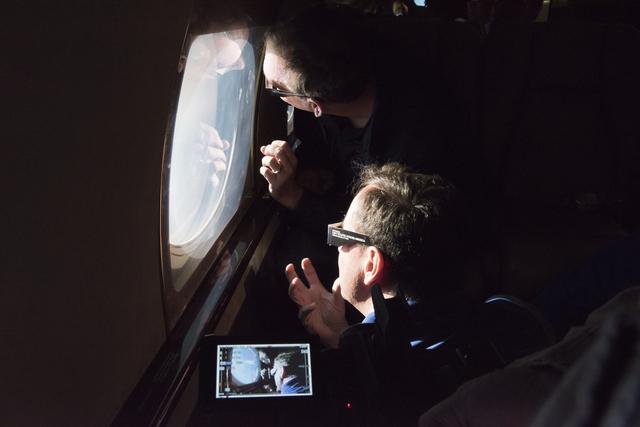
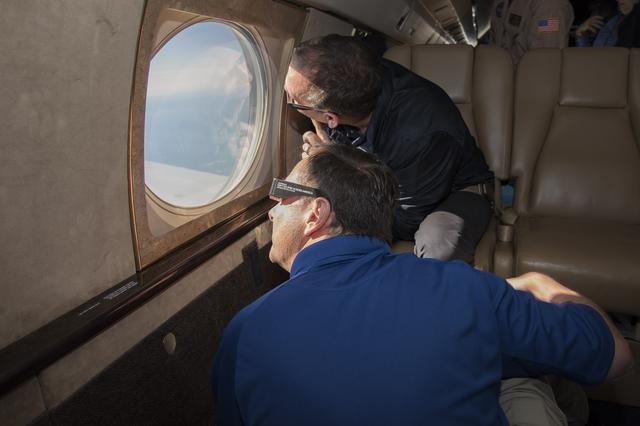
Armstrong videographer Mike Agnew operates spectrograph instrument on the 20th to prepare for eclipse day, the 21st. Photo Credit: (NASA/Carla Thomas)
2017 Total Solar Eclipse
Robert Lightfoot, acting NASA administrator, takes photo of eclipse using eclipse glasses on cell phone. Photo Credit: (NASA/Carla Thomas)
2017 Total Solar Eclipse
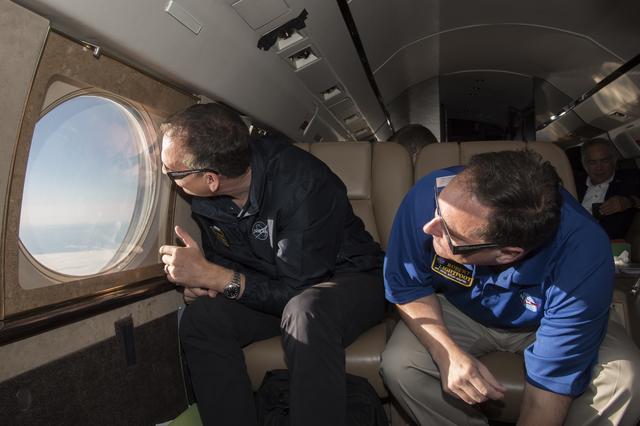
Robert Lightfoot, acting NASA administrator and Thomas Zurbuchen NASA AA for the science mission directorate view a partial eclipse solar eclipse Monday, August 21, 2017, from onboard a NASA Armstrong Flight Research Center’s Gulfstream III…
2017 Total Solar Eclipse
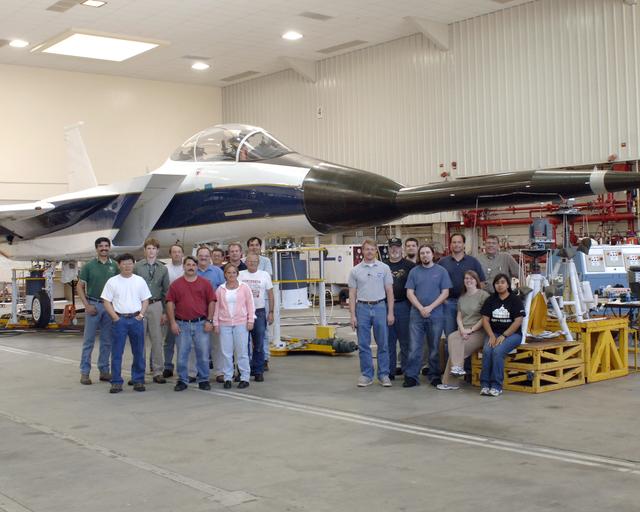
Some of the test team for the Gulfstream Quiet Spike project assembled for a group photo on May 3, 2006. The project seeks to verify the structural integrity of the multi-segmented, articulating spike attachment designed to reduce and contr…
Some of the test team for the Gulfstream Quiet Spike project assembled for a group photo on May 3, 2006
 NASA Dryden lead technician David Neufeld prepares JPL's unmanned aircraft Synthetic Aperture Radar pod for inertial swing tests in Dryden's loads laboratory.
ED06-0200-07
Approaching the runway after the first evaluation flight of the Quiet Spike project, NASA's F-15B testbed aircraft cruises over Roger's Dry Lakebed near the Dryden Flight Research Center. The Quiet Spike was developed by Gulfstream Aerospac…
Approaching the runway after the first evaluation flight of the Quiet Spike project, NASA's F-15B testbed aircraft cruises over Roger's Dry Lakebed
C-20A on NASA Dryden Ramp
EC02-0226-5
Johanna Lucht, observing data from the Mission Control Center at NASA’s Armstrong Flight Research Center in California, received flight communications from an interpreter, seen on Lucht’s monitor, through American Sign Language. Two-way vis…
AFRC2017-0076-3
Gulfstream's Quiet Spike sonic boom mitigator being installed on NASA DFRC's F-15B testbed aircraft. The project seeks to verify the structural integrity of the multi-segmented, articulating spike attachment designed to reduce and control a…
Gulfstream's Quiet Spike sonic boom mitigator being installed on NASA DFRC's F-15B testbed aircraft
A total solar eclipse is seen on Monday, August 21, 2017 from onboard a NASA Armstrong Flight Research Center’s Gulfstream III 25,000 feet above the Oregon coast. A total solar eclipse swept across a narrow portion of the contiguous United…
2017 Total Solar Eclipse
Group photo following the 300th NASA Dryden flight of F-15B #836.
Group photo following the 300th NASA Dryden flight of F-15B #836
The Moon is seen passing in front of the Sun during a total solar eclipse on Monday, August 21, 2017 from onboard a NASA Gulfstream III aircraft flying 25,000 feet above the Oregon coast. A total solar eclipse swept across a narrow portion…
2017 Total Solar Eclipse
A total solar eclipse is seen on Monday, August 21, 2017 from onboard a NASA Armstrong Flight Research Center’s Gulfstream III 25,000 feet above the Oregon coast. A total solar eclipse swept across a narrow portion of the contiguous United…
2017 Total Solar Eclipse
NASA Dryden's F-15B testbed aircraft with the Gulfstream Quiet Spike sonic boom mitigator attached undergoes ground vibration testing in preparation for test flights. The project seeks to verify the structural integrity of the multi-segment…
NASA Dryden's F-15B aircraft with the Gulfstream Quiet Spike sonic boom mitigator attached undergoes ground vibration testing in preparation for test flights
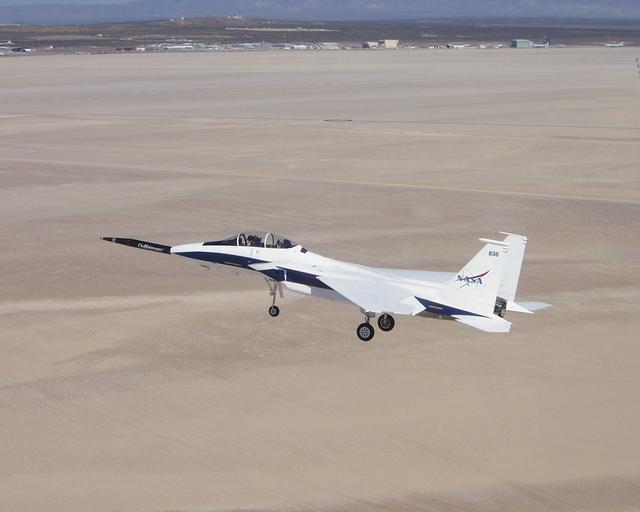
NASA F-15B #836 in flight with Quiet Spike attached. The project seeks to verify the structural integrity of the multi-segmented, articulating spike attachment designed to reduce and control a sonic boom.
NASA F-15B #836 in flight with Quiet Spike attached
NASA's Thomas Zurbuchen, AA for science mission directorate explains to Lesa Roe, acting deputy administrator, how the spectrograph showing different colors correlate to different elements, such as helium, in the Sun's atmosphere. Photo Cre…
2017 Total Solar Eclipse
Robert Lightfoot, acting NASA administrator and Thomas Zurbuchen NASA AA for the science mission directorate view a partial eclipse solar eclipse Monday, August 21, 2017, from onboard a NASA Armstrong Flight Research Center’s Gulfstream III…
2017 Total Solar Eclipse
NASA's Thomas Zurbuchen, AA for science mission directorate explains to Lesa Roe, acting deputy administrator, how the spectrograph showing different colors correlate to different elements, such as helium, in the Sun's atmosphere. Photo Cre…
2017 Total Solar Eclipse
The Moon is seen passing in front of the Sun during a total solar eclipse on Monday, August 21, 2017 from onboard a NASA Gulfstream III aircraft flying 25,000 feet above the Oregon coast. A total solar eclipse swept across a narrow portion…
2017 Total Solar Eclipse
The Moon is seen passing in front of the Sun during a total solar eclipse on Monday, August 21, 2017 from onboard a NASA Gulfstream III aircraft flying 25,000 feet above the Oregon coast. A total solar eclipse swept across a narrow portion…
2017 Total Solar Eclipse
A Gulfstream GV aircraft sits on the ramp at NASA’s Armstrong Flight Research Center in Edwards, California, on Tuesday, Jan. 13, 2026. This aircraft is being modified to support the Airborne Science Program.
NASA Armstrong Gulfstream GV
A total solar eclipse is seen on Monday, August 21, 2017 from onboard a NASA Armstrong Flight Research Center’s Gulfstream III 25,000 feet above the Oregon coast. A total solar eclipse swept across a narrow portion of the contiguous United…
2017 Total Solar Eclipse
The Moon is seen passing in front of the Sun during a total solar eclipse on Monday, August 21, 2017 from onboard a NASA Gulfstream III aircraft flying 25,000 feet above the Oregon coast. A total solar eclipse swept across a narrow portion…
2017 Total Solar Eclipse
During the total solar eclipse, the Sun’s corona, only visible during the total eclipse, is shown as a crown of white flares from the surface. The red spots called Bailey's beads occurs where the moon grazes by the Sun and the rugged lunar…
2017 Total Solar Eclipse
During the total solar eclipse, the Sun’s corona, only visible during the total eclipse, is shown as a crown of white flares from the surface. The red spots called Bailey's beads occurs where the moon grazes by the Sun and the rugged lunar…
2017 Total Solar Eclipse
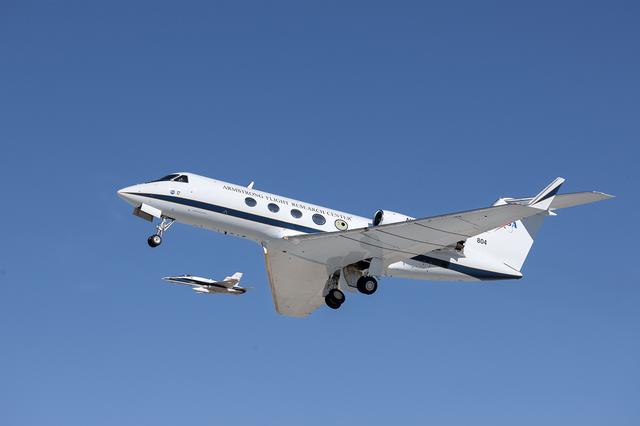
C-20A (Gulfstream III) in flight over the NASA Dryden Flight Research Center
EC03-0100-2
Gulfstream Aerospace and NASA's Dryden Flight Research Center are testing the structural integrity of a telescopic 'Quiet Spike' sonic boom mitigator on the F-15B testbed. The Quiet Spike was developed as a means of controlling and reducing…
NASA's F-15B testbed aircraft with Gulfstream Quiet Spike sonic boom mitigator attached
NASA's F-15B testbed aircraft lands after the first flight of the Quiet Spike project. The first flight was performed for evaluation purposes, and the spike was not extended. The Quiet Spike was developed as a means of controlling and reduc…
NASA's F-15B testbed aircraft lands after the first flight of the Quiet Spike project
The Moon is seen passing in front of the Sun during a total solar eclipse on Monday, August 21, 2017 from onboard a NASA Gulfstream III aircraft flying 25,000 feet above the Oregon coast. A total solar eclipse swept across a narrow portion…
2017 Total Solar Eclipse
The control panel for the joint NASA/Gulfstream Quiet Spike project, located in the backseat of NASA's F-15B testbed aircraft. The project seeks to verify the structural integrity of the multi-segmented, articulating spike attachment design…
The control panel for the joint NASA/Gulfstream Quiet Spike project, located in the backseat of NASA's F-15B testbed aircraft
NASA F-15B #836 landing with Quiet Spike attached. The project seeks to verify the structural integrity of the multi-segmented, articulating spike attachment designed to reduce and control a sonic boom.
NASA F-15B #836 landing with Quiet Spike attached
Robert Lightfoot, acting NASA administrator and Thomas Zurbuchen NASA AA for the science mission directorate view a partial eclipse solar eclipse Monday, August 21, 2017, from onboard a NASA Armstrong Flight Research Center’s Gulfstream III…
2017 Total Solar Eclipse
NASA's Thomas Zurbuchen, AA for science missiond directorate and NASA's Robert Lightfoot, acting administrator, waiting for partial eclipse to occur. Photo Credit: (NASA/Carla Thomas)
2017 Total Solar Eclipse
NASA's Thomas Zurbuchen, AA for science mission directorate explains to Lesa Roe, acting deputy administrator, how the spectrograph showing different colors correlate to different elements, such as helium, in the Sun's atmosphere. Photo Cre…
2017 Total Solar Eclipse
NASA's Lesa Roe, Acting Deputy Administrator, waiting for partial eclipse to occur. Photo Credit: (NASA/Carla Thomas)
2017 Total Solar Eclipse
NASA's F-15B testbed aircraft in flight during the first evaluation flight of the joint NASA/Gulfstream Quiet Spike project. The project seeks to verify the structural integrity of the multi-segmented, articulating spike attachment designed…
NASA's F-15B testbed aircraft in flight during the first evaluation flight of the joint NASA/Gulfstream Quiet Spike project
During the total solar eclipse, the Sun’s corona, only visible during the total eclipse, is shown as a crown of white flares from the surface. The red spots called Bailey's beads occurs where the moon grazes by the Sun and the rugged lunar…
2017 Total Solar Eclipse
The Moon is seen passing in front of the Sun during a total solar eclipse on Monday, August 21, 2017 from onboard a NASA Gulfstream III aircraft flying 25,000 feet above the Oregon coast. A total solar eclipse swept across a narrow portion…
2017 Total Solar Eclipse
During the total solar eclipse, the Sun’s corona, only visible during the total eclipse, is shown as a crown of white flares from the surface. The red spots called Bailey's beads occurs where the moon grazes by the Sun and the rugged lunar…
2017 Total Solar Eclipse
NASA Armstrong’s Mission Control Center, or MCC, is where culmination of all data-gathering occurs. Engineers, flight controllers and researchers monitor flights and missions as they are carried out. Data and video run through the MCC and a…
AFRC2017-0076-1
Bob Meyer (right), acting deputy director of NASA Dryden, shakes hands with Les Bordelon, executive director of Edwards Air Force Base.
EC02-0221-6
The Moon is seen passing in front of the Sun during a total solar eclipse on Monday, August 21, 2017 from onboard a NASA Gulfstream III aircraft flying 25,000 feet above the Oregon coast. A total solar eclipse swept across a narrow portion…
2017 Total Solar Eclipse
NASA's F-15B testbed aircraft undergoes pre-flight checks before performing the first flight of the Quiet Spike project. The first flight was performed for evaluation purposes, and the spike was not extended. The Quiet Spike was developed a…
NASA's F-15B testbed aircraft undergoes pre-flight checks before performing the first flight of the Quiet Spike project
The diamond-ring effect occurred at the beginning and end of totality during a total solar eclipse. As the last bits of sunlight pass through the valleys on the moon's limb, and the faint corona around the sun is just becoming visible, it l…
2017 Total Solar Eclipse
Initial flight-testing of the ACTE followed extensive wind tunnel experiments. For the first phase of ACTE flights, the experimental control surfaces were locked at a specified setting. Varied flap settings on subsequent tests are now demon…
ED14-0338-081
NASA’s Subsonic Research Aircraft Testbed, or SCRAT, is a modified Gulfstream III that operates out of Armstrong Flight Research Center in Edwards, California. SCRAT the test bed aircraft for the ACTE flexible-flap research project, which e…
ED11-0072-14
Manny Rodriguez, center, Gulfstream G-III aircraft crew chief, drives a tug while mechanic Marlon Espinoza, left, and Scott Erickson, a quality assurance inspector, prepare the aircraft for takeoff on Friday, March 27, 2026, at NASA’s Armst…
NASA G-III Captures Heat Shield Data for Artemis II Mission
Manny Rodriguez, Gulfstream G-III crew chief, completes flight control checks with the pilots on Friday, March 27, 2026, at NASA’s Armstrong Flight Research Center in Edwards, California. The G-III will join other NASA aircraft to capture i…
NASA G-III Captures Heat Shield Data for Artemis II Mission