
This compilation shows the constellation Hercules, as imaged on May 21 and 22, 2003, by NASA Galaxy Evolution Explorer. The images were captured by the two channels of the spacecraft camera during the mission first light milestone.

The Galaxy Evolution Explorer specializes in surveying galaxies in ultraviolet light. Its telescope, 50 centimeters (19.7 inches) in diameter, has a field of view that is much wider than most ground-based and space-based telescopes. This fi…
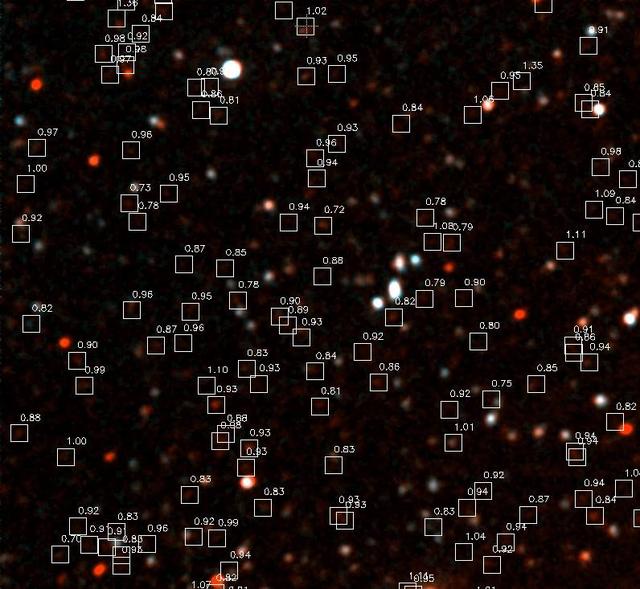
NASA's Galaxy Evolution Explorer photographed this ultraviolet color blowup of the Groth Deep Image on June 22 and June 23, 2003. Hundreds of galaxies are detected in this portion of the image, and the faint red galaxies are believed to be…
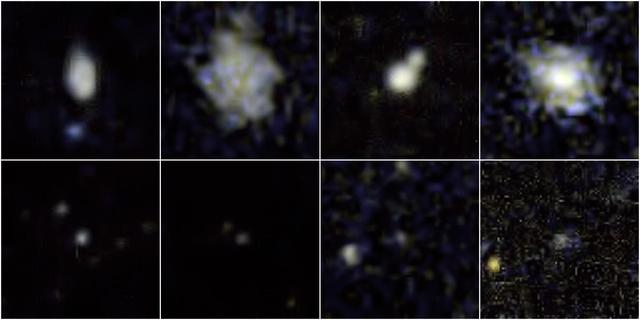
These postage-stamp images taken by NASA Galaxy Evolution Explorer are helping to solve a mystery -- why do the littlest of galaxies produce the biggest of star explosions, or supernovae?
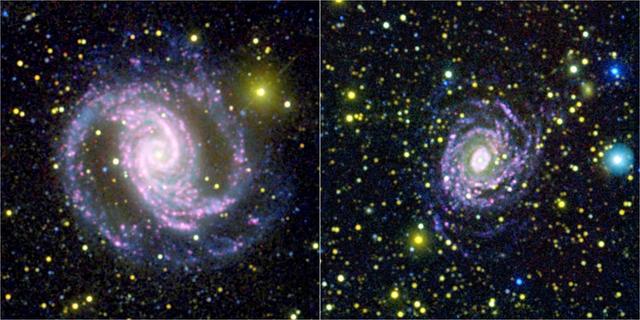
These two photographs were made by combining data from NASA Galaxy Evolution Explorer spacecraft and the Cerro Tololo Inter-American Observatory in Chile to learn that not all galaxies make stars of different sizes in the same quantities.

From sparkling blue rings to dazzling golden disks and mined from NASA Galaxy Evolution Explorer Survey of Nearby Galaxies data, these cosmic gems were collected with the telescope sensitive ultraviolet instruments.

This image was taken May 21 and 22, 2003 by NASA Galaxy Evolution Explorer. The image was made from data gathered by the far ultraviolet channel of the spacecraft camera during the mission first light milestone. It shows about 400 celestial…

This artist concept depicts a supermassive black hole at the center of a galaxy. NASA Galaxy Evolution Explorer found evidence that black holes once they grow to a critical size stifle the formation of new stars in elliptical galaxies.

This image from NASA Galaxy Evolution Explorer shows NGC 4565, one of the nearest and brightest galaxies not included in the famous list by 18th-century comet hunter Charles Messier.

Wispy tendrils of hot dust and gas glow brightly in this ultraviolet image of the Cygnus Loop nebula, taken by NASA Galaxy Evolution Explorer. The nebula lies about 1,500 light-years away.

This image from NASA Galaxy Evolution Explorer GALEX shows Messier 94, also known as NGC 4736, in ultraviolet light. It is located 17 million light-years away in the constellation Canes Venatici.
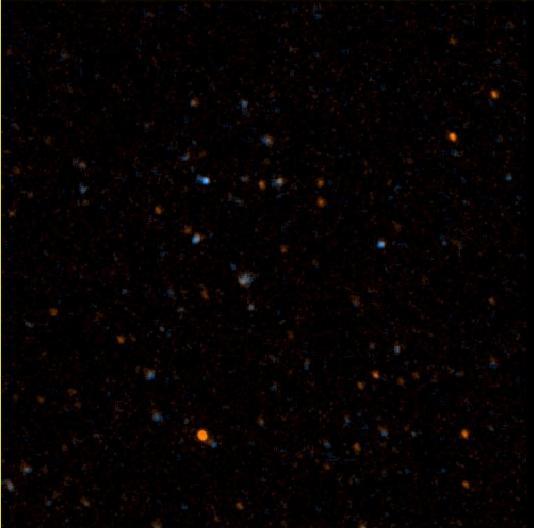
NASA's Galaxy Evolution Explorer took this image on May 21 and 22, 2003. The image was made from data gathered by the two channels of the spacecraft camera during the mission's "first light" milestone. It shows about 100 celestial objects i…
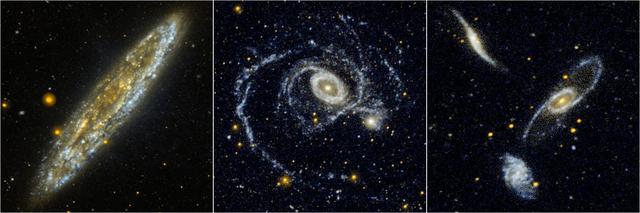
Located 10 million light-years away in the southern constellation Sculptor, the Silver Dollar galaxy, or NGC 253, is one of the brightest spiral galaxies in the night sky as seen in this edge-on view from NASA Galaxy Evolution Explorer.

NASA Galaxy Evolution Explorer spacecraft and Cerro Tololo Inter-American Observatory combined data making this diagram illustratrating the extent to which astronomers have been underestimating the proportion of small to big stars in certai…

NASA Galaxy Evolution Explorer found a tail behind a galaxy called IC 3418. This star-studded tail was created as the galaxy plunged into gas in a family of galaxies known as the Virgo cluster.

New ultraviolet images from NASA Galaxy Evolution Explorer shows a speeding star that is leaving an enormous trail of eeds for new solar systems. The star, named Mira pronounced my-rah after the latin word for wonderful.
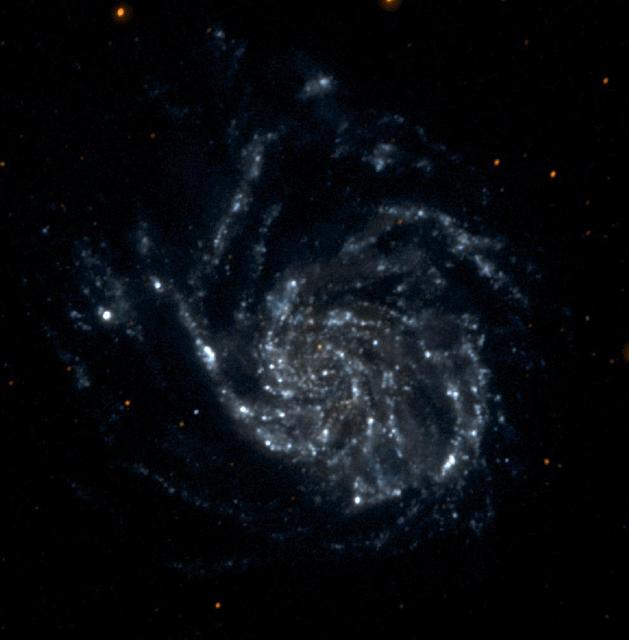
This single orbit exposure, ultraviolet color image of Messier 101 was taken by NASA's Galaxy Evolution Explorer on June 20, 2003. Messier 101 is a large spiral galaxy located 20 million light-years from Earth. This image is a short and med…

This artist concept shows a supermassive black hole at the center of a remote galaxy digesting the remnants of a star.
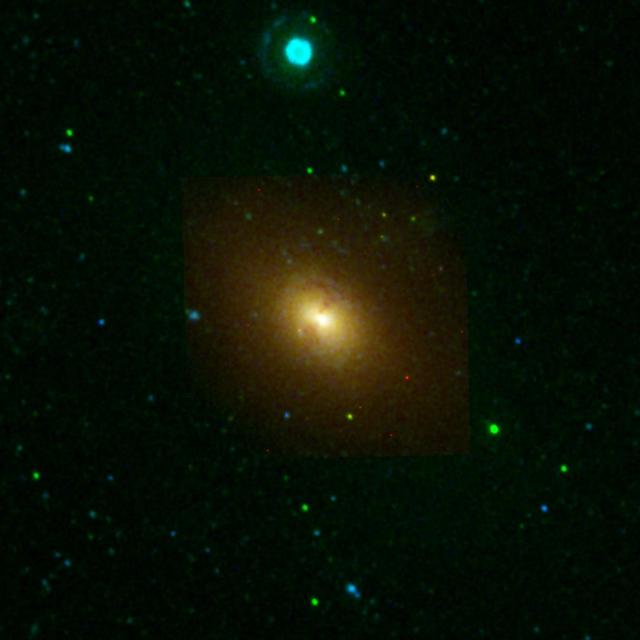
This image from NASA Galaxy Evolution Explorer shows the galaxy NGC 1316, located about 62 million light-years away in the constellation Fornax. The elliptical-shaped galaxy may be in the late stages of merging with a smaller companion gala…

NASA Galaxy Evolution Explorer is celebrates its fourth year in space with some of M81 hottest stars. In this ultraviolet image, the magnificent M81 spiral galaxy is shown at the center.

This artist concept illustrates a young, red dwarf star surrounded by three planets. NASA Galaxy Evolution Explorer is helping to identify young, red dwarf stars that are close to us by detecting their ultraviolet light.

This diagram illustrates research from NASA Galaxy Evolution Explorer showing that black holes once they reach a critical size can put the brakes on new star formation in elliptical galaxies.

The Blue Ring Nebula was discovered in 2004 by NASA's Galaxy Evolution Explorer (GALEX) mission. Astronomers think the nebula was created by the merger of two stars, and that we are seeing the system a few thousand years after the merger, w…

This computer-simulated image shows gas from a tidally shredded star falling into a black hole. Astronomers observed the flare in ultraviolet light using NASA Galaxy Evolution Explorer.
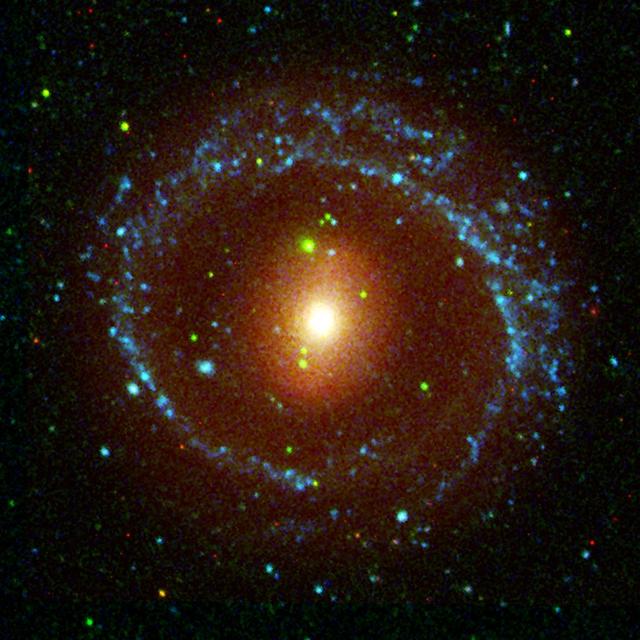
This image from NASA Galaxy Evolution Explorer shows the galaxy NGC 1291, located about 33 million light-years away in the constellation Eridanus. NGC 1291 is notable for its unusual inner bar and outer ring structure.

The unique ultraviolet vision of NASA Galaxy Evolution Explorer revealed, for the first time, dwarf galaxies forming out of nothing more than pristine gas likely leftover from the early universe.

The Ghost of Mirach galaxy is shown in visible light on the left, and in ultraviolet as seen by NASA Galaxy Evolution Explorer on the right. The fields of view are identical in both pictures, with the Ghost of Mirach -— a galaxy called NGC…
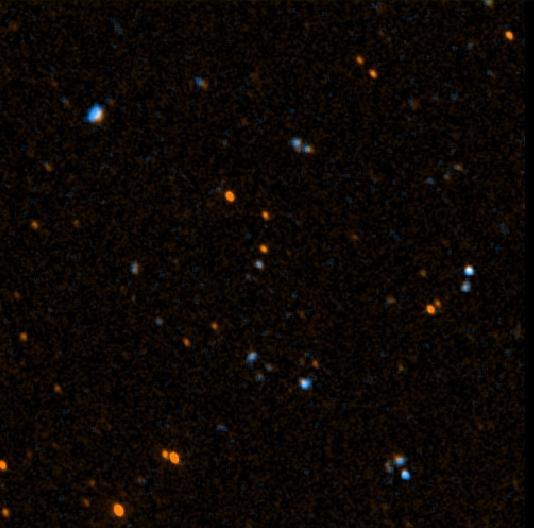
This image was taken May 21 and 22, 2003, by NASA Galaxy Evolution Explorer. The image was made from data gathered by the two channels of the spacecraft camera during the mission first light milestone.
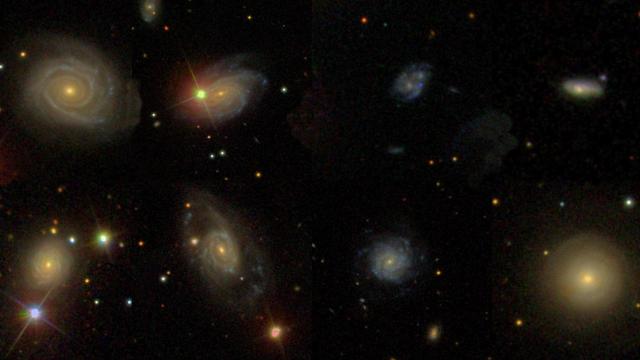
A new study analyzes several sites where dead stars once exploded. The explosions, called Type Ia supernovae, occurred within galaxies, six of which are shown in these images from the Sloan Digital Sky Survey.

Evidence from NASA Galaxy Evolution Explorer supports the long-held notion that many galaxies begin life as smaller spirals before transforming into larger, elliptical-shaped galaxies.

This image is from NASA Galaxy Evolution Explorer is an observation of the large galaxy in Andromeda, Messier 31. The Andromeda galaxy is the most massive in the local group of galaxies that includes our Milky Way.
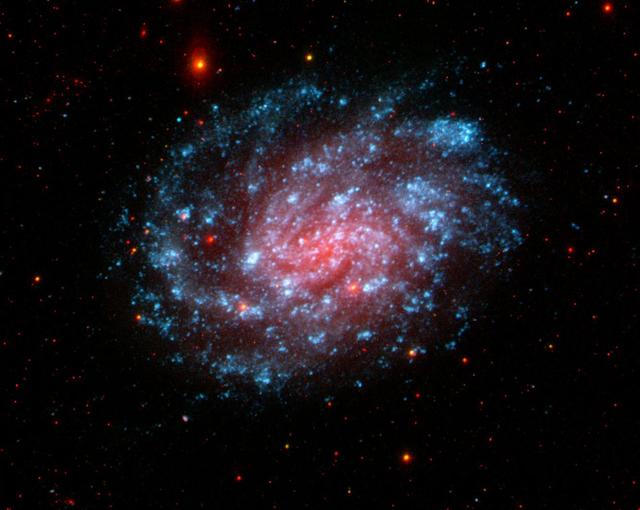
This image from NASA Galaxy Evolution Explorer shows the galaxy NGC 300, located about seven million light-years away in the constellation Sculptor. It is a classic spiral galaxy with open arms and vigorous star formation throughout.

These images from NASA GALEX and NuSTAR is of Andromeda, a spiral galaxy like our Milky Way but larger in size. It lies 2.5 million light-years away in the Andromeda constellation.

In the Multi-Payload Processing Facility, workers check the deployment of the cover of the telescope on NASA Galaxy Evolution Explorer, an orbiting space telescope observing galaxies in ultraviolet light across 10 billion years of cosmic hi…
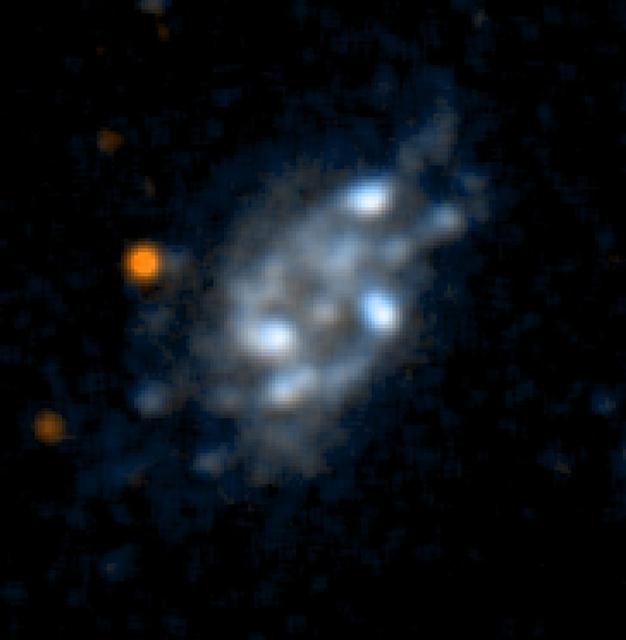
This ultraviolet color image of the galaxy UGC10445 was taken by NASA Galaxy Evolution Explorer on June 7 and June 14, 2003. UGC10445 is a spiral galaxy located 40 million light-years from Earth. http://photojournal.jpl.nasa.gov/catalog/PI…

This diagram based on results from NASA Galaxy Evolution Explorer and the Anglo-Australian Telescope illustrates two ways to measure how fast the universe is expanding.
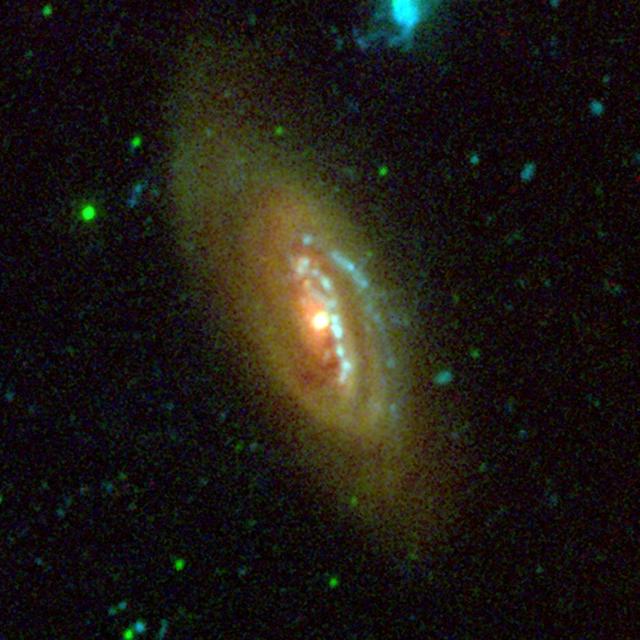
This image from NASA Galaxy Evolution Explorer shows the galaxy NGC 4569 in the constellation Virgo. It is one of the largest and brightest spiral galaxies found in the Virgo cluster of galaxies, the nearest major galaxy cluster to our Milk…

The galaxy UGC 1382 has been revealed to be far larger and stranger than previously thought. Astronomers relied on a combination of ground-based and space telescopes to uncover the true nature of this "Frankenstein galaxy." The composite im…

This image from NASA Galaxy Evolution Explorer shows NGC 6744, one of the galaxies most similar to our Milky Way in the local universe.
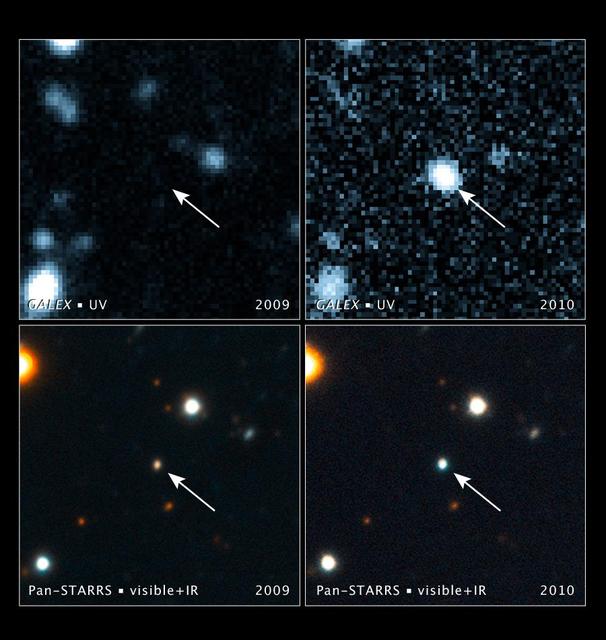
These images, taken with NASA Galaxy Evolution Explorer and the Pan-STARRS1 telescope in Hawaii, show a brightening inside a galaxy caused by a flare from its nucleus. The arrow in each image points to the galaxy.

New results from NASA Galaxy Evolution Explorer and the Anglo-Australian Telescope atop Siding Spring Mountain in Australia confirm that dark energy is a smooth, uniform force that now dominates over the effects of gravity.
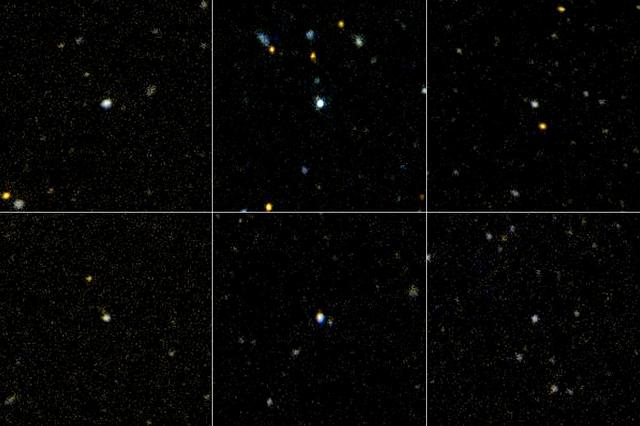
This image shows six of the three-dozen "ultraviolet luminous galaxies" spotted in our corner of the universe by NASA's Galaxy Evolution Explorer. These massive galaxies greatly resemble newborn galaxies that were common in the early univer…

A group of six streaking objects, the identities of which remain unknown, can be seen here flying across the telescope sight in this image from NASA Galaxy Evolution Explorer.

Computer simulations of the collision between NGC 6872 and IC 4970 reproduce the basic features of the galaxies as we see them today.

This image was taken on May 21 and 22, 2003, by NASA Galaxy Evolution Explorer. The image was made from data gathered during the missions first light milestone, and shows celestial objects in the constellation Hercules.

Since its launch in 2003, NASA Galaxy Evolution Explorer the space telescope originally designed to observe galaxies across the universe in ultraviolet light has discovered a festive sky blinking with flaring and erupting stars.
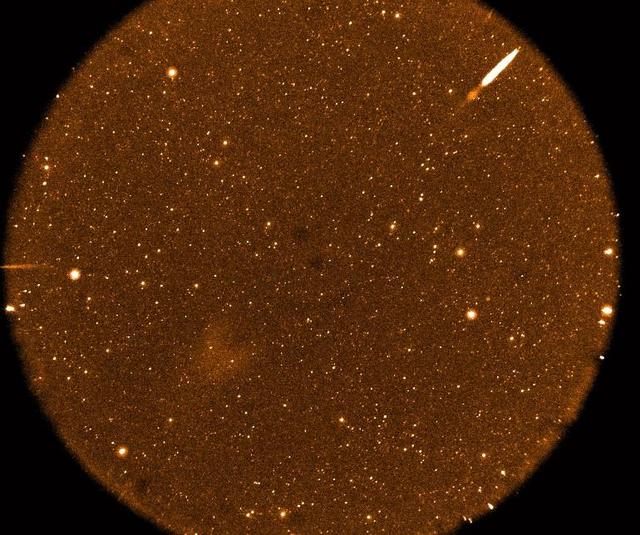
This is the first Deep Imaging Survey image taken by NASA Galaxy Evolution Explorer. On June 22 and 23, 2003, the spacecraft obtained this near ultraviolet image of the Groth region by adding multiple orbits for a total exposure time of 14,…
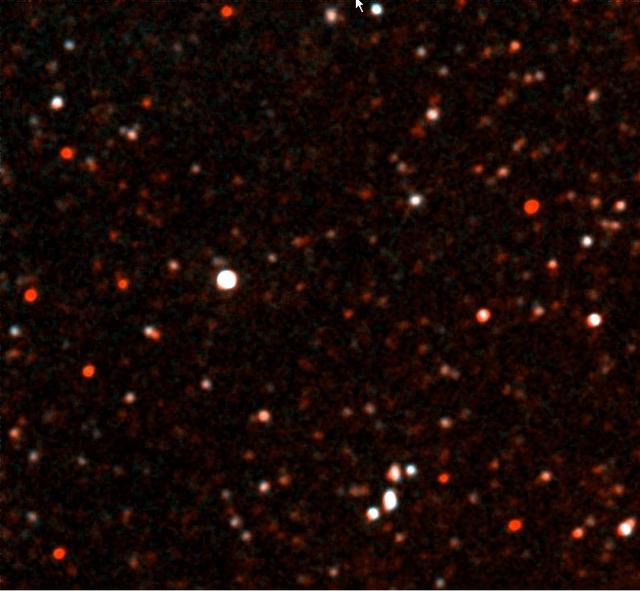
This ultraviolet color blowup of the Groth Deep Image was taken by NASA Galaxy Evolution Explorer on June 22 and June 23, 2003. Many hundreds of galaxies are detected in this portion of the image. NASA astronomers believe the faint red gal…