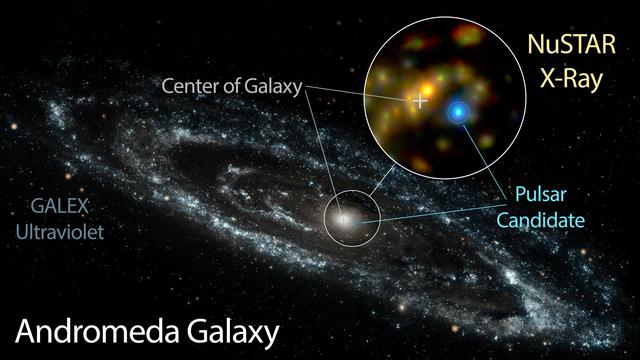
NASA's Nuclear Spectroscope Telescope Array, or NuSTAR, has identified a candidate pulsar in Andromeda -- the nearest large galaxy to the Milky Way. This likely pulsar is brighter at high energies than the Andromeda galaxy's entire black ho…

CAPE CANAVERAL, Fla. – At the Astrotech payload processing facility, an overhead crane carries NASA's Kepler spacecraft toward a mobile stand to be covered and moved to the Hazardous Processing Facility for fueling. Kepler is designed to su…

CAPE CANAVERAL, Fla. – At the Astrotech payload processing facility, an overhead crane lifts NASA's Kepler spacecraft from a work stand. Kepler will be moved to a mobile stand to be covered and moved to the Hazardous Processing Facility fo…

This composite image shows examples of galaxies similar to our Milky Way at various stages of construction over a time span of 11 billion years. The galaxies are arranged according to time. Those on the left reside nearby; those at far rig…
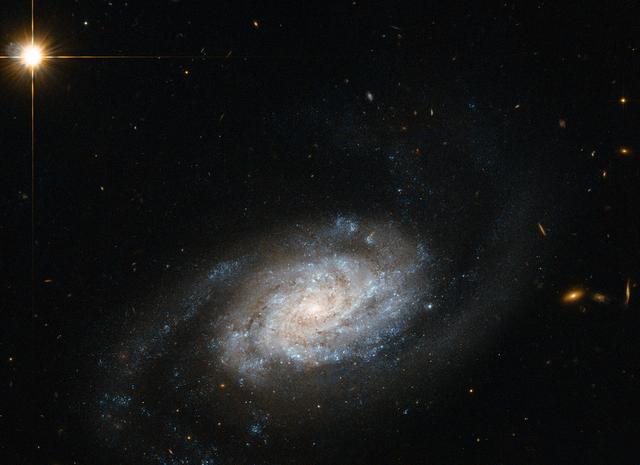
Shown here is a spiral galaxy known as NGC 3455, which lies some 65 million light-years away from us in the constellation of Leo (the Lion). Galaxies are classified into different types according to their structure and appearance. This cla…

Galaxy NGC 1068 can be seen in close-up in this view from NASA's Hubble Space Telescope. NuSTAR's high-energy X-rays eyes were able to obtain the best view yet into the hidden lair of the galaxy's central, supermassive black hole. This acti…
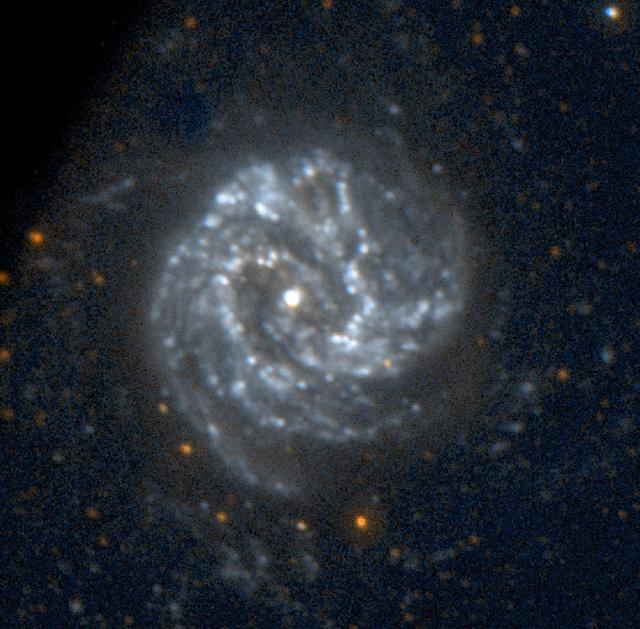
This image of the spiral galaxy Messier 83 was taken by NASA's Galaxy Evolution Explorer on June 7, 2003. Located 15 million light years from Earth and known as the Southern Pinwheel Galaxy, Messier 83 displays significant amounts of ultrav…

CAPE CANAVERAL, Fla. -- Ball Aerospace and Technology workers adjust the light cast on solar array panels during illumination testing of NASA's Kepler spacecraft. A NASA Discovery mission, Kepler is specifically designed to survey our re…

In the Multi-Payload Processing Facility, workers check the deployment of the cover of the telescope on NASA Galaxy Evolution Explorer, an orbiting space telescope observing galaxies in ultraviolet light across 10 billion years of cosmic hi…
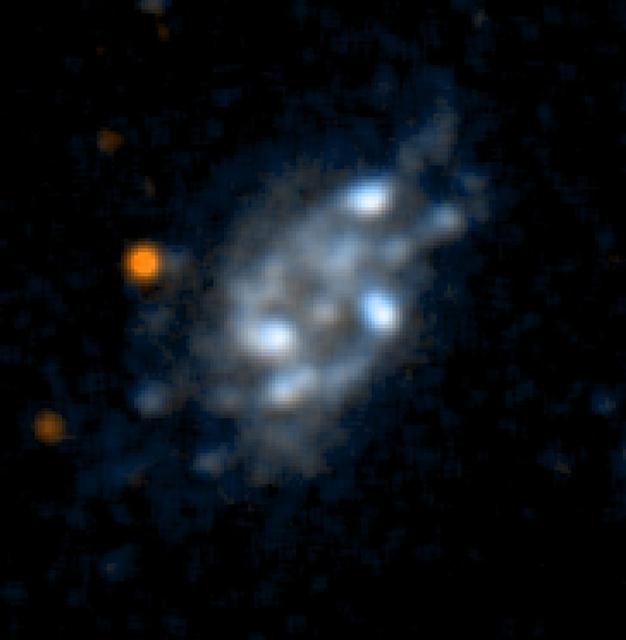
This ultraviolet color image of the galaxy UGC10445 was taken by NASA Galaxy Evolution Explorer on June 7 and June 14, 2003. UGC10445 is a spiral galaxy located 40 million light-years from Earth. http://photojournal.jpl.nasa.gov/catalog/PI…

CAPE CANAVERAL, Fla. – On Launch pad 17-B at Cape Canaveral Air Force Station in Florida, NASA's Kepler spacecraft arrives at the transfer level of the mobile service tower. Kepler will be moved inside for mating with the Delta II rocket…

CAPE CANAVERAL, Fla. – At the Astrotech payload processing facility in Titusville, Fla., the top of the canister is lowered over NASA's Kepler spacecraft where it will be attached to the lower segments. The canister surrounding Kepler pro…

This diagram based on results from NASA Galaxy Evolution Explorer and the Anglo-Australian Telescope illustrates two ways to measure how fast the universe is expanding.
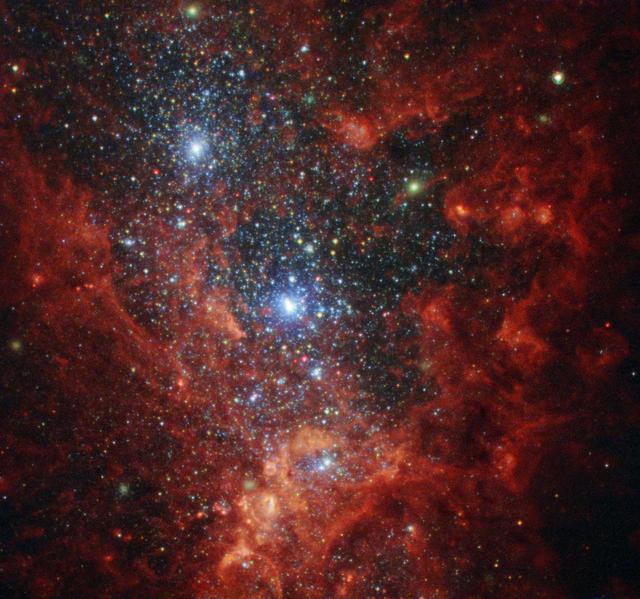
This NASA/ESA Hubble Space Telescope image reveals the iridescent interior of one of the most active galaxies in our local neighbourhood — NGC 1569, a small galaxy located about eleven million light-years away in the constellation of Camelo…

CAPE CANAVERAL, Fla. – Inside the Hazardous Processing Facility at Astrotech in Titusville, Fla., NASA's Kepler spacecraft is lowered onto a stand for fueling. Kepler is designed to survey more than 100,000 stars in our galaxy to determine…

NASA image release August 5, 2010 A beautiful new image of two colliding galaxies has been released by NASA's Great Observatories. The Antennae galaxies, located about 62 million light-years from Earth, are shown in this composite image fr…

Andromeda Galaxy (ref; P-26394C)

Andromeda galaxy from Infrared Astronomical Satellite (ref; 83-HC-316)

CAPE CANAVERAL, Fla. – At the Astrotech payload processing facility, another protective cover is lowered over NASA's Kepler spacecraft. When covered, Kepler will be moved to the Hazardous Processing Facility for fueling. Kepler is designed…

Release Date: March 10, 2010 - Distant galaxy clusters mysteriously stream at a million miles per hour along a path roughly centered on the southern constellations Centaurus and Hydra. A new study led by Alexander Kashlinsky at NASA's Godda…

Fireworks shows are not just confined to Earth’s skies. NASA’s Hubble Space Telescope has captured a spectacular fireworks display in a small, nearby galaxy, which resembles a July 4th skyrocket. A firestorm of star birth is lighting up on…

Most galaxies are clumped together in groups or clusters. A neighboring galaxy is never far away. But this galaxy, known as NGC 6503, has found itself in a lonely position, at the edge of a strangely empty patch of space called the Local Vo…

The smudge of stars at the center of this NASA/ESA Hubble Space Telescope image is a galaxy known as UGC 5797. UGC 5797 is an emission line galaxy, meaning that it is currently undergoing active star formation. The result is a stellar popul…

CAPE CANAVERAL, Fla. – At the Astrotech payload processing facility in Titusville, Fla., the top of the canister is lifted for a move to the unfinished canister at left. The canister surrounding NASA's Kepler spacecraft provides protectio…

This artist concept shows a supermassive black hole at the center of a remote galaxy digesting the remnants of a star.

This Chandra X-ray observatory image of M83 shows numerous point-like neutron stars and black hole x-ray sources scattered throughout the disk of this spiral galaxy. The bright nuclear region of the galaxy glows prominently due to a burst o…
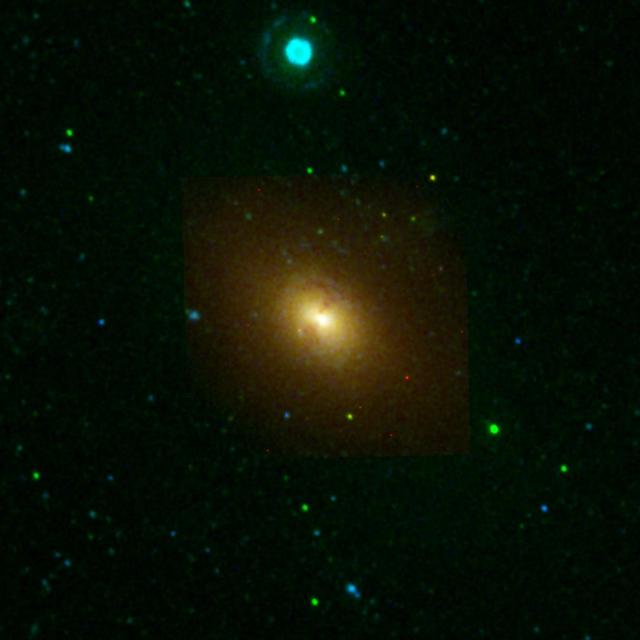
This image from NASA Galaxy Evolution Explorer shows the galaxy NGC 1316, located about 62 million light-years away in the constellation Fornax. The elliptical-shaped galaxy may be in the late stages of merging with a smaller companion gala…

CAPE CANAVERAL, Fla. – At the Astrotech payload processing facility, the second cover is placed over NASA's Kepler spacecraft. Kepler will be moved to the Hazardous Processing Facility for fueling. Kepler is designed to survey more than 1…

The Galaxy Evolution Explorer specializes in surveying galaxies in ultraviolet light. Its telescope, 50 centimeters (19.7 inches) in diameter, has a field of view that is much wider than most ground-based and space-based telescopes. This fi…
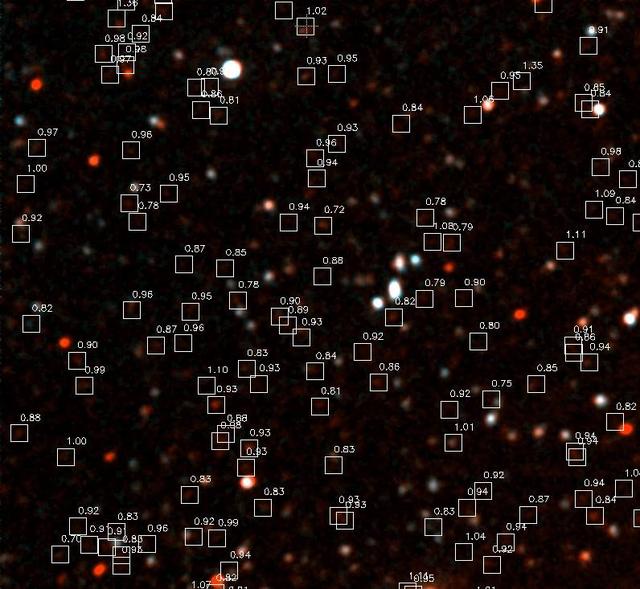
NASA's Galaxy Evolution Explorer photographed this ultraviolet color blowup of the Groth Deep Image on June 22 and June 23, 2003. Hundreds of galaxies are detected in this portion of the image, and the faint red galaxies are believed to be…

CAPE CANAVERAL, Fla. – Covered by a protective cover, NASA's Kepler spacecraft arrives on Launch pad 17-B at Cape Canaveral Air Force Station in Florida. Kepler will be lifted into the mobile service tower for mating with the Delta II roc…
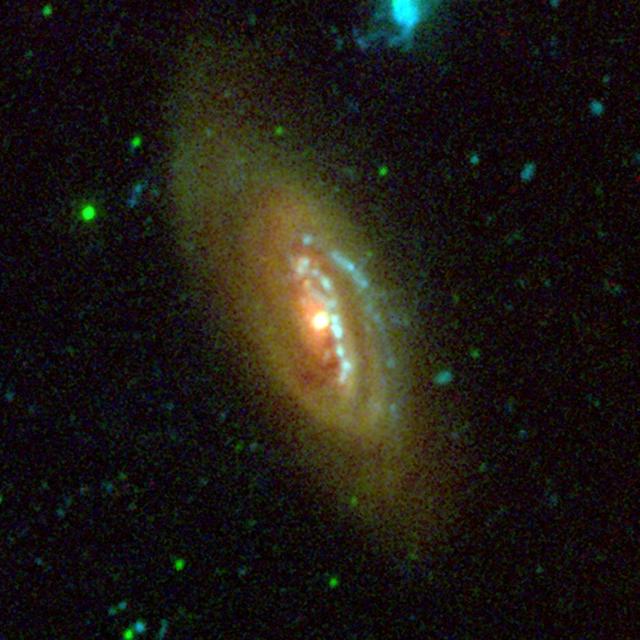
This image from NASA Galaxy Evolution Explorer shows the galaxy NGC 4569 in the constellation Virgo. It is one of the largest and brightest spiral galaxies found in the Virgo cluster of galaxies, the nearest major galaxy cluster to our Milk…
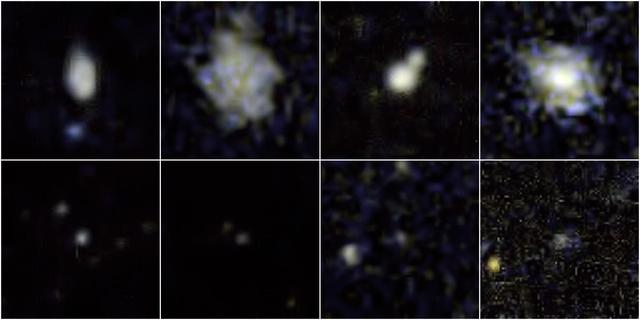
These postage-stamp images taken by NASA Galaxy Evolution Explorer are helping to solve a mystery -- why do the littlest of galaxies produce the biggest of star explosions, or supernovae?

This ultraviolet image from NASA Galaxy Evolution Explorer is of a small area of the Virgo Cluster of galaxies. http://photojournal.jpl.nasa.gov/catalog/PIA07906

CAPE CANAVERAL, Fla. – At the Astrotech payload processing facility, the protective cover at right is lifted toward NASA's Kepler spacecraft at left. When covered, Kepler will be moved to the Hazardous Processing Facility for fueling. Keple…

Andromeda galaxy from Palomar Observatory

CAPE CANAVERAL, Fla. – At the Astrotech payload processing facility, the protective cover is lowered over NASA's Kepler spacecraft. When covered, Kepler will be moved to the Hazardous Processing Facility for fueling. Kepler is designed to…
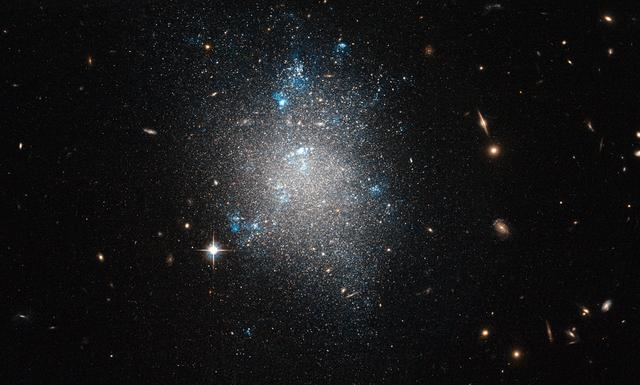
The constellation of Ursa Major (The Great Bear) is home to Messier 101, the Pinwheel Galaxy. Messier 101 is one of the biggest and brightest spiral galaxies in the night sky. Like the Milky Way, Messier 101 is not alone, with smaller dwarf…

This false-color composite image shows the Cartwheel galaxy as seen by NASA Galaxy Evolution Explorer, where the first ripple appears as an ultraviolet-bright blue outer ring.

At the center of this amazing Hubble image is the elliptical galaxy NGC 3610. Surrounding the galaxy are a wealth of other galaxies of all shapes. There are spiral galaxies, galaxies with a bar in their central regions, distorted galaxies a…

This compilation shows the constellation Hercules, as imaged on May 21 and 22, 2003, by NASA Galaxy Evolution Explorer. The images were captured by the two channels of the spacecraft camera during the mission first light milestone.

CAPE CANAVERAL, Fla. – Thoroughly wrapped for travel, NASA's Kepler spacecraft is moved to the Hazardous Processing Facility at Astrotech in Titusville, Fla., for fueling. Kepler is designed to survey more than 100,000 stars in our galaxy t…

S69-60424 (29 Nov. 1969) --- Astronaut Charles Conrad Jr., commander of the Apollo 12 lunar landing mission, holds two lunar rocks which were among the samples brought back from the moon by the Apollo 12 astronauts. The samples are under sc…

CAPE CANAVERAL, Fla. – At the Astrotech payload processing facility in Titusville, Fla., workers place the second row of canister segments around NASA's Kepler spacecraft. The "canning" provides protection during the spacecraft's transpor…

NASA Galaxy Evolution Explorer is celebrates its fourth year in space with some of M81 hottest stars. In this ultraviolet image, the magnificent M81 spiral galaxy is shown at the center.

CAPE CANAVERAL, Fla. – At the Hazardous Processing Facility at Astrotech in Titusville, Fla., workers check the Kepler spacecraft as it is lifted for weighing. Kepler is designed to survey more than 100,000 stars in our galaxy to determine…

CAPE CANAVERAL, Fla. – At the Astrotech payload processing facility in Titusville, Fla., the top of the canister has been attached to the lower segments encasing NASA's Kepler spacecraft. The canister surrounding Kepler provides protection…

CAPE CANAVERAL, Fla. – NASA's Kepler spacecraft on Launch pad 17-B at Cape Canaveral Air Force Station in Florida is lifted up to the transfer level of the mobile service tower. It will be moved into the tower for mating with the Delta II…