AirVenture at Oshkosh 2023
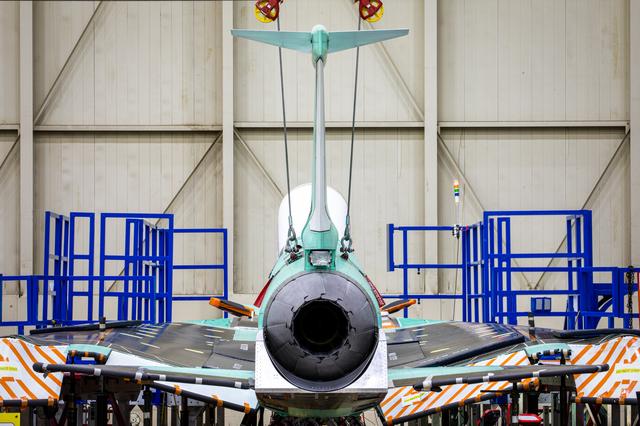
Here is a close-up of the GE F414 engine, from the aft deck or rear, before the tail section of the X-59 is lifted into place and attached to the aircraft. The aft deck helps control the shockwaves at the end of the aircraft and reduce the…
Lower Empennage Test Fit Install
A Lockheed Martin Skunk Works technician takes a break for a photo. Note that the technician is wearing protective clean gear while sitting inside the X-59 engine inlet. Wearing this gear reduces the chance of any foreign objects from damag…
Engine Test Fit Install
This image shows the X-59’s engine inlet from the aft view, which is the rear of the airplane, looking forward. Once the aircraft and ground testing are complete, the X-59 will undergo flight testing, which will demonstrate the plane’s abil…
Quesst Mission | X-59 Engine Inlet
The X-59 team working on the aircraft’s wiring around the engine inlet prior to the engine being installed.  Once complete, the X-59 is designed to fly supersonic while reducing the loud sonic boom. The Quesst mission could help change the…
Quesst Mission | X-59 Engine Inlet
NASA test pilot, Nils Larson, inspects the X-59 cockpit displays and lighting system during system checkouts. The External Vision System (XVS) is displayed on the top screen, and the avionics flight displays, which can show navigation infor…
Quesst Mission- NASA Test Piot Nils Larson Inspects X-59’s Cockpit
A perfectly framed up rearview shot of NASA’s X-59 tail after its recent installation of the lower empennage, or tail section, in late March at Lockheed Martin Skunk Works in Palmdale, California.
Lower Empennage Final Install
Top view if GE fan model, 3/4 top view. Straight wing. 1 fan per wing, conventional struts. Woody Kook, Branch Chief.
A-28399. GE Fan in Wing in Ames 40x80 foot wind tunnel.
 Here is an image of the X-59’s 13-foot General Electric F414 engine as the team prepares for a fit check. Making sure components, like the aircraft’s hydraulic lines, which help control functions like brakes or landing gear, and wiring of…
Engine Test Fit Install
Artist concept of the X-59 three forths view top
X59_threeForths
A Go-Pro is mounted on the inside of the X-59’s cockpit to capture the pilots activities during flight.
X-59’s Cockpit Outfitted with Cameras for Pilot Data
The F414-GE-100 engine, which will power NASA’s X-59 Quiet SuperSonic Technology X-plane (QueSST) in flight, is unboxed at NASA’s Armstrong Flight Research Center in Edwards, California. The engine, one of two delivered by GE, is approximat…
X-59 Engine Delivered to NASA Armstrong
NASA’s X-59 sits in support framing while undergoing the installation of its lower empennage, or tail section, at Lockheed Martin Skunk Works in Palmdale, California in late March.
Lower Empennage Final Install Event
This is an overhead view of the X-59 aircraft at Lockheed Martin Skunk Works in Palmdale, California. The nose was installed, and the plane awaits engine installation. Technicians continue to wire the aircraft as the team preforms several s…
From Above With Nose Installed
The X-59 team at Lockheed Martin Skunk Works in Palmdale, California, load the lower empennage - the tail section - into place. The surfaces used to control the tilt of the airplane are called stabilators and are connected to the lower empe…
Lower Empennage Test Fit Install
The tail of NASA’s X-59 aircraft is shown here in late March at Lockheed Martin Skunk Works in Palmdale, California where the plane recently underwent a final install of the lower empennage or better known as tail section of the plane.
Lower Empennage Final Install Event
Laser based blade deflection measurement system on Counter Rotation Pusher Propeller model in 8x6 SWT (Supersonic Wind Tunnel)
Laser based blade deflection measurement system on Counter Rotat
This is an image of the X-59 inlet with a safety covering. The inlet’s purpose is to adjust air speeds before they pass through the aircraft’s engine. The purpose of the covering is to protect the inlet and engine from foreign objects.
Critical Components - Forebody and Miscellaneous
The X-59 team at Lockheed Martin Skunk Works in Palmdale, California, load the lower empennage - the tail section - into place. The surfaces used to control the tilt of the airplane are called stabilators and are connected to the lower empe…
Lower Empennage Test Fit Install
A quality inspector inspects the GE F-414 engine nozzle after installation at Lockheed Martin’s Skunk Works facility in Palmdale, California. Once the aircraft and ground testing are complete, the X-59 will undergo flight testing, which wil…
Quality Inspection of NASA’s X-59 Engine
An overhead view of the X-59 during assembly in spring 2023. Assembly took place at Lockheed Martin’s Skunk Works facility in Palmdale, California.  Once complete, the X-59 is designed to fly supersonic while reducing the loud sonic boom. T…
Overhead Image of NASA’s X-59 in Construction
The F414-GE-100 engine, which will power NASA’s X-59 Quiet SuperSonic Technology X-plane (QueSST) in flight, is unboxed at NASA’s Armstrong Flight Research Center in Edwards, California. The engine, one of two delivered by GE, is approximat…
X-59 Engine Delivered to NASA Armstrong
A look at the X-59’s engine nozzle, where the thrust -the force that moves the aircraft- will exit.  Once complete, the X-59 is designed to fly supersonic while reducing the loud sonic boom. The Quesst mission could help change the rules fo…
Engine Nozzle of NASA’s X-59
Technicians perform landing gear checkout testing at Lockheed Martin Skunk Works in Palmdale, California. These tests make sure that all the parts of X-59’s landing gear and doors are working in the correct order.  The X-59 is the centerpie…
Checkout Tests of X-59 Landing Gear
No more images