
BOEING HIGH CAPACITY FUEL TANK BEING READIED FOR PLACEMENT ON WEST TEST AREA TEST STAND IN ANTICIPATION OF FURTHER TESTING.

This photograph shows how the fuel tank assembly and the liquid oxygen tank for the Saturn V S-IC (first) stage are placed side by side prior to commencement of the mating of the two stages in the Marshall Space Flight Center, building 4705…

The components of the Saturn V booster (S-IC stage) fuel tank are shown in this photograph. The liquid oxygen tank bulkhead on the left and both halves of the fuel tank were in the Marshall Space Flight Center (MSFC) Manufacturing Engineeri…

CAPE CANAVERAL, Fla. – The Pegasus barge is docked in the turn basin in the Launch Complex 39 Area at NASA's Kennedy Space Center in Florida. Inside is the external fuel tank, ET- 132, designated for space shuttle Discovery on the STS-128…

This image shows the Saturn V S-IC-T stage (S-IC static test article) fuel tank being attached to the thrust structure in the vehicle assembly building at the Marshall Space Flight Center (MSFC). The S-IC stage utilized five F-1 engines tha…

This photograph shows a fuel tank lower half for the Saturn V S-IC-T stage (the S-IC stage for static testing) on a C-frame transporter inside the vertical assembly building at the Marshall Space Flight Center.

This photograph shows a bulkhead for the Saturn V S-IC stage fuel tank being fabricated at the Manufacturing Engineering Laboratory, building 4704, at the Marshall Space Flight Center.

A technician is pictured at the Marshall Space Flight Center welding the Y-ring to the S-IC stage bulkhead and the fuel tank for the Saturn V SA-502 launch vehicle (Apollo 6 mission) in building 4705. The size of the S-IC required a special…

Technicians complete foaming around the area of Atlantis, Orbiter Vehicle (OV) 104, 17 inch diameter external tank (ET) feed line in preparation for the second liquid hydrogen tanking test at the Kennedy Space Center (KSC). An elaborate net…

BOEING HIGH CAPACITY FUEL TANK BEING READIED FOR PLACEMENT ON WEST TEST AREA TEST STAND IN ANTICIPATION OF FURTHER TESTING.

This photograph shows the fuel tank assembly for the Saturn V S-IC (first) stage being transported to the Marshall Space Flight Center, building 4705 for mating to the liquid oxygen (LOX) tank. The fuel tank carried kerosene (RP-1) as its f…

CAPE CANAVERAL, Fla. – The Pegasus barge, towed by a tugboat, enters the turn basin in the Launch Complex 39 Area at NASA's Kennedy Space Center in Florida. The barge holds the external fuel tank, ET- 132, designated for space shuttle Disc…

CAPE CANAVERAL, Fla. – Viewed from across the turn basin in the Launch Complex 39 Area at NASA's Kennedy Space Center in Florida, the Pegasus barge is maneuvered up to the dock. In the background at left is the Vehicle Assembly Building.…

Marshall Space Flight Center successfully conducted hydrostatic testing on the Saturn V S-IC (first) stage fuel tank. The first stage was powered by five F-1 engines, that used liquid oxygen and kerosene as its propellant.

CAPE CANAVERAL, Fla. – The Pegasus barge is docked in the turn basin in the Launch Complex 39 Area at NASA's Kennedy Space Center in Florida. Inside is the external fuel tank, ET- 132, designated for space shuttle Discovery on the STS-128…

S83-39238 (1 Aug. 1983) --- The giant cluster of spaceflight hardware for NASA's eighth Space Transportation System (STS) mission begins its slow move to the launch pad at launch complex 39 at NASA's Kennedy Space Center (KSC). Following it…

The fuel tank assembly for the Saturn V S-IC (first) stage arrived at the Marshall Space Flight Center, building 4707, for mating to the liquid oxygen tank. The fuel tank carried kerosene as its fuel. The S-IC stage used five F-1 engines, t…

At the Marshall Space Flight Center (MSFC), the fuel tank assembly for the Saturn V S-IC-T (static test stage) fuel tank assembly is mated to the liquid oxygen (LOX) tank in building 4705. This stage underwent numerous static firings at the…

CAPE CANAVERAL, Fla. – Viewed from across the turn basin in the Launch Complex 39 Area at NASA's Kennedy Space Center in Florida, the Pegasus barge is maneuvered up to the dock. In the background at left is the Vehicle Assembly Building.…

CAPE CANAVERAL, Fla. – Tugboats maneuver the Pegasus barge toward the dock in the turn basin in the Launch Complex 39 Area at NASA's Kennedy Space Center in Florida. The barge holds the external fuel tank, ET- 132, designated for space sh…
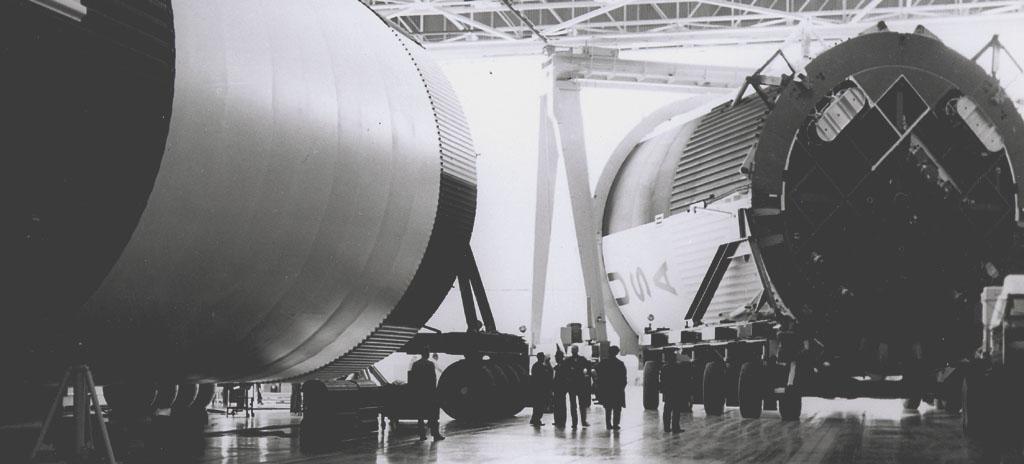
This photograph shows the Saturn V assembled LOX (Liquid Oxygen) and fuel tanks ready for transport from the Manufacturing Engineering Laboratory at Marshall Space Flight Center in Huntsville, Alabama. The tanks were then shipped to the lau…

The fuel tank assembly of the Saturn V S-IC (first) stage is readied to be mated to the liquid oxygen tank at the Marshall Space Flight Center. The fuel tank carried kerosene as its fuel. The S-IC stage utilized five F-1 engines that used k…

This photograph shows the components for the Saturn V S-IC stage fuel tank assembly in the Manufacturing Engineering Laboratory, building 4707, at the Marshall Space Flight Center (MSFC). Left to right are upper head, lower head, and forwar…

At its founding, the Marshall Space Flight Center (MSFC) inherited the Army’s Jupiter and Redstone test stands, but much larger facilities were needed for the giant stages of the Saturn V. From 1960 to 1964, the existing stands were remodel…
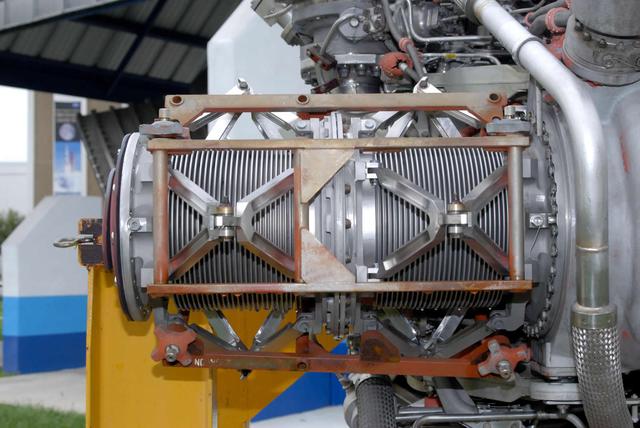
Stennis Space Center engineers are preparing to conduct water tests on an updated version of the scissors duct component of the J-2X engine. Measuring about 2 feet long and about 8 inches in diameter, the duct on the J-2X predecessor, the J…