Interferogram of Transonic flow field - reconstructed laser hologram as an infinite-fringe interferogram shows shock-wave shape, location and separaton of the airfoil boundry layer
ARC-1979-AC79-0054-1
S62-08046 (1961) --- Aerial view of the future site of the Manned Spacecraft Center, Houston, Texas.     NOTE: The Manned Spacecraft Center was named Lyndon B. Johnson Space Center in memory of the late President following his death.
Aerial view of the future site of the Manned Spacecraft Center, Houston, Tx
NASA astronaut Andre Douglas collects soil samples during the first in a series of four simulated moonwalks in the San Francisco Volcanic Field in Norther Arizona on May 13, 2024.   Credit: NASA/Josh Valcarcel
Andre Douglas - JETT 5 - jsc2024e033758
The Flame Nebula sits on the eastern hip of Orion the Hunter, a constellation most easily visible in the northern hemisphere during winter evenings in this view from NASA WISE Telescope.
A Different View of the Flame Nebula
This image from NASA Wide-field Infrared Survey Explorer highlights the dust that speckles the Andromeda galaxy spiral arms. The hot dust, which is being heated by newborn stars, traces the spidery arms all the way to the center of the gala…
The Dirt on Andromeda
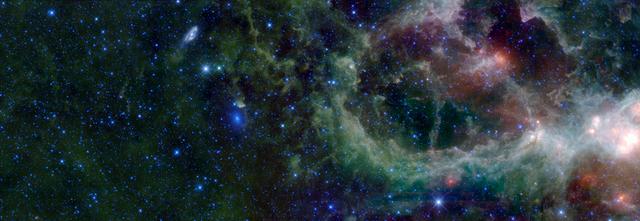
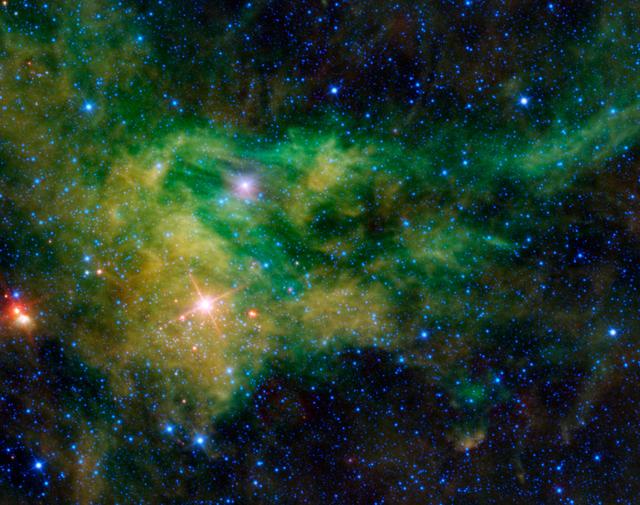
This mosaic of images from NASA WISE Telescope is in the constellation of Cassiopeia. This region contains a large star forming nebula within the Milky Way Galaxy, sometimes called the Heart Nebula, and is over 6 thousand light-years from E…
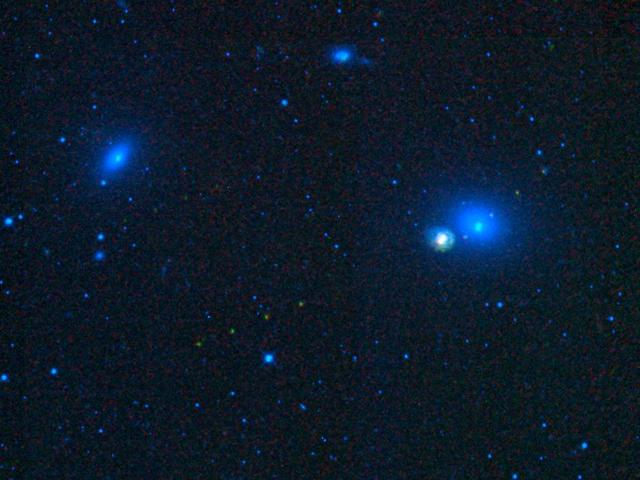
Maffei 1 and 2
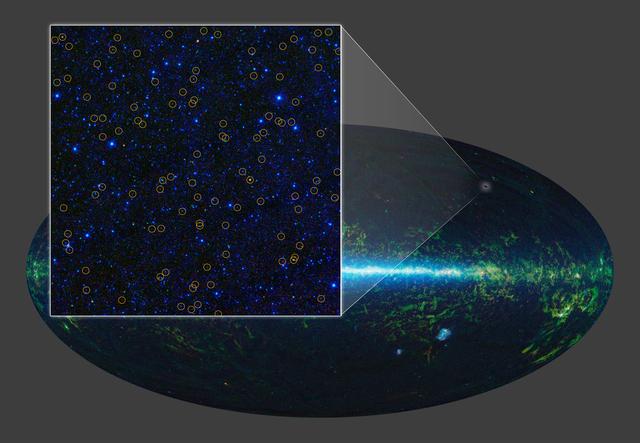
This mosaic of images covering the entire sky was observed by NASA WISE telescope and is part of its All-Sky Data Release. The projection used in this image of the sky is called an equirectangular.
Mapping the Infrared Universe: The Entire WISE Sky -- Rectangular Format
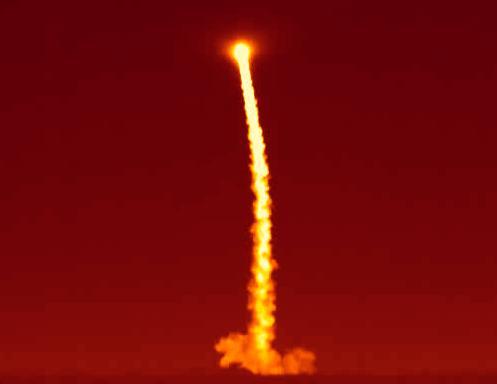
This infrared image shows NASA Wide-field Infrared Survey Explorer WISE rocketing into the sky just before dawn on Dec. 14 from Vandenberg Air Force Base in California. All systems are behaving as expected.
Prepping WISE to Pop its Lens Cap
This image from NASA Wide-field Infrared Survey Explorer, or WISE, is a view within the constellation Cassiopeia of another portion of the vast star forming complex that makes up part of the Perseus spiral arm of the Milky Way Galaxy.
IC 1795
This artist concept illustrates the first known Earth Trojan asteroid, discovered by NEOWISE, the asteroid-hunting portion of NASA WISE mission. The asteroid is shown in gray and its extreme orbit is shown in green. Objects are not drawn to…
Trojan Asteroid Shares Orbit with Earth Artist Animation
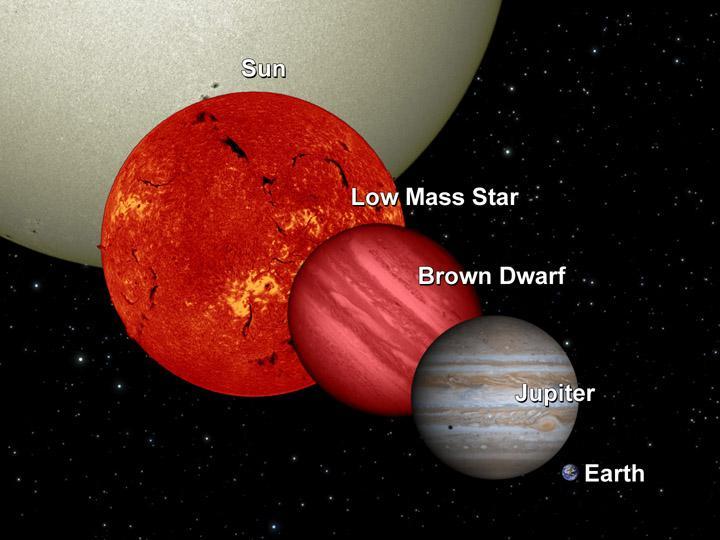
NASA Wide-field Infrared Survey Explorer will uncover many failed stars, or brown dwarfs, in infrared light. This diagram shows a brown dwarf in relation to Earth, Jupiter, a low-mass star and the sun.
Brown Dwarf Comparison
NASA Wide-field Infrared Survey Explorer, or WISE, back-end imager optics. This picture shows the imager optics which are mounted at the back of the optical system.
NASA WISE Imager Optics
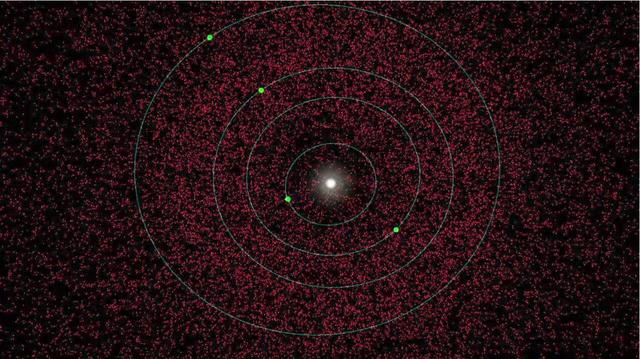
This frame from an animation illustrates asteroid-hunting results from NASA Wide-field Infrared Survey Explorer, or WISE, taken during its one-year survey of the sky in infrared light.
Changing Views of Our Solar System
With its all-sky infrared survey, NASA Wide-field Infrared Survey Explorer, or WISE, has identified millions of quasar candidates. Quasars are supermassive black holes with masses millions to billions times greater than our sun.
A Sky Chock-Full of Black Holes
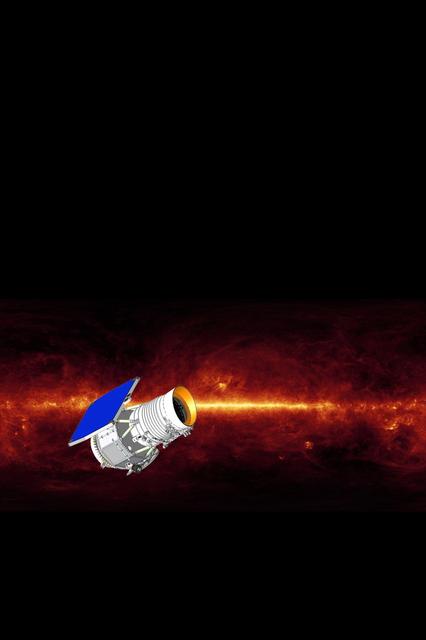
NASA Wide-field Infrared Survey Explorer mission will survey the entire sky in a portion of the electromagnetic spectrum called the mid-infrared with far greater sensitivity than any previous mission or program ever has.
Wide-field Infrared Survey Explorer Artist Concept
A colorful creature in a starry sea stands out in this image from NASA Wide-field Infrared Explorer; infrared light that has been assigned visible colors we see with our eyes. The jellyfish-looking object is actually a very close pair of dy…
Cosmic Ocean Dweller
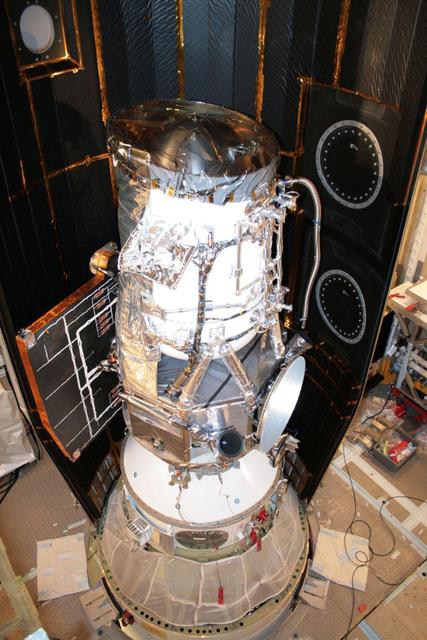
NASA Wide-field Infrared Survey Explorer is shown inside one-half of the nose cone, or fairing, that will protect it during launch.
WISE Snug in its Nose Cone
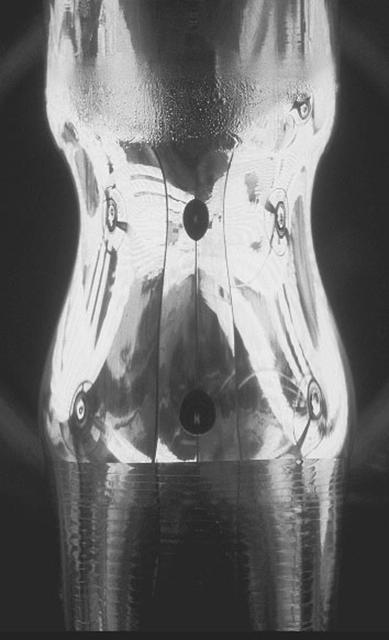
Interferogram of Transonic flow field - reconstructed laser hologram as an infinite-fringe interferogram shows shock-wave shape, location and separaton of the airfoil boundry layer
ARC-1979-A79-0054-4
The Vangard III satellite to study the magnetic field and radiation belt in orbit. NASA successfully launched Vanguard III (SLV-7) from Cape Canaveral, Florida on September 18, 1959.
Early Rockets
Crystal Growth in magnetic fields, a float-zone sample, the surface tension of the melt keeps the sample suspended between the sample rods in the furnace forming an actual liquid bridge. Principal Investigator: Dr. Frank Szofran
Microgravity
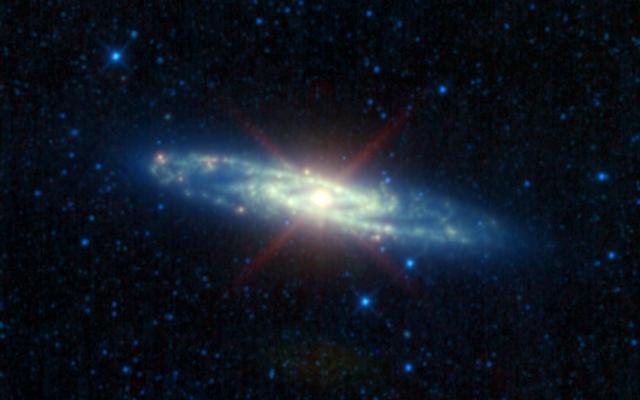
The Sculptor galaxy, or NGC 253, is seen in a rainbow of infrared colors in this mosaic by NASA Wide-field Infrared Survey Explorer. The Sculptor galaxy can be seen by observers in the southern hemisphere with a pair of good binoculars.
The Many Infrared Personalities of the Sculptor Galaxy
This stellar object is called Spitzer 073425.3-465409, as seen by NASA Wide-field Infrared Survey Explorer; the cloud CG4 might be imagined as a cosmic alligator eating its way across the sky.
Cosmic Alligator Eats its Way through the Sky
A young, free-floating world sits alone in space in this illustration. The object, called WISEA J114724.10-204021.3, is thought to be an exceptionally low-mass brown dwarf.
Young Brown Dwarf in TW Hydrae Family of Stars Artist Concept
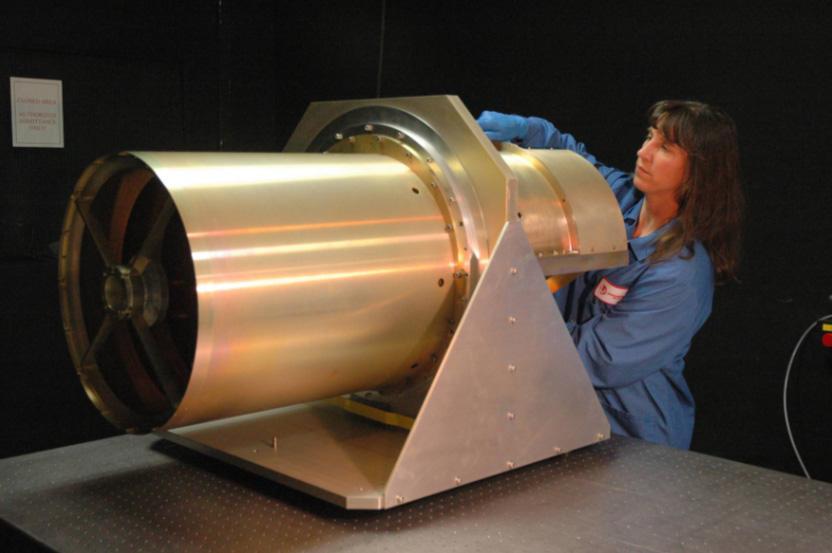
This image shows NASA 40 cm diameter Wide-field Infrared Survey Explorer telescope. Here the lead optical test engineer attaches the back-end imager optics to the afocal.
NASA WISE Telescope
It a dust bunny of cosmic proportions. Astronomers used images from NASA WISE to locate an aging star shedding loads of dust orange dot at upper left.
Dusty Star Stands Out From the Rest
A dying star, called the Helix nebula, is shown surrounded by the tracks of asteroids in an image captured by NASA WISE. Skirting around the edges of the Helix nebula are the footprints of asteroids marching across the field of view.
March of Asteroids Across Dying Star
SOIL UNLOAD FOR THE SIMULATED PLANETARY BODY FIELD IN THE WEST TEST AREA. AREA TO BE USED FOR TESTING OF THE MIGHTY EAGLE LANDER
1300963
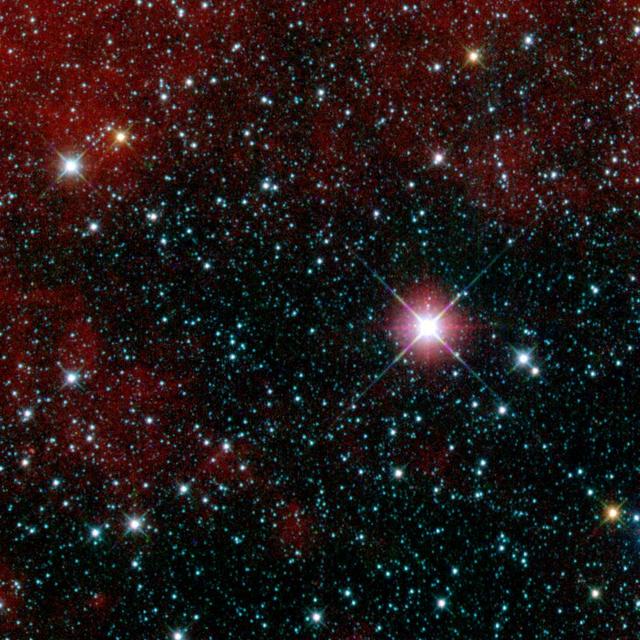
This infrared snapshot of a region in the constellation Carina near the Milky Way was taken shortly after NASA Wide-field Infrared Survey Explorer ejected its cover. The first-light picture shows thousands of stars and covers an area three…
WISE First-Light Image
This large mosaic image from NASA Wide-field Infrared Survey Explorer, features the wreckage of an exploded star, as well as other stars nearing the end of their lives.
Beyond the Veil
NASA Wide-field Infrared Survey Explorer, shows a giant nebula around Lambda Orionis, inflating Orion head to huge proportions.
Orion Big Head Revealed in Infrared
Data from NASA Wide-field Infrared Survey Explorer has led to revisions in the estimated population of near-Earth asteroids. The most accurate survey to date has allowed new estimates of the total numbers of objects in different size catego…
WISE Revises Numbers of Asteroids Near Earth
NASA Wide-Field Infrared Survey Explorer has uncovered a striking population of young stellar objects in a complex of dense, dark clouds in the southern constellation of Circinus.
Star Formation in the Circinus Molecular Cloud Complex
This infrared image from NASA Wide-field Infrared Survey Explorer shows the Lambda Centauri nebula, a star-forming cloud in our Milky Way galaxy, also known as the Running Chicken nebula.
Chasing Chickens in the Lambda Centauri Nebula
This illustration lays a depiction of the sun's magnetic fields over an image captured by NASA’s Solar Dynamics Observatory on March 12, 2016. The complex overlay of lines can teach scientists about the ways the sun's magnetism changes in r…
Picturing the Sun’s Magnetic Field
These banana-shaped loops are part of a computer-generated snapshot of our sun's magnetic field. The solar magnetic-field lines loop through the sun's corona, break through the sun's surface, and cornect regions of magnetic activity, such a…
Space Science
PHOTO DATE:  10-20-21 LOCATION:  Flagstaff, Arizona - Field Location SUBJECT: Photographic support and coverage of night field evaluation. EVA Test #1 PHOTOGRAPHER: BILL STAFFORD
jsc2021e048675
A view of the flexure springs in the soft ride being mated to the payload attach fitting for NASA Wide-field Infrared Survey Explorer, or WISE, spacecraft.
View of Flexure Springs on NASA WISE Spacecraft
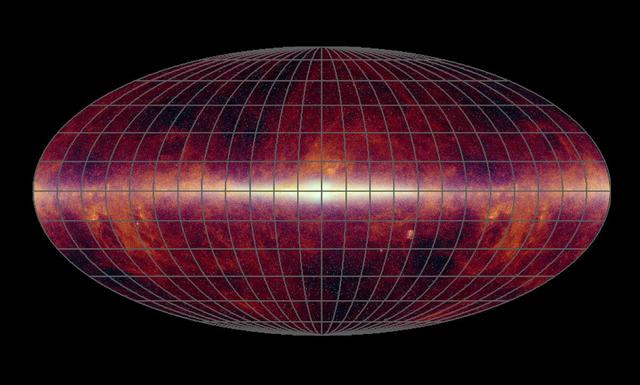
This image is an all-sky infrared map consisting of data taken by previous missions: the Infrared Astronomical Satellite; NASA Cosmic Background Explorer; and the Two-Micron All-Sky Survey.
WISE Eyes the Whole Sky
In the Perseus spiral arm of the Milky Way galaxy, opposite the galactic center, lies the nebula SH 2-235. As seen in infrared light, NASA Wide-field Infrared Survey Explorer reveals SH 2-235 to be a huge star formation complex.
WISE Eyes Evolution of Massive Stars
To celebrate the one-year anniversary of the launch of NASA Wide-Field Infrared Explorer, the mission team put together this image showing just a sample of the millions of galaxies that have been imaged by WISE during its survey of the enti…
A Collage of Nearby Galaxies
This image from NASA Wide-field Infrared Survey Explorer, shows four galaxies in the Virgo cluster: Messier 59, Messier 60, NGC 4647, and NGC 4638. It also shows the tracks of three asteroids, which appear in this image as trails of green d…
Asteroids in Virgo
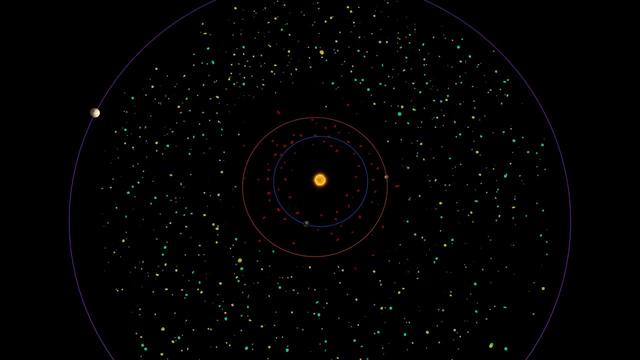
This diagram shows a bird eye view of our asteroid belt, which lies between the orbits of Mars red and Jupiter purple.
Asteroid Belt Bird Eye View
Some might see a blood-red jellyfish, while others might see a pair of lips. In fact, the red-colored object in this new image from NASA Wide-field Infrared Survey Explorer is a sphere of stellar innards.
Jumbo Jellyfish or Massive Star?
WISE J104915.57-531906, center of the larger image, was taken by the NASA WISE. This is the closest star system discovered since 1916, and the third closest to our sun. It is 6.5 light-years away.
Two Brown Dwarfs in Our Backyard
The blue star near the center of this image is Zeta Ophiuchi. Zeta Ophiuchi is actually a very massive, hot, bright blue star plowing its way through a large cloud of interstellar dust and gas in this image from NASA Wide-field Infrared Sur…
Zeta Ophiuchi -- Runaway Star Plowing through Space Dust
This mosaic image taken by NASA Wide-field Infrared Survey Explorer, features three nebulae that are part of the giant Orion Molecular Cloud. Included in this view are the Flame nebula, the Horsehead nebula and NGC 2023.
A Flame in Orion Belt
NASA Wide-field Infrared Survey Explorer captured this colorful image of the nebula BFS 29 surrounding the star CE-Camelopardalis, found hovering in the band of the night sky comprising the Milky Way.
Supergiant Star Near Giraffe Hind Foot
NASA Wide-field Infrared Survey Explorer highlights the Small Magellanic Cloud, a small galaxy about 200,000 light-years away. Located in the constellation Tucana, the Small Magellanic Cloud looks like a wispy cloud encircling the south cel…
WISE View of a Wispy Cloud