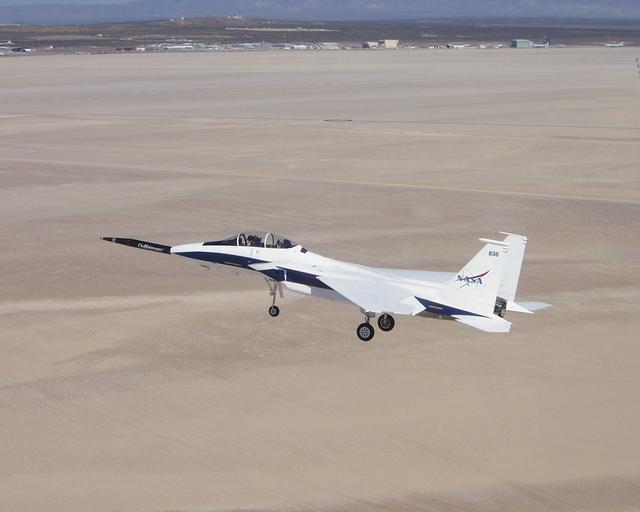
In-flight photo of the NASA F-15B used in tests of the X-33 Thermal Protection System (TPS) materials. Flying at subsonic speeds, the F-15B tests measured the air loads on the proposed X-33 protective materials. In contrast, shock loads tes…
F-15B in flight with X-33 Thermal Protection Systems (TPS) on Flight Test Fixture
Left to right: workhorse F-15B #836, "Mr. Bones" F-15D #884, and "2nd to None" F-15D #897 on the back ramp at NASA's Neil A. Armstrong Flight Research Center.
AFRC2016-0073-72
Mike Frederick and NASA interns Jack Ly and Kassidy McLaughlin monitor an F-15B flight.
ED16-0038-64
NASA Dryden's highly modified F-15B aircraft, tail number 837, serves as an Intelligent flight Control System (IFCS) research testbed aircraft.
NASA Dryden's highly modified F-15B aircraft, tail number 837, serves as an Intelligent Flight Control System (IFCS) research testbed aircraft
NASA Dryden's highly modified F-15B aircraft, tail number 837, serves as an Intelligent flight Control System (IFCS) research testbed aircraft.
NASA Dryden's highly modified F-15B aircraft, tail number 837, serves as an Intelligent Flight Control System (IFCS) research testbed aircraft
Approaching the runway after the first evaluation flight of the Quiet Spike project, NASA's F-15B testbed aircraft cruises over Roger's Dry Lakebed near the Dryden Flight Research Center. The Quiet Spike was developed by Gulfstream Aerospac…
Approaching the runway after the first evaluation flight of the Quiet Spike project, NASA's F-15B testbed aircraft cruises over Roger's Dry Lakebed
NASA's F-15B Research Testbed aircraft flew instrumentation in June 2004 called the Local Mach Investigation (LMI), designed to gather local airflow data for future research projects using the aircraft's Propulsion Flight Test Fixture (PFTF…
NASA's F-15B conducts a local Mach investigation flight over California's Mojave Desert.
NASA's F-15B research testbed jet from the NASA Dryden Flight Research Center flew in the supersonic shockwave of a Northrop Grumman Corp. modified F-5E in support of the Shaped Sonic Boom Demonstration (SSBD) project, which is part of the…
NASA's F-15B research testbed jet from the NASA Dryden Flight Research Center flew in the supersonic shockwave of a Northrop Grumman Corp. modified F-5E in support of the Shaped Sonic Boom Demonstration (SSBD) project, which is part of DARPA's Quiet Supers
NASA's F-15B research testbed jet from NASA's Dryden Flight Research Center flew in the supersonic shockwave of a Northrop Grumman Corp. modified U.S. Navy F-5E jet in support of the Shaped Sonic Boom Demonstration (SSBD) project, which is…
NASA's F-15B research testbed jet flew in the supersonic shockwave of a Northrop Grumman Corp. - modified U.S. Navy F-5E jet in support of the Shaped Sonic Boom Demonstration project.
The control panel for the joint NASA/Gulfstream Quiet Spike project, located in the backseat of NASA's F-15B testbed aircraft. The project seeks to verify the structural integrity of the multi-segmented, articulating spike attachment design…
The control panel for the joint NASA/Gulfstream Quiet Spike project, located in the backseat of NASA's F-15B testbed aircraft
The Aerostructures Test Wing (ATW), which consisted of an 18-inch carbon fiber test wing with surface-mounted piezoelectric strain actuators, was mounted on a special ventral flight test fixture and flown on Dryden's F-15B Research Testbed…
The Aerostructures Test Wing (ATW), which consisted of an 18-inch carbon fiber test wing with surface-mounted piezoelectric strain actuators, was mounted on a special ventral flight test fixture and flown on Dryden's F-15B Research Testbed aircraft
Research on the Eagle Aero Probe is ongoing from an F-15B flight test fixture, as the aircraft flies missions over the high desert.
AFRC2016-0072-01
One of NASA's two F-15 research aircraft gets refueled in mid-air over Lake Isabella from a USAF KC-135 tanker while NASA's other F-15 flies chase alongside.
All six divots of thermal insulation foam have been ejected from the flight test fixture on NASA's F-15B testbed as it returns from a LIFT experiment flight.
An inert AIM-54 Phoenix missile nestled under the fuselage of NASA Dryden's F-15B aircraft is being studied as a possible test vehicle to obtain hypersonic data.
An inert Phoenix missile nestled under the fuselage of NASA Dryden's F-15B aircraft is being studied as a possible test vehicle to obtain hypersonic data.
A close up of the Flight Test Fixture II, mounted on the underside of the F-15B Aerodynamic Flight Facility aircraft. The Thermal Protection System (TPS) samples, which included metallic Inconel tiles, soft Advanced Flexible Reusable Surfac…
Closeup of F-15B Flight Test Fixture (FTF) with X-33 Thermal Protection Systems (TPS)
Left to right: "2nd to None" (F-15D #897), "Mr. Bones" (F-15D #884), and workhorse F-15B #836 on the back ramp at NASA's Neil A. Armstrong Flight Research Center.
AFRC2016-0073-80
This view from a NASA Dryden F-18 chase aircraft shows Dryden's highly modified F-15B, tail number 837, which resumed Intelligent Flight Control System (IFCS) project flights on Dec. 6, 2002.
NASA Dryden's highly modified F-15B aircraft, tail number 837, serves as an Intelligent flight Control System (IFCS) research testbed aircraft.
NASA Dryden's highly modified F-15B aircraft, tail number 837, serves as an Intelligent Flight Control System (IFCS) research testbed aircraft
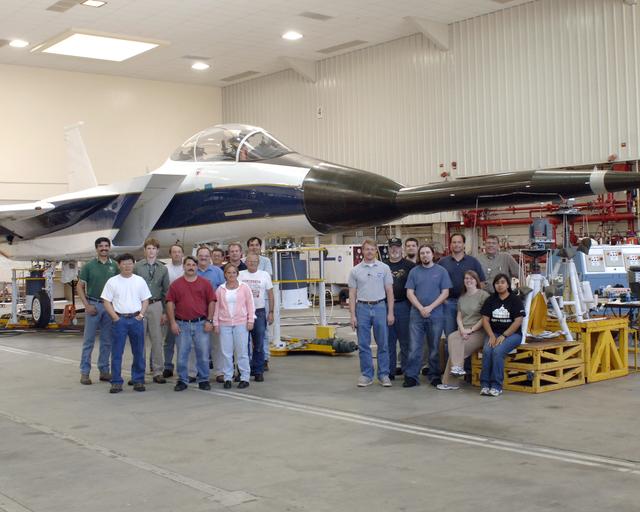
Some of the test team for the Gulfstream Quiet Spike project assembled for a group photo on May 3, 2006. The project seeks to verify the structural integrity of the multi-segmented, articulating spike attachment designed to reduce and contr…
Some of the test team for the Gulfstream Quiet Spike project assembled for a group photo on May 3, 2006
Gulfstream's Quiet Spike sonic boom mitigator being installed on NASA DFRC's F-15B testbed aircraft. The project seeks to verify the structural integrity of the multi-segmented, articulating spike attachment designed to reduce and control a…
Gulfstream's Quiet Spike sonic boom mitigator being installed on NASA DFRC's F-15B testbed aircraft
Gulfstream Aerospace and NASA's Dryden Flight Research Center are testing the structural integrity of a telescopic 'Quiet Spike' sonic boom mitigator on the F-15B testbed. The Quiet Spike was developed as a means of controlling and reducing…
NASA's F-15B testbed aircraft with Gulfstream Quiet Spike sonic boom mitigator attached
NASA's F-15B testbed aircraft lands after the first flight of the Quiet Spike project. The first flight was performed for evaluation purposes, and the spike was not extended. The Quiet Spike was developed as a means of controlling and reduc…
NASA's F-15B testbed aircraft lands after the first flight of the Quiet Spike project
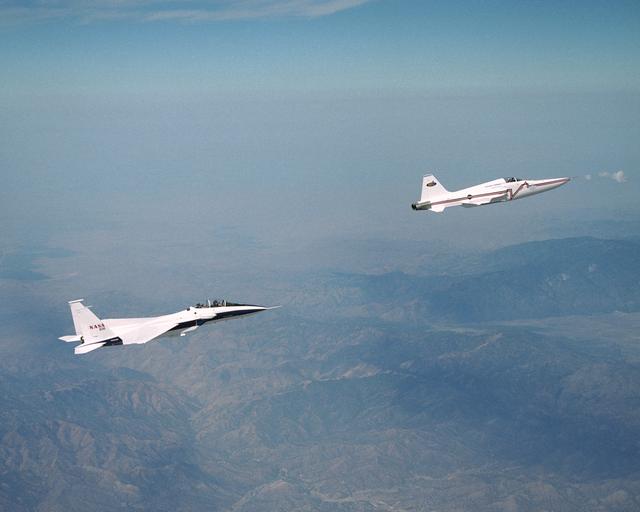
In a role-reversal, Northrop Grumman Corp.'s modified F-5E Shaped Sonic Boom Demonstration (SSBD) aircraft flies off the wing of NASA's F-15B Research testbed aircraft. The F-15B, from NASA's Dryden Flight Research Center, flew in the super…
Northrop Grumman Corp.'s modified F-5E Shaped Sonic Boom Demonstration (SSBD) aircraft flies off the wing of NASA's F-15B Research testbed aircraft.
NASA's F-15B research testbed jet from NASA's Dryden Flight Research Center flew in the supersonic shockwave of a Northrop Grumman Corp. modified U.S. Navy F-5E jet in support of the Shaped Sonic Boom Demonstration (SSBD) project, which is…
NASA's F-15B from the Dryden Flight Research Center flew in the supersonic shockwave of a modified U.S. Navy F-5E jet in support of the Shaped Sonic Boom Demonstration (SSBD) project. On Aug. 27, 2003, the F-5 SSBD aircraft demonstrated a method to reduce
Northrop Grumman Corporation's modified U.S. Navy F-5E Shaped Sonic Boom Demonstration (SSBD) aircraft flies over Lake Isabella, California on Aug. 4, 2003. NASA Dryden provided range, air and ground data-gathering support for the SSBD proj…
Northrop Grumman Corporation's modified U.S. Navy F-5E Shaped Sonic Boom Demonstration (SSBD) aircraft flies over Lake Isabella, Calif., on Aug. 4, 2003
NASA Dryden's F-15B testbed aircraft with the Gulfstream Quiet Spike sonic boom mitigator attached undergoes ground vibration testing in preparation for test flights. The project seeks to verify the structural integrity of the multi-segment…
NASA Dryden's F-15B aircraft with the Gulfstream Quiet Spike sonic boom mitigator attached undergoes ground vibration testing in preparation for test flights
The Aerostructures Test Wing (ATW), which consisted of an 18-inch carbon fiber test wing with surface-mounted piezoelectric strain actuators, following intentional failure on its final flight
Dryden Flight Research Center - aircraft fleet on ramp
ED08-0292-1
NASA F-15B #836 landing with Quiet Spike attached. The project seeks to verify the structural integrity of the multi-segmented, articulating spike attachment designed to reduce and control a sonic boom.
NASA F-15B #836 landing with Quiet Spike attached
Two panels of Space Shuttle TPS insulation were mounted on the flight test fixture underneath NASA's F-15B during the Lifting Foam Trajectory flight test series.
Two panels of Space Shuttle TPS insulation were mounted on the flight test fixture underneath NASA's F-15B during the Lifting Foam Trajectory flight test series
NASA photographer Jim Ross captured this shot while pilot Troy Asher flew inverted in an F-15D. The F-15B is seen here flying over the mirror farm, AKA the Abengoa Mojave Solar Project, east of Four Corners off of Highway 58 in Southern Cal…
AFRC2016-0082-13
A new supersonic probe seen affixed to a F-15B flight test fixture might one day measure the sonic booms of a new generation of supersonic aircraft.
ED16-0038-69
NASA Dryden's highly modified F-15B, tail number 837, seen here with the Boron Mine as a backdrop, resumed Intelligent Flight Control System (IFCS) project flights on Dec. 6, 2002.
NASA Dryden's highly modified F-15B aircraft, tail number 837, serves as an Intelligent flight Control System (IFCS) research testbed aircraft.
NASA Dryden's highly modified F-15B aircraft, tail number 837, serves as an Intelligent Flight Control System (IFCS) research testbed aircraft
NASA's F-15B testbed aircraft in flight during the first evaluation flight of the joint NASA/Gulfstream Quiet Spike project. The project seeks to verify the structural integrity of the multi-segmented, articulating spike attachment designed…
NASA's F-15B testbed aircraft in flight during the first evaluation flight of the joint NASA/Gulfstream Quiet Spike project
Group photo following the 300th NASA Dryden flight of F-15B #836.
Group photo following the 300th NASA Dryden flight of F-15B #836
NASA's F-15B testbed aircraft undergoes pre-flight checks before performing the first flight of the Quiet Spike project. The first flight was performed for evaluation purposes, and the spike was not extended. The Quiet Spike was developed a…
NASA's F-15B testbed aircraft undergoes pre-flight checks before performing the first flight of the Quiet Spike project
NASA's F-15B Research Testbed aircraft flew instrumentation in June 2004 called the Local Mach Investigation (LMI), designed to gather local airflow data for future research projects using the aircraft's Propulsion Flight Test Fixture (PFTF…
NASA's F-15B conducts a local Mach investigation flight over California's Mojave Desert.
NASA's F-15B research testbed jet from NASA's Dryden Flight Research Center flew in the supersonic shockwave of a Northrop Grumman Corp. modified U.S. Navy F-5E jet in support of the Shaped Sonic Boom Demonstration (SSBD) project, which is…
NASA's F-15B research testbed jet flew in the supersonic shockwave of a Northrop Grumman Corp. - modified U.S. Navy F-5E jet in support of the Shaped Sonic Boom Demonstration project.
Northrop-Grumman Corporation's modified U.S. Navy F-5E Shaped Sonic Boom Demonstration (SSBD) aircraft.
Northrop-Grumman Corporation's modified U.S. Navy F-5E Shaped Sonic Boom Demonstration (SSBD) aircraft
Northrop Grumman Corporation's modified U.S. Navy F-5E Shaped Sonic Boom Demonstration (SSBD) aircraft flies over the company's Palmdale, California facilities on Aug. 2, 2003. NASA Dryden provided range, air and ground data-gathering suppo…
Northrop Grumman Corporation's modified U.S. Navy F-5E Shaped Sonic Boom Demonstration (SSBD) aircraft flies over the company's Palmdale, Calif. facilities on Aug. 2, 2003
NASA's two modified F-15B research aircraft joined up for a fly-over of NASA's Dryden Flight Research Center on Edwards AFB, Calif., after a research mission.
The Aerostructures Test Wing (ATW) experiment, which consisted of an 18-inch carbon fiber test wing with surface-mounted piezoelectric strain actuators, undergoing ground testing prior to flight on Dryden's F-15B Research Testbed aircraft
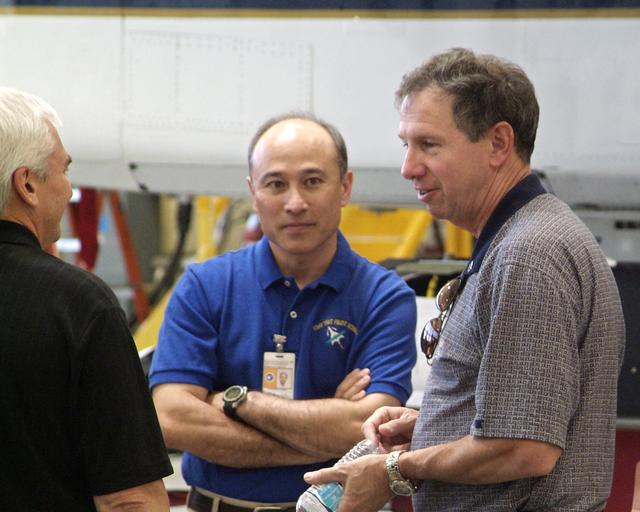
New NASA Administrator Michael Griffin (right) shares a moment with Director Kevin Petersen (left) and F-15B project manager Stephen Corda (center) during Griffin's visit to NASA Dryden Flight Research Center on Tuesday, May 24.
NASA Administrator Michael Griffin (right) with Kevin Petersen (left) and Stephen Corda (center) during Griffin's visit to NASA Dryden
NASA F-15B #836 in flight with Quiet Spike attached. The project seeks to verify the structural integrity of the multi-segmented, articulating spike attachment designed to reduce and control a sonic boom.
NASA F-15B #836 in flight with Quiet Spike attached
A close-up of the panels on the F-15B's flight test fixture shows five divots of TPS foam were successfully ejected during the LIFT experiment flight #2, the first flight with TPS foam.
A close-up of the panels on the F-15B's flight test fixture shows five divots of TPS foam were successfully ejected during the LIFT experiment.