
This photograph depicts a test firing of an F-1 engine at the F-1 engine test stand in the west test area of the Marshall Space Flight Center. This engine produced 1,500,000 pounds of thrust using liquid oxygen and RP-1, which is a derivati…

CAPE CANAVERAL, Fla. – Components for two of the F-1 engines that powered the first stage of the Saturn V rockets that lifted NASA's Apollo missions to the moon were recovered from the Atlantic Ocean March 21 by Jeff Bezos, the founder and…

CAPE CANAVERAL, Fla. – Components for two of the F-1 engines that powered the first stage of the Saturn V rockets that lifted NASA's Apollo missions to the moon were recovered from the Atlantic Ocean March 21 by Jeff Bezos, the founder and…
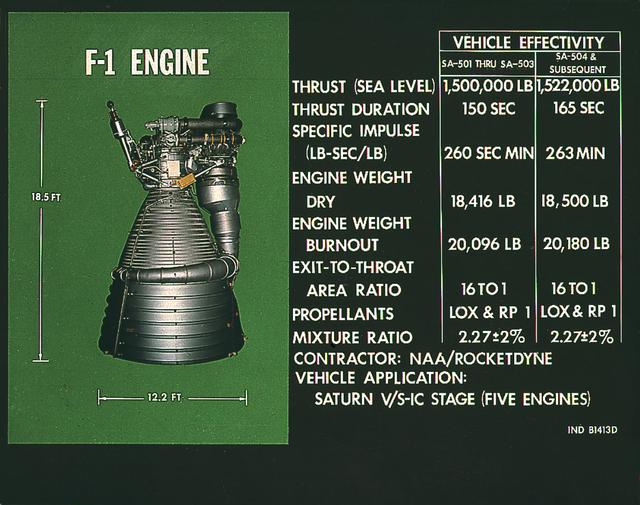
This chart provides the vital statistics for the F-1 rocket engine. Developed by Rocketdyne, under the direction of the Marshall Space Flight Center, the F-1 engine was utilized in a cluster of five engines to propel the Saturn V's first st…

CAPE CANAVERAL, Fla. – Components for two of the F-1 engines that powered the first stage of the Saturn V rockets that lifted NASA's Apollo missions to the moon were recovered from the Atlantic Ocean March 21 by Jeff Bezos, the founder and…

PC271-002-055 F1 GG Testing with LOX/RP-1 (Dynetics/PWR) GG 02/13/2013 TS116

CAPE CANAVERAL, Fla. – Components for two of the F-1 engines that powered the first stage of the Saturn V rockets that lifted NASA's Apollo missions to the moon were recovered from the Atlantic Ocean March 21 by Jeff Bezos, the founder and…

The support crew for the F-16A, the F-16XL no. 1, and the F-16 AFTI are, top row, left to right: Randy Weaver; mechanic, Susan Ligon; mechanic, Bob Garcia; Crew Chief, Rich Kelly; mechanic, Dale Edminister; Avionics Technician. Bottom row,…
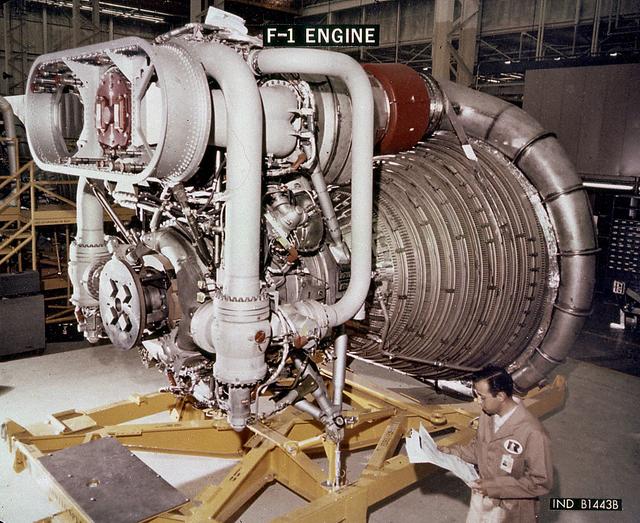
This close-up view of the F-1 engine for the Saturn V S-IC (first) stage shows the engine's complexity, and also its large size as it dwarfs the technician. Developed by Rocketdyne, under the direction of the Marshall Space Flight Center, t…

Four different versions of the F-16 were used by Dryden in the 1990s. On the left and right sides are two F-16XLs. On the left is the F-16XL #2 (NASA 848), which is the two-seat version, used for advanced laminar flow studies until late 199…
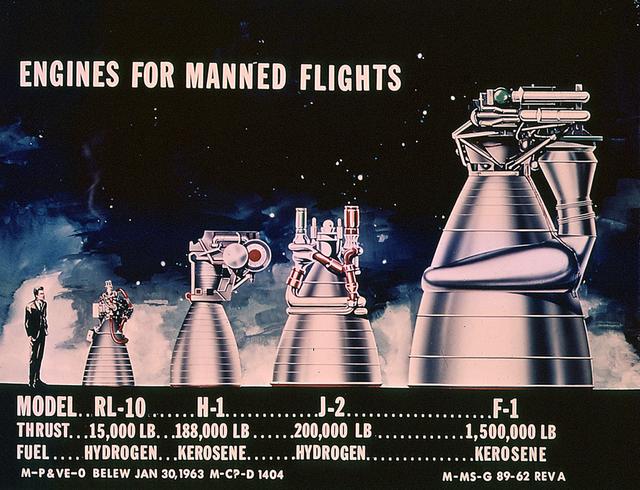
This drawing clearly shows the comparative sizes of the rocket engines used to launch the Saturn vehicles. The RL-10 and the H-1 engines were used to launch the Saturn I rockets. The J-2 engine was used on the second stage of Saturn IB and…

The static firing of a Saturn F-1 engine at the Marshall Space Flight Center's Static Test Stand. The F-1 engine is a single-start, 1,5000,000 Lb fixed-thrust, bipropellant rocket system. The engine uses liquid oxygen as the oxidizer and R…

The single-seat F-16XL, NASA 849, joins up with an SR-71A, NASA 844, as crews set up for one of the flights in the recent sonic boom research program conducted by the Dryden Flight Research Center, Edwards, California. During the missions,…

NASA's single-seat F-16XL makes a drag chute landing on the runway at Edwards Air Force Base in California's Mojave Desert. The aircraft was most recently used in the Cranked-Arrow Wing Aerodynamics Project (CAWAP) to test boundary layer pr…

Engineers at the Marshall Space Flight Center install the F-1 engines on the S-IC stage thrust structure at the S-IC static test stand. Engines are installed on the stage after it has been placed in the test stand. This image shows a close-…

CAPE CANAVERAL, Fla. – Components for two of the F-1 engines that powered the first stage of the Saturn V rockets that lifted NASA's Apollo missions to the moon were recovered from the Atlantic Ocean March 21 by Jeff Bezos, the founder and…

PC271-004-049 F1 GG Testing with LOX/RP-1 (Dynetics/PWR) 02/14/2013 TS116

CAPE CANAVERAL, Fla. – Components for two of the F-1 engines that powered the first stage of the Saturn V rockets that lifted NASA's Apollo missions to the moon were recovered from the Atlantic Ocean March 21 by Jeff Bezos, the founder and…

PC271-009—009 F1 GG Testing with LOX/RP-1 (Dynetics/PWR) 03/06/2013 TS116

CAPE CANAVERAL, Fla. – Components for two of the F-1 engines that powered the first stage of the Saturn V rockets that lifted NASA's Apollo missions to the moon were recovered from the Atlantic Ocean March 21 by Jeff Bezos, the founder and…

CAPE CANAVERAL, Fla. – Components for two of the F-1 engines that powered the first stage of the Saturn V rockets that lifted NASA's Apollo missions to the moon were recovered from the Atlantic Ocean March 21 by Jeff Bezos, the founder and…

CAPE CANAVERAL, Fla. – Components for two of the F-1 engines that powered the first stage of the Saturn V rockets that lifted NASA's Apollo missions to the moon were recovered from the Atlantic Ocean March 21 by Jeff Bezos, the founder and…

CAPE CANAVERAL, Fla. – Components for two of the F-1 engines that powered the first stage of the Saturn V rockets that lifted NASA's Apollo missions to the moon were recovered from the Atlantic Ocean March 21 by Jeff Bezos, the founder and…

The support crew for the F-16A, the F-16XL no. 1, and the F-16 AFTI are, top row, left to right: Randy Weaver; mechanic, Susan Ligon; mechanic, Bob Garcia; Crew Chief, Rich Kelly; mechanic, Dale Edminister; Avionics Technician. Bottom row,…

An image of the F-16XL #1 during its functional flight check of the Digital Flight Control System (DFCS) on December 16, 1997. The mission was flown by NASA research pilot Dana Purifoy, and lasted 1 hour and 25 minutes. The tests included p…

This figure is a drawing of the F-1 engine with callouts of the major components and the engine characteristics.

A complete F-1 engine assembly is shown in this photograph. Designed and developed by Rocketdye under the direction of the Marshall Space Flight Center, the engine measured 19-feet tall by 12.5 feet at the nozzle exit, and each engine produ…

The single-seat F-16XL, NASA 849, joins up with an SR-71A, NASA 844, as crews set up for one of the flights in the recent sonic boom research program conducted by the Dryden Flight Research Center, Edwards, California. During the missions,…

Marshall Space Flight Center's F-1 Engine Test Stand is shown in this picture. Constructed in 1963, the test stand is a vertical engine firing test stand, 239 feet in elevation and 4,600 square feet in area at the base, and was designed to…

At its founding, the Marshall Space Flight Center (MSFC) inherited the Army’s Jupiter and Redstone test stands, but much larger facilities were needed for the giant stages of the Saturn V. From 1960 to 1964, the existing stands were remodel…

The test laboratory of the Marshall Space Flight Center (MSFC) tested the F-1 engine, the most powerful rocket engine ever fired at MSFC. The engine was tested on the newly modified Saturn IB Static Test Stand which had been used for three…

CAPE CANAVERAL, Fla. – Components for two of the F-1 engines that powered the first stage of the Saturn V rockets that lifted NASA's Apollo missions to the moon were recovered from the Atlantic Ocean March 21 by Jeff Bezos, the founder and…

CAPE CANAVERAL, Fla. – Components for two of the F-1 engines that powered the first stage of the Saturn V rockets that lifted NASA's Apollo missions to the moon were recovered from the Atlantic Ocean March 21 by Jeff Bezos, the founder and…

PC271-003-060 F1 GG Testing with LOX/RP-1 (Dynetics/PWR) 02/14/2013 TS116

PC271-001-033 F1 GG Testing with LOX/RP-1 (Dynetics/PWR) 02/13/2013 TS116

CAPE CANAVERAL, Fla. – Components for two of the F-1 engines that powered the first stage of the Saturn V rockets that lifted NASA's Apollo missions to the moon were recovered from the Atlantic Ocean March 21 by Jeff Bezos, the founder and…

CAPE CANAVERAL, Fla. – Components for two of the F-1 engines that powered the first stage of the Saturn V rockets that lifted NASA's Apollo missions to the moon were recovered from the Atlantic Ocean March 21 by Jeff Bezos, the founder and…

PC271-006-047 F1 GG Testing with LOX/RP-1 (Dynetics/PWR) 02/15/2013 TS116

CAPE CANAVERAL, Fla. – Components for two of the F-1 engines that powered the first stage of the Saturn V rockets that lifted NASA's Apollo missions to the moon were recovered from the Atlantic Ocean March 21 by Jeff Bezos, the founder and…

CAPE CANAVERAL, Fla. – Components for two of the F-1 engines that powered the first stage of the Saturn V rockets that lifted NASA's Apollo missions to the moon were recovered from the Atlantic Ocean March 21 by Jeff Bezos, the founder and…

This photograph depicts the Rocketdyne static firing of the F-1 engine at the towering 76-meter Test Stand 1-C in Area 1-125 of the Edwards Air Force Base in California. The Saturn V S-IC (first) stage utilized five F-1 engines for its thru…

The F-16XL #1 (NASA 849) takes off for the first flight of the Digital Flight Control System (DFCS) on December 16, 1997. Like most first flight, the DFCS required months of preparations. During July 1997, crews worked on the engine, cockpi…

The single-seat F-16XL, NASA 849, joins up with an SR-71A, NASA 844, as crews set up for one of the flights in the recent sonic boom research program conducted by the Dryden Flight Research Center, Edwards, California. During the missions,…

This photograph depicts the F-1 engine firing in the Marshall Space Flight Center’s F-1 Engine Static Test Stand. Construction of the S-IC Static test stand complex began in 1961 in the west test area of MSFC, and was completed in 1964. It…

The F-1 engine was developed and built by Rocketdyne under the direction of the Marshall Space Flight Center. It measured 19 feet tall by 12.5 feet at the nozzle exit, and produced a 1,500,000-pound thrust using liquid oxygen and kerosene a…

NASA 834, an F-14 Navy Tomcat, seen here in flight, was used at Dryden in 1986 and 1987 in a program known as the Variable-Sweep Transition Flight Experiment (VSTFE). This program explored laminar flow on variable sweep aircraft at high sub…

The test laboratory of the Marshall Space Flight Center (MSFC) tested the F-1 engine, the most powerful rocket engine ever fired at MSFC. The engine was tested on the newly modified Saturn IB static test stand that had been used for three y…

This photograph shows F-1 engines being stored in the F-1 Engine Preparation Shop, building 4666, at the Marshall Space Flight Center. Each F-1 engine produced a thrust of 1,500,000 pounds. A cluster of five engines was mounted on the thrus…