The DC-8 banking over the jagged peak of Mount Whitney on a February 25, 1998 flight. The DC-8 and a pair of ER-2 aircraft are operated by the Airborne Science program at the NASA Dryden Flight Research Center. NASA, other governmental agen…
DC-8 Airborne Laboratory in flight over Mt. Whitney
Eric Nisbet works on a part for the ER-2 instrument panel.
ER-2 Cockpit Effort Will Enhance Pilot Safety
Herman Escobar works on a part for the ER-2 instrument panel.
ER-2 Cockpit Effort Will Enhance Pilot Safety
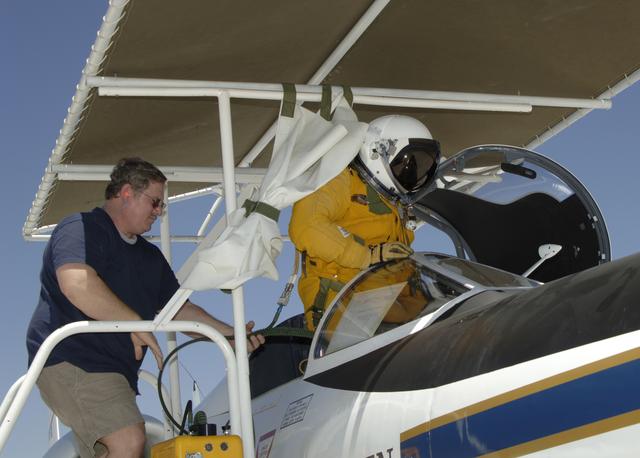
NASA Dryden life support technician Jim Sokolik assists pressure-suited pilot Dee Porter into the cockpit of NASA's ER-2 Earth resources aircraft.
A NASA ER-2 high-altitude aircraft takes off from NASA’s Armstrong Flight Research Center in Edwards California on Tuesday, March 31, 2026, to support the Geological Earth Mapping Experiment (GEMx) airborne science mission.
NASA ER-2 Prepares for Geological Earth Mapping Experiment Flights
Dryden Flight Research Center - aircraft fleet on ramp
ED08-0292-1
The large air intakes for its powerful engine are obvious as NASA's high-flying ER-2 #806 Earth resources aircraft taxies out for another science mission.
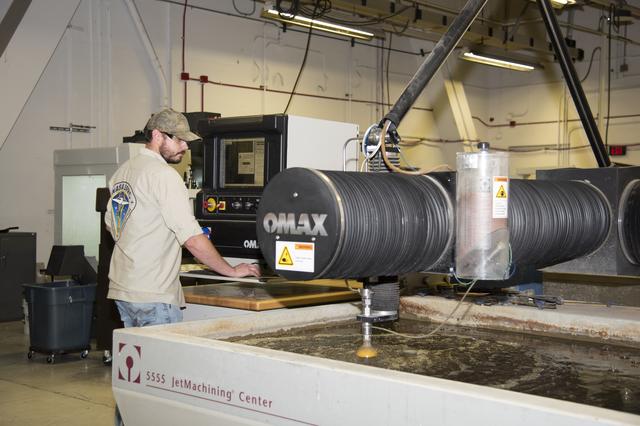
Hector Rosas works on fabricating a part for the ER-2 instrumentation panel.
ER-2 Cockpit Effort Will Enhance Pilot Safety
Mechanic Francisco Rodriguez and crew chief Darin Whittington installed the Airborne Visible/Infrared Imaging Spectrometer (AVIRIS) instrument into a NASA ER-2 high-altitude aircraft at NASA’s Armstrong Flight Research Center in Edwards, Ca…
NASA ER-2 Prepares for Geological Earth Mapping Experiment Flights
Crew chief Darin Whittington and mechanic Edwin Flores watch as mechanic Francisco Rodriguez works on a mounting bolt to secure the Airborne Visible/Infrared Imaging Spectrometer (AVIRIS) instrument into a NASA ER-2 high-altitude aircraft a…
NASA ER-2 Prepares for Geological Earth Mapping Experiment Flights
NASA’s ER-2 high-altitude aircraft prepares for a night flight with the Airborne Lunar Spectral Irradiance (air-LUSI) instrument on Monday, Feb. 2, 2026. The instrument measures Moonlight to improve accuracy of space-based sensors that fore…
NASA ER-2 Moonlight Mission Improves Space Sensors
Andrew Shaw works on a component for the high-altitude ER-2 aircraft's instrument panel.
ER-2 Cockpit Effort Will Enhance Pilot Safety
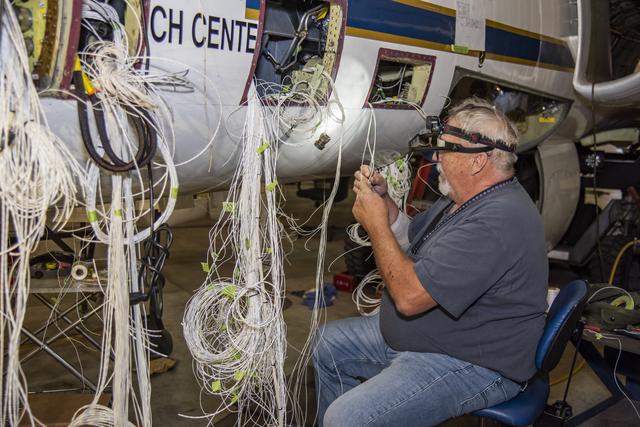
Technician Johnny Bryant works on rewiring the high-altitude aircraft's fixed nose and cockpit.
ER-2 Cockpit Effort Will Enhance Pilot Safety
Technician David Johnson works on rewiring the high-altitude ER-2 aircraft's fixed nose and cockpit.Â
ER-2 Cockpit Effort Will Enhance Pilot Safety
NASA'S ER-2 #806 lifts off from Edwards Air Force Base on a CALIPS/CloudSat validation instrument checkout flight.
A NASA ER-2 high-altitude aircraft takes off from NASA’s Armstrong Flight Research Center in Edwards California on Tuesday, March 31, 2026, to support the Geological Earth Mapping Experiment (GEMx) airborne science mission.
NASA ER-2 Prepares for Geological Earth Mapping Experiment Flights
From left, NASA avionics technician Jesse Orellana; quality assurance employee Jose Prieto; mechanic Francisco Rodriguez; and mechanic Vincent Moreno work on an ER-2 aircraft Monday, Jan. 26, 2026, at NASA’s Armstrong Flight Research Center…
NASA ER-2 Maintenance Staff Keeps Aircraft Mission Ready
David A. Wright is associate director for Center Operations at the NASA Dryden Flight Research Center, Edwards, Calif. He was formerly director of Flight Operations. He is also a research pilot, flying NASA's ER-2 and T-38. The ER-2s are ci…
David A. Wright in ER-2
No more images