Drawing DARPA Ejector fighter model  (deHavilland/Canada/NASA) E-7
ARC-1989-AC89-0060
The second X-45A Unmanned Combat Air Vehicle (UCAV) technology demonstrator completed its first flight on November 21, 2002, after taking off from a dry lakebed at NASA's Dryden Flight Research Center, Edwards Air Force Base, California.  X…
The second X-45A Unmanned Combat Air Vehicle (UCAV) technology demonstrator aircraft during its maiden flight. The flight marks another milestone for the UCAV program, and verified the aircraft's flight control software
The DARPA/U.S. Air Force X-45A Unmanned Combat Air Vehicle (UCAV) system demonstration program completed the first phase of demonstrations, known as Block I, on Feb. 28, 2003. The final Block I activities included two flights at Dryden, dur…
X-45A Air Vehicle #1 during flight #13, with weapons bay door open
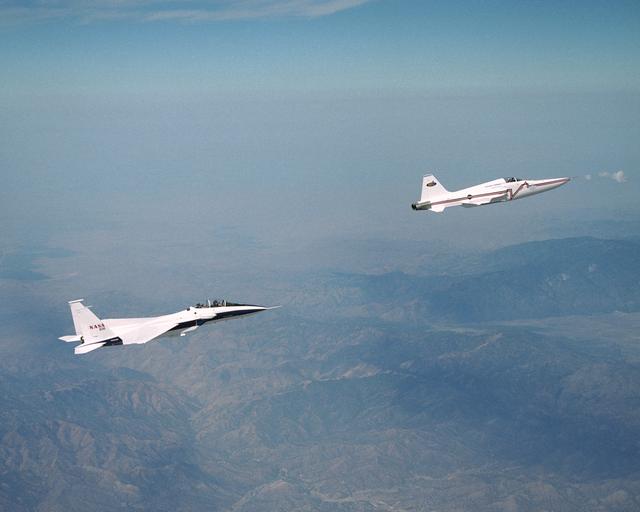
NASA's F-15B research testbed jet from the NASA Dryden Flight Research Center flew in the supersonic shockwave of a Northrop Grumman Corp. modified F-5E in support of the Shaped Sonic Boom Demonstration (SSBD) project, which is part of the…
NASA's F-15B research testbed jet from the NASA Dryden Flight Research Center flew in the supersonic shockwave of a Northrop Grumman Corp. modified F-5E in support of the Shaped Sonic Boom Demonstration (SSBD) project, which is part of DARPA's Quiet Supers
NASA's F-15B research testbed jet from NASA's Dryden Flight Research Center flew in the supersonic shockwave of a Northrop Grumman Corp. modified U.S. Navy F-5E jet in support of the Shaped Sonic Boom Demonstration (SSBD) project, which is…
NASA's F-15B from the Dryden Flight Research Center flew in the supersonic shockwave of a modified U.S. Navy F-5E jet in support of the Shaped Sonic Boom Demonstration (SSBD) project. On Aug. 27, 2003, the F-5 SSBD aircraft demonstrated a method to reduce
Northrop-Grumman Corporation's modified U.S. Navy F-5E Shaped Sonic Boom Demonstration (SSBD) aircraft.
Northrop-Grumman Corporation's modified U.S. Navy F-5E Shaped Sonic Boom Demonstration (SSBD) aircraft
NASA's F-15B Research Testbed aircraft recently flew in the supersonic shock wave of a U.S. Navy F-5E in support of the F-5 Shaped Sonic Boom Demonstration (SSBD) project, part of the Defense Advanced Research Projects Agency's (DARPA) Quie…
NASA's F-15B Research Testbed aircraft flies in the supersonic shock wave of a U.S. Navy F-5E as part of the F-5 Shaped Sonic Boom Demonstration (SSBD) project.
Steve Howe, former director of the Center for Space Nuclear Research at the Idaho National Laboratory, left, NASA Deputy Administrator Pam Melroy, center, and Stefanie Tompkins, director of the Defense Advance Research Projects Agency (DARP…
NASA and DARPA Collaboration on Rocket Propulsion Technology Ann
NASA Deputy Administrator Pam Melroy, left, and Stefanie Tompkins, director of the Defense Advance Research Projects Agency (DARPA), right, are seen during a fireside chat announcing a new collaboration on nuclear thermal propulsion at the…
NASA and DARPA Collaboration on Rocket Propulsion Technology Ann
Steve Howe, former director of the Center for Space Nuclear Research at the Idaho National Laboratory, left, NASA Deputy Administrator Pam Melroy, center, and Stefanie Tompkins, director of the Defense Advance Research Projects Agency (DARP…
NASA and DARPA Collaboration on Rocket Propulsion Technology Ann
NASA's F-15B Research Testbed aircraft recently flew in the supersonic shock wave of a U.S. Navy F-5E in support of the F-5 Shaped Sonic Boom Demonstration (SSBD) project, part of the Defense Advanced Research Projects Agency's (DARPA) Quie…
NASA's F-15B Research Testbed aircraft flies in the supersonic shock wave of a U.S. Navy F-5E as part of the F-5 Shaped Sonic Boom Demonstration (SSBD) project.
This photo shows the X-29 during a 1991 research flight. Smoke generators in the nose of the aircraft were used to help researchers see the behavior of the air flowing over the aircraft. The smoke here is demonstrating forebody vortex flow.…
X-29 at High Angle of Attack with Smoke Generators
Panels participants, from left, Dr. John P. Holdren, Assistant to the President for Science and Technology and Director of the White House Office of Science & Technology Policy, former White House Science Fair participant Joey Hudy, Environ…
State of STEM (SoSTEM) Address
The second X-45A Unmanned Combat Air Vehicle (UCAV) technology demonstrator completed its first flight on November 21, 2002, after taking off from a dry lakebed at NASA's Dryden Flight Research Center, Edwards Air Force Base, California.  X…
The second X-45A Unmanned Combat Air Vehicle (UCAV) technology demonstrator aircraft during its maiden flight. The flight marks another milestone for the UCAV program, and verified the aircraft's flight control software
The first X-45A Unmanned Combat Air Vehicle (UCAV) technology demonstrator completed its sixth flight on Dec. 19, 2002, raising its landing gear in flight for the first time. The X-45A flew for 40 minutes and reached an airspeed of 195 knot…
X-45A in flight with F-18 #846 chase aircraft, during first GPS-guided weapon demonstration flight
The DARPA/U.S. Air Force X-45A Unmanned Combat Air Vehicle (UCAV) system demonstration program completed the first phase of demonstrations, known as Block I, on Feb. 28, 2003. The final Block I activities included two flights at Dryden, dur…
X-45A Air Vehicle #1 during flight #13, with weapons bay door open
In a role-reversal, Northrop Grumman Corp.'s modified F-5E Shaped Sonic Boom Demonstration (SSBD) aircraft flies off the wing of NASA's F-15B Research testbed aircraft. The F-15B, from NASA's Dryden Flight Research Center, flew in the super…
Northrop Grumman Corp.'s modified F-5E Shaped Sonic Boom Demonstration (SSBD) aircraft flies off the wing of NASA's F-15B Research testbed aircraft.
The DARPA/U.S. Air Force X-45A Unmanned Combat Air Vehicle (UCAV) system demonstration program completed the first phase of demonstrations, known as Block I, on Feb. 28, 2003. The final Block I activities included two flights at Dryden, dur…
X-45A Air Vehicle #1 during flight #13, with weapons bay door open
An artists concept of the Demonstration Rocket for Agile Cislunar Operations, or DRACO, spacecraft is seen on a screen during a fireside chat announcing a new collaboration on nuclear thermal propulsion at the American Institute of Aeronaut…
NASA and DARPA Collaboration on Rocket Propulsion Technology Ann
Northrop Grumman Corporation's modified U.S. Navy F-5E Shaped Sonic Boom Demonstration (SSBD) aircraft flies over Lake Isabella, California on Aug. 4, 2003. NASA Dryden provided range, air and ground data-gathering support for the SSBD proj…
Northrop Grumman Corporation's modified U.S. Navy F-5E Shaped Sonic Boom Demonstration (SSBD) aircraft flies over Lake Isabella, Calif., on Aug. 4, 2003
Defense Advanced Research Projects Agency  (DARPA) Gill Pratt speaks at the annual White House State of Science, Technology, Engineering, and Math (SoSTEM) address, Wednesday, Jan. 29, 2014, in the South Court Auditorium in the Eisenhower E…
State of STEM (SoSTEM) Address
An artists concept of the Demonstration Rocket for Agile Cislunar Operations, or DRACO, spacecraft is seen on a screen as Steve Howe, former director of the Center for Space Nuclear Research at the Idaho National Laboratory, left, NASA Depu…
NASA and DARPA Collaboration on Rocket Propulsion Technology Ann
NASA Deputy Administrator Pam Melroy, left, and Stefanie Tompkins, director of the Defense Advance Research Projects Agency (DARPA), right, are seen during a fireside chat announcing a new collaboration on nuclear thermal propulsion at the…
NASA and DARPA Collaboration on Rocket Propulsion Technology Ann
Steve Howe, former director of the Center for Space Nuclear Research at the Idaho National Laboratory, left, NASA Deputy Administrator Pam Melroy, center, and Stefanie Tompkins, director of the Defense Advance Research Projects Agency (DARP…
NASA and DARPA Collaboration on Rocket Propulsion Technology Ann
Because the number two X-29 at NASA's Ames-Dryden Flight Research Facility (later the Dryden Flight Research Center) flew at higher angles of attack than the number one aircraft, it required a spin chute system for safety. The system deploy…
X-29 Number Two in Flight Closeup of Spin Chute Mechanism
The second X-45A Unmanned Combat Air Vehicle (UCAV) technology demonstrator completed its first flight on November 21, 2002, after taking off from a dry lakebed at NASA's Dryden Flight Research Center, Edwards Air Force Base, California.  X…
The second X-45A Unmanned Combat Air Vehicle (UCAV) technology demonstrator aircraft during its maiden flight. The flight marks another milestone for the UCAV program, and verified the aircraft's flight control software
The DARPA/U.S. Air Force X-45A Unmanned Combat Air Vehicle (UCAV) system demonstration program completed the first phase of demonstrations, known as Block I, on Feb. 28, 2003. The final Block I activities included two flights at Dryden, dur…
X-45A Air Vehicle #1 during flight #13, with weapons bay door open
NASA's F-15B research testbed jet from NASA's Dryden Flight Research Center flew in the supersonic shockwave of a Northrop Grumman Corp. modified U.S. Navy F-5E jet in support of the Shaped Sonic Boom Demonstration (SSBD) project, which is…
NASA's F-15B research testbed jet flew in the supersonic shockwave of a Northrop Grumman Corp. - modified U.S. Navy F-5E jet in support of the Shaped Sonic Boom Demonstration project.
Northrop Grumman Corporation's modified U.S. Navy F-5E Shaped Sonic Boom Demonstration (SSBD) aircraft flies over the company's Palmdale, California facilities on Aug. 2, 2003. NASA Dryden provided range, air and ground data-gathering suppo…
Northrop Grumman Corporation's modified U.S. Navy F-5E Shaped Sonic Boom Demonstration (SSBD) aircraft flies over the company's Palmdale, Calif. facilities on Aug. 2, 2003
NASA Deputy Administrator Pam Melroy answers a question during a fireside chat announcing a new collaboration on nuclear thermal propulsion at the American Institute of Aeronautics and Astronautics SciTech Forum, Tuesday, Jan. 24, 2023, at…
NASA and DARPA Collaboration on Rocket Propulsion Technology Ann
Stefanie Tompkins, director of the Defense Advance Research Projects Agency (DARPA), right, answers a question alongside Steve Howe, former director of the Center for Space Nuclear Research at the Idaho National Laboratory, left, NASA Deput…
NASA and DARPA Collaboration on Rocket Propulsion Technology Ann
Stefanie Tompkins, director of the Defense Advance Research Projects Agency (DARPA), is seen during a fireside chat announcing a new collaboration on nuclear thermal propulsion at the American Institute of Aeronautics and Astronautics SciTe…
NASA and DARPA Collaboration on Rocket Propulsion Technology Ann
NASA Administrator Bill Nelson delivers opening remarks during a fireside chat announcing a new collaboration on nuclear thermal propulsion at the American Institute of Aeronautics and Astronautics SciTech Forum, Tuesday, Jan. 24, 2023, at…
NASA and DARPA Collaboration on Rocket Propulsion Technology Ann
Panels participants, from left, Dr. John P. Holdren, Assistant to the President for Science and Technology and Director of the White House Office of Science & Technology Policy, former White House Science Fair participant Joey Hudy, Environ…
State of STEM (SoSTEM) Address
No more images