This photograph shows the last face on view of the Great Dark Spot that Voyager will make with the narrow angle camera. The image was shuttered 45 hours before closest approach at a distance of 2.8 million kilometers (1.7 million miles). Th…
Neptune Great Dark Spot in High Resolution
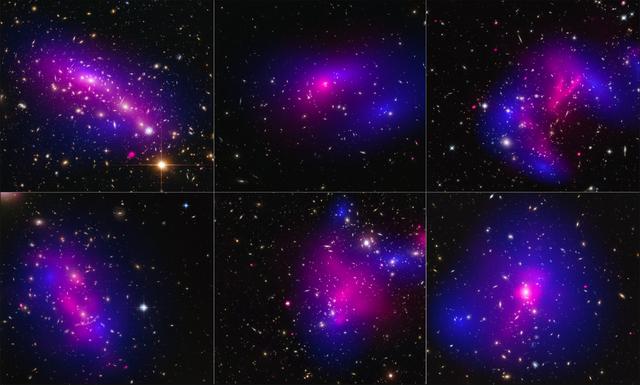
Using observations from NASA’s Hubble Space Telescope and Chandra X-ray Observatory, astronomers have found that dark matter does not slow down when colliding with itself, meaning it interacts with itself less than previously thought. Resea…
NASA Find Clues that May Help Identify Dark Matter
This new NASA/ESA Hubble Space Telescope image shows a variety of intriguing cosmic phenomena.  Surrounded by bright stars, towards the upper middle of the frame we see a small young stellar object (YSO) known as SSTC2D J033038.2+303212. Lo…
Hubble Looks at Light and Dark in the Universe
Image acquired October 30, 2012  Scientists watched the Arctic with particular interest in the summer of 2012, when Arctic sea ice set a new record low. The behavior of sea ice following such a low extent also interests scientists, but as A…
Monitoring the Arctic during Polar Darkness
STS-38 Atlantis, Orbiter Vehicle (OV) 104, lifts off from Kennedy Space Center (KSC) Launch Complex (LC) Pad at 6:48:15:0639 pm (Eastern Standard Time (EST)) for Department of Defense (DOD)-devoted mission. OV-104, atop the external tank (E…
STS-38 Atlantis, OV-104, lifts off from KSC LC Pad during night launch
Spotlights illuminate Atlantis, Orbiter Vehicle (OV) 104, during safing operations at the Kennedy Space Center's (KSC's) Shuttle Landing Facility (SLF). OV-104 parked on runway 33 is serviced by KSC ground crews. STS-38, a Department of Def…
STS-38 Atlantis, OV-104, during safing operations after KSC SLF landing
These images show the presence of dark matter in the same region of sky, created using data from NASA’s Webb telescope in 2026 (right) and from the Hubble Space Telescope in 2007 (left). Webb’s higher resolution is providing new insights in…
Dark Matter Revealed in Webb, Hubble Observations
This picture of Neptune was produced from the last whole planet images taken through the green and orange filters on NASA's Voyager 2 narrow angle camera. The images were taken at a range of 4.4 million miles from the planet, 4 days and 20…
PIA01492
This shining disk of a spiral galaxy sits approximately 25 million light-years away from Earth in the constellation of Sculptor. Named NGC 24, the galaxy was discovered by British astronomer William Herschel in 1785, and measures some 40,00…
Hubble Explores the Hidden Dark Side of a Spiral Galaxy
NASA image acquired October 28, 2012  <b>For the latest info from NASA on Hurricane Sandy go to: <a href="http://1.usa.gov/Ti5SgS" rel="nofollow">1.usa.gov/Ti5SgS</a></b>  This image of Hurricane Sandy was acquired by the Visible Infrared I…
Hurricane Sandy Viewed in the Dark of Night
STS-26 Discovery, Orbiter Vehicle (OV) 103, mated with the external tank (ET) and solid rocket boosters (SRBs), is framed by Kennedy Space Center's (KSC's) vehicle assembly building (VAB) doorway as it rolled out. This high angle view shows…
STS-26 Discovery, OV-103, rolls out of KSC VAB into darkness of the night
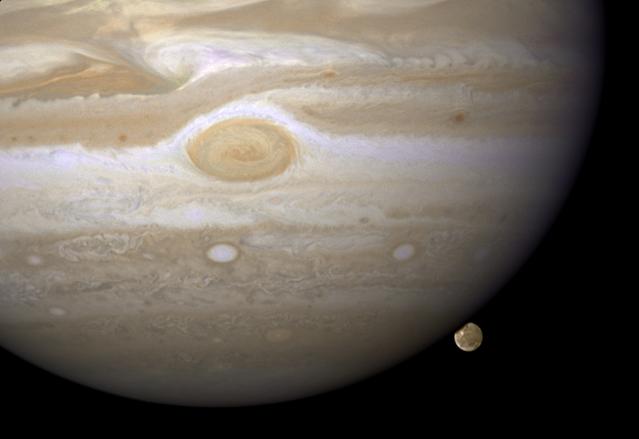
Hubble Catches Jupiter's Largest Moon Going to the 'Dark Side'  HST/WFPC2 Image of Jupiter and Ganymede Taken April 9, 2007  NASA's Hubble Space Telescope has caught Jupiter's moon Ganymede playing a game of &quot;peek-a-boo.&quot; In this…
Hubble Catches Jupiter's Largest Moon Going to the 'Dark Side'
Monitors show the status of NASA's Deep Space Network ahead of the Mars InSight landing, Monday, Nov. 26, 2018 at NASA's Jet Propulsion Laboratory in Pasadena, California.  InSight, short for Interior Exploration using Seismic Investigation…
Mars InSight Pre-Landing
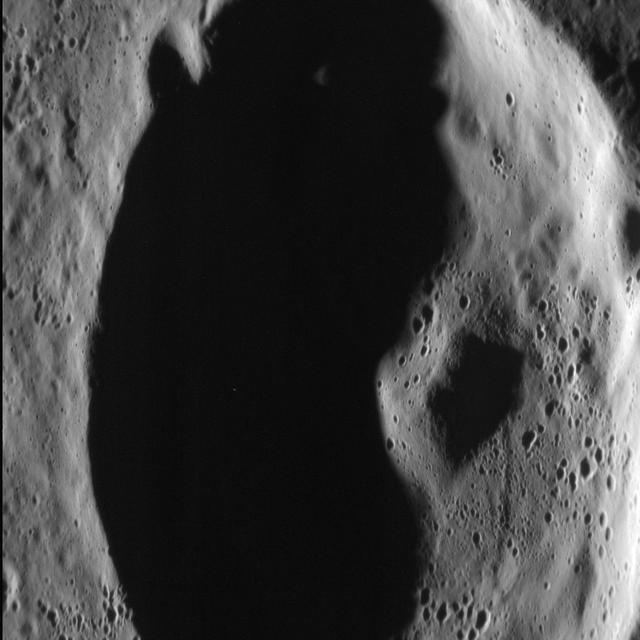
In this dramatic scene, an unnamed crater in Mercury's northern volcanic plains is bathed in darkness as the sun sits low on the horizon. Rising from the floor of the crater is its central peak, a small mountain resulting from the crater's…
Peaking Into the Dark
This image from NASA’s James Webb Space Telescope, containing nearly 800,000 galaxies, is overlaid with a map of dark matter, represented in blue. Brighter blue areas indicate a higher density of dark matter. Researchers used Webb data to f…
Webb Data Reveals Dark Matter
NASA image release March 2, 2012  This composite image shows the distribution of dark matter, galaxies, and hot gas in the core of the merging galaxy cluster Abell 520, formed from a violent collision of massive galaxy clusters. The natural…
Dark Matter Core Defies Explanation
Nighttime interior shot of the DC-8 during the transit flight to Santiago.   Credit: NASA/Michael Studinger  NASA's Operation IceBridge is an airborne science mission to study Earth's polar ice. For more information about IceBridge, visit:…
DC-8 after dark
STS-32 Columbia, Orbiter Vehicle (OV) 102, is captured as its main landing gear (MLG) touches down on runway 22 at Edwards Air Force Base (EAFB), California, in the early morning darkness. The night landing ended a record 11-day mission in…
STS-32 Columbia, OV-102, makes night landing on runway 22 at EAFB, California
STS-38 Atlantis, Orbiter Vehicle (OV) 104, lifts off from Kennedy Space Center (KSC) Launch Complex Pad at 6:46:15:0639 pm (Eastern Standard Time (EST)). As OV-104, atop the external tank (ET) and flanked by two solid rocket boosters (SRBs)…
STS-38 Atlantis, OV-104, lifting off from KSC LC Pad during night launch
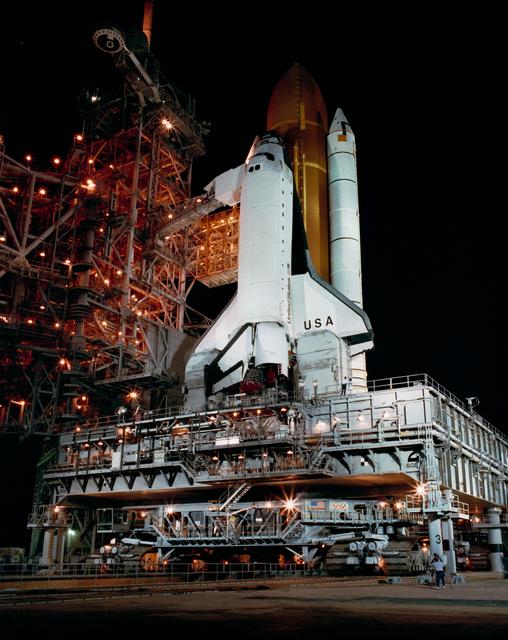
STS-28 Columbia, Orbiter Vehicle (OV) 102, arrives at Kennedy Space Center (KSC) Launch Complex (LC) Pad 39B. View taken from ground level, shows OV-102 with external tank (ET) and solid rocket boosters (SRBs) mounted atop mobile launcher p…
STS-28 Columbia, OV-102, night time processing at KSC LC Pad 39B
No more images