
This new view of the historical supernova remnant Cassiopeia A, located 11,000 light-years away, was taken by NASA Nuclear Spectroscopic Telescope Array, or NuSTAR. While the star is long dead, its remains are still bursting with action.
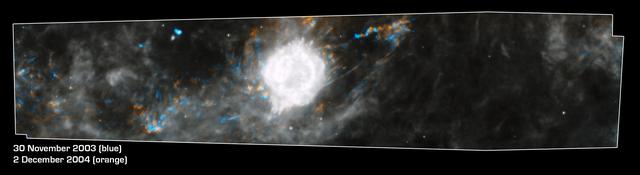
This Spitzer Space Telescope composite shows the supernova remnant Cassiopeia A white ball and surrounding clouds of dust gray, orange and blue. It consists of two processed images taken one year apart.

The elements and molecules that flew out of the Cassiopeia A star when it exploded about 300 years ago can be seen clearly for the first time in this plot of data, called a spectrum, taken by NASA Spitzer Space Telescope.

This artist concept shows that NASA Spitzer Space Telescope found evidence that this star, the remains of which are named Cassiopeia A, exploded with some degree of order, preserving chunks of its onion-like layers as it blasted apart.

This x-ray image of the Cassiopeia A (CAS A) supernova remnant is the official first light image of the Chandra X-Ray Observatory (CXO). The 5,000-second image was made with the Advanced Charged Coupled Device (CCD) Image Spectrometer (ACIS…

The colorful streamers that float across the sky in this photo taken by NASA's Hubble Space Telescope (HST) were created by the universe's biggest firecracker, the titanic supernova explosion of a massive star. The light from the exploding…

This supernova in the constellation Cassiopeia was observed by Tycho Brahe in 1572. In this x-ray image from the High Energy Astronomy Observatory (HEAO-2/Einstein Observatory produced by nearly a day of exposure time, the center region app…

These images from NASA Spitzer Space Telescope, taken one year apart, show the supernova remnant Cassiopeia A yellow ball and surrounding clouds of dust reddish orange.
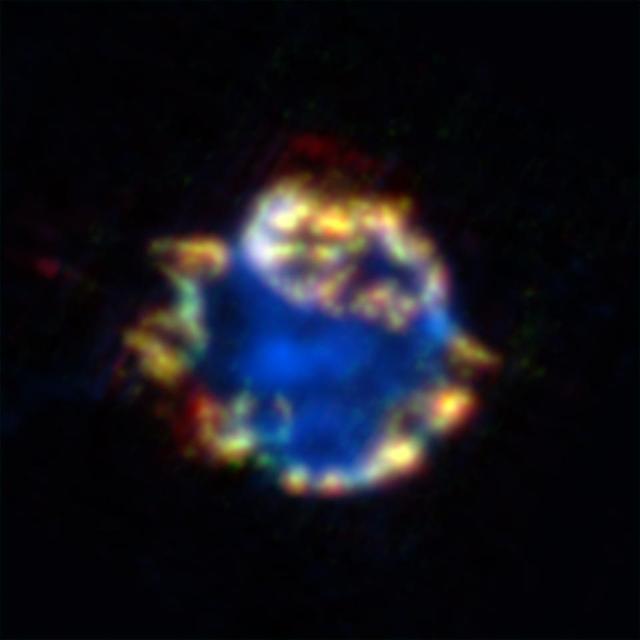
NASA Spitzer Space Telescope used its infrared camera to image this beautiful bulb which might look like a Christmas ornament but is the blown-out remains of a stellar explosion, or supernova.

The Cassiopeia A supernova first flash of radiation makes six clumps of dust circled in annotated version unusually hot. The supernova remnant is the large white ball in the center. This infrared picture was taken by NASA Spitzer Space Tele…
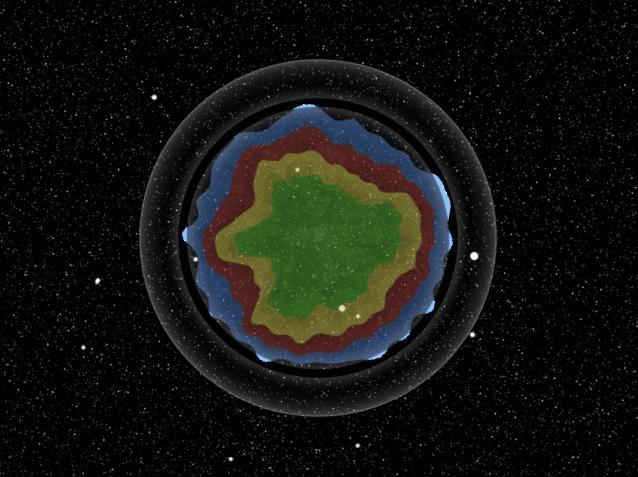
This artist concept shows the explosion of a massive star, the remains of which are named Cassiopeia A. NASA Spitzer Space Telescope found evidence that the star exploded with some degree of order.
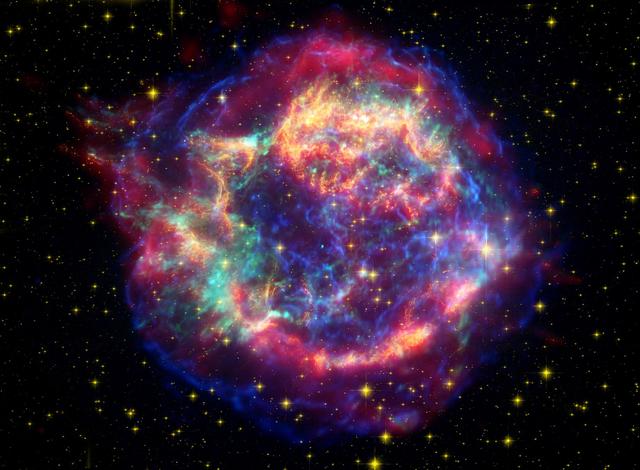
This false-color image from three of NASA Great Observatories provides one example of a star that died in a fiery supernova blast. Called Cassiopeia A, this supernova remnant is located 10,000 light-years away in the constellation Cassiopei…

This sky map shows the location of the star HD 219134 (circle), host to the nearest confirmed rocky planet found to date outside of our solar system. The star lies just off the "W" shape of the constellation Cassiopeia and can be seen with…

NASA's Fermi Closes on Source of Cosmic Rays New images from NASA's Fermi Gamma-ray Space Telescope show where supernova remnants emit radiation a billion times more energetic than visible light. The images bring astronomers a step closer…

This x-ray photograph of the Supernova remnant Cassiopeia A, taken with the High Energy Astronomy Observatory (HEAO) 2/Einstein Observatory, shows that the regions with fast moving knots of material in the expanding shell are bright and cle…
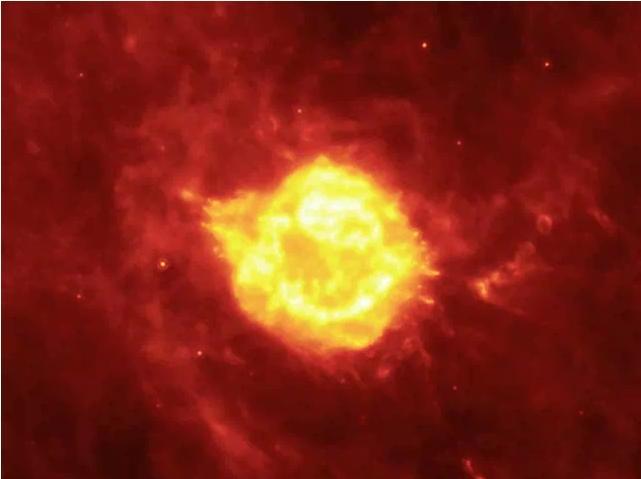
A seething cauldron of light appears to bubble and ooze around the remains of a giant star that astronomers have been watching tear itself apart for the last 300 years. Different observations taken over three years by NASA Spitzer Space Tel…

This composite image from NASA Spitzer Space Telescope shows the remnant of a star that exploded, called Cassiopeia A center and its surrounding light echoes -- dances of light through dusty clouds, created when stars blast apart.

This image from NASA Spitzer Space Telescope shows the scattered remains of an exploded star named Cassiopeia A. Spitzer infrared detectors picked through these remains and found that much of the star original layering had been preserved.
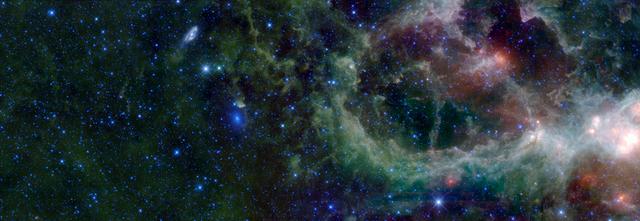
This mosaic of images from NASA WISE Telescope is in the constellation of Cassiopeia. This region contains a large star forming nebula within the Milky Way Galaxy, sometimes called the Heart Nebula, and is over 6 thousand light-years from E…

This is an extraordinary first image from the Chandra X-Ray Observatory (CXO), the supernova remnant Cassiopeia A, tracing the aftermath of a gigantic stellar explosion in such sturning detail that scientists can see evidence of what may be…

This spectacular Chandra X-Ray Observatory (CXO) image of the supernova remnant Cassiopeia A is the most detailed image ever made of the remains of an exploded star. The one-million-second image shows a bright outer ring (green) 10 light y…
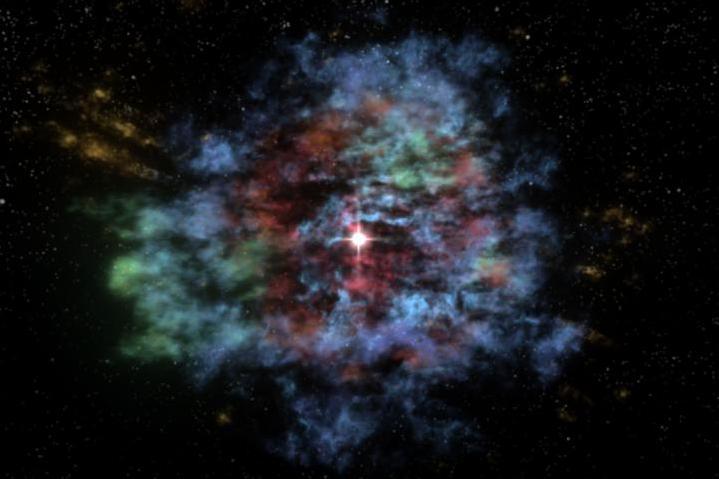
For the first time, a multiwavelength three-dimensional reconstruction of a supernova remnant has been created. This visualization of Cassiopeia A, or Cas A, the result of an explosion approximately 330 years ago, uses data from several NAS…