
This view in the southern constellation Carina was acquired on December 13, 2007 as part of the characterization tests of the Framing Camera. The cluster of stars in the center is NGC 3532, and the nebula in the lower right is the Eta Carin…

These false-color image taken by NASA Spitzer Space Telescope shows the South Pillar region of the star-forming region called the Carina Nebula.

Researchers found likely twins of the giant, erupting star Eta Carinae by comparing infrared images from NASA Spitzer Space Telescope (top) and NASA Hubble Space Telescope (bottom). Astronomers cannot yet explain what caused the titanic eru…

NASA image release April 22, 2010 Object Names: Carina Nebula, NGC 3372 Image Type: Astronomical Credit: NASA/N. Smith (University of California, Berkeley) and NOAO/AURA/NSF To read learn more about this image go to: <a href="http://www…

Carina Nebula Details: The Caterpillar Credit for Hubble Image: NASA, ESA, N. Smith (University of California, Berkeley), and The Hubble Heritage Team (STScI/AURA) Credit for CTIO Image: N. Smith (University of California, Berkeley) and N…

Cassini briefly turned its gaze from Saturn and its rings and moons to marvel at the Carina Nebula, a brilliant region 8,000 light years from our solar system and more than 200 light years across

Carina Nebula Details: Great Clouds Credit for Hubble Image: NASA, ESA, N. Smith (University of California, Berkeley), and The Hubble Heritage Team (STScI/AURA) Credit for CTIO Image: N. Smith (University of California, Berkeley) and NOAO…
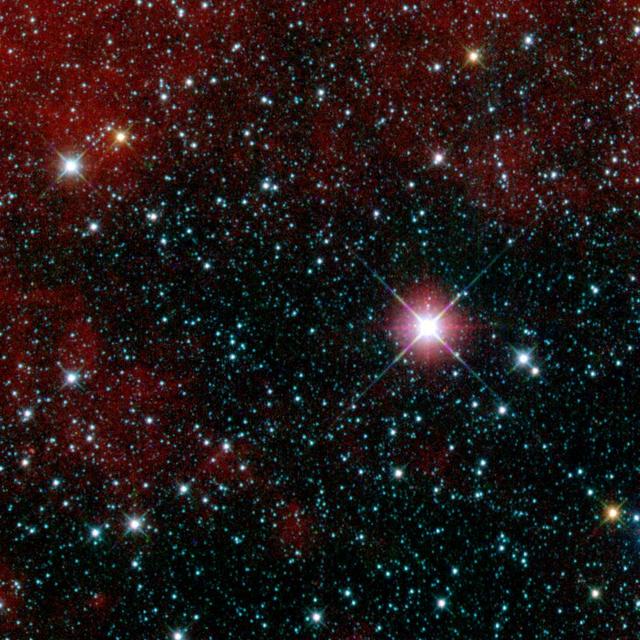
This infrared snapshot of a region in the constellation Carina near the Milky Way was taken shortly after NASA Wide-field Infrared Survey Explorer ejected its cover. The first-light picture shows thousands of stars and covers an area three…

Release Date March 30, 2010 The raised arcs, lines, dots, and other markings in this 17-by-11-inch Hubble Space Telescope image of the Carina Nebula highlight important features in the giant gas cloud, allowing visually impaired people to…

What looks much like craggy mountains on a moonlit evening is actually the edge of a nearby, young, star-forming region NGC 3324 in the Carina Nebula. Captured in infrared light by the Near-Infrared Camera (NIRCam) on NASA’s James Webb Spac…
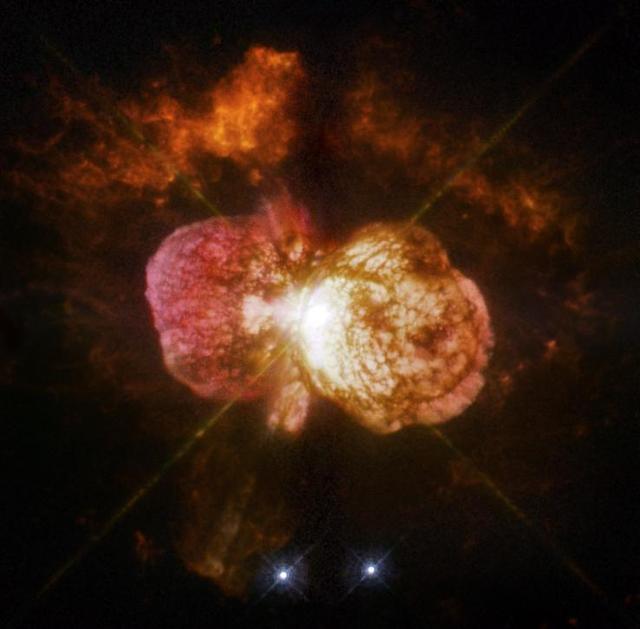
The discovery of likely Eta Carinae twins in other galaxies will help scientists better understand this brief phase in the life of a massive star with images such as this from NASA Hubble Space Telescope. Astronomers cannot yet explain what…

This Chandra X-Ray Observatory image of the mysterious superstar Eta Carinae reveals a surprising hot irner core, creating more questions than answers for astronomers. The image shows three distinct structures: An outer, horseshoe shaped ri…

This image is an x-ray view of Eta Carinae Nebula showing bright stars taken with the High Energy Astronomy Observatory (HEAO)-2/Einstein Observatory. The Eta Carinae Nebula is a large and complex cloud of gas, crisscrossed with dark lanes…

NASA image release April 22, 2010 NASA's Hubble Space Telescope captured this billowing cloud of cold interstellar gas and dust rising from a tempestuous stellar nursery located in the Carina Nebula, 7,500 light-years away in the southern…