All spinning objects, from carousels to planets, generate centripetal force. If a planet rotates too fast, that force can pull it apart. Before that happens, the planet will experience "flattening," or bulging around its midsection, as seen…
Flattening of Brown Dwarf, Jupiter and Saturn (Illustration)
This artist's concept shows an auroral display on a brown dwarf. If you could see an aurora on a brown dwarf, it would be a million times brighter than an aurora on Earth.  Credits: Chuck Carter and Gregg Hallinan/Caltech   --- Mysterious o…
Powerful Auroras Found at Brown Dwarf
Brown dwarfs are more massive than planets but not quite as massive as stars. Generally speaking, they have between 13 and 80 times the mass of Jupiter. A brown dwarf becomes a star if its core pressure gets high enough to start nuclear fus…
What is a Brown Dwarf?
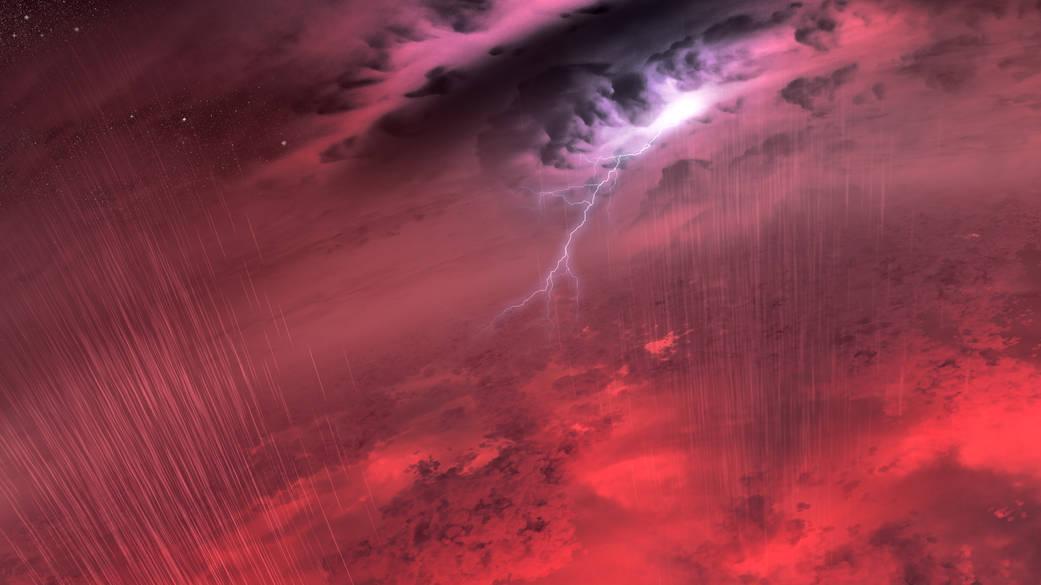
This artist's concept shows what the weather might look like on cool star-like bodies known as brown dwarfs. These giant balls of gas start out life like stars, but lack the mass to sustain nuclear fusion at their cores, and instead, fade a…
Brown Dwarf Weather (Artist's Concept)
The faster a brown dwarf spins, the narrower the different-colored atmospheric bands on it likely become, as shown in this illustration. Some brown dwarfs glow in visible light, but they are typically brightest in infrared wavelengths, whic…
A Swiftly Rotating Brown Dwarf (Illustration)
This artist's concept animation shows a brown dwarf with bands of clouds, thought to resemble those seen on Neptune and the other outer planets in the solar system.  By using NASA's Spitzer Space Telescope, astronomers have found that the v…
Brown Dwarf Weather (Artist's Concept)
JANUARY 8, 2013: Astronomers using NASA's Hubble and Spitzer space telescopes have probed the stormy atmosphere of a brown dwarf named 2MASSJ22282889-431026, creating the most detailed "weather map" yet for this class of cool, sta…
NASA Space Telescopes See Weather Patterns in Brown Dwarf
No more images