ISS040-E-089829 (8 Aug. 2014) --- The “Georges Lemaitre” Automated Transfer Vehicle (ATV-5), photographed by an Expedition 40 crew member, flies directly under the International Space Station at a distance of about 3.7 miles to test sensors…
ATV Fly-Under
ISS040-E-091918 (13 Aug. 2014) --- European Space Agency astronaut Alexander Gerst, Expedition 40 flight engineer, prepares to remove the docking mechanism to gain access to the hatch of the newly attached "Georges Lemaitre" Automated Trans…
ATV Ingress
ISS040-E-091979 (13 Aug. 2014) --- European Space Agency astronaut Alexander Gerst, Expedition 40 flight engineer, is pictured in the hatch after removing the docking mechanism of the newly-attached "Georges Lemaitre" Automated Transfer Veh…
ATV Ingress
MATERIALS ENGINEER LARRY PELHAM OF NASA’S MARSHALL SPACE FLIGHT CENTER IN HUNTSVILLE, ALABAMA, OPERATES THE CEUS AUTOMATED FIBER PLACEMENT CYLINDRICAL MANUFACTURING TOOL IN BUILDING 4707. THE TOOL WILL BE USED BY THE COMPOSITES FOR EXPLORAT…
The CEUS automated fiber placement cylindrical manufacturing tool
ISS040-E-091673 (12 Aug. 2014) --- In the Zvezda Service Module, European Space Agency astronaut Alexander Gerst (right) and Russian cosmonaut Alexander Skvortsov, both Expedition 40 flight engineers, take a brief moment for a photo during…
ATV docking ops
A NASA F/A-18 flies over the Dryden Flight Research Center and Rogers Dry Lake on December 11, 2002. The aircraft participated in the Automated Aerial Refueling (AAR) project. The 300-gallon aerial refueling store seen on the belly of the a…
EC02-0282-1
MATERIALS ENGINEER LARRY PELHAM OF NASA’S MARSHALL SPACE FLIGHT CENTER IN HUNTSVILLE, ALABAMA, OPERATES THE CEUS AUTOMATED FIBER PLACEMENT CYLINDRICAL MANUFACTURING TOOL IN BUILDING 4707. THE TOOL WILL BE USED BY THE COMPOSITES FOR EXPLORAT…
The CEUS automated fiber placement cylindrical manufacturing tool
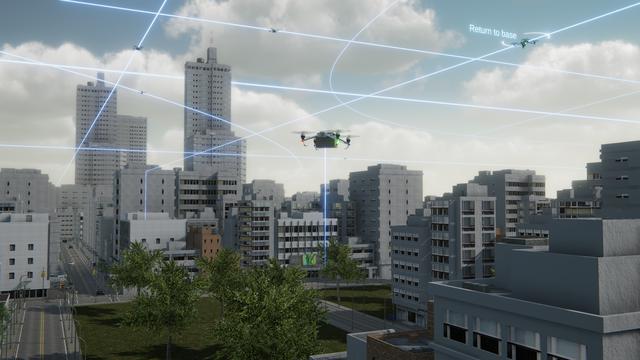
Several projects supporting NASA's Advanced Air Mobility or AAM mission are working on different elements to help make AAM a reality and one of these research areas is automation. This concept graphic shows how elements of automation could…
Advanced Air Mobility Looks Ahead to Automation
This is a photo of a technician at KES Science and Technology Inc., in Kernesaw, Georgia, assembling the AiroCide Ti02, an anthrax-killing device about the size of a small coffee table. The anthrax-killing air scrubber, AiroCide Ti02, is a…
Benefit from NASA
NASA software developer, Ethan Williams, left, pilot Scott Howe, and operations test consultant Jan Scofield run a flight path management software simulation at NASA’s Armstrong Flight Research Center in Edwards, California in May 2023. Thi…
Advanced Air Mobility National Campaign Integration of Automated Systems Simulation Test
The Exploration Research and Technology Programs at NASA’s Kennedy Space Center in Florida hosted a two-day workshop, Aug. 6 and 7, 2019, focusing on robotics and automation in space crop production. Participants from around the world and m…
Robotics and Automation and Space Crop Production Workshop
Nathan Gelino, a principal investigator with the Exploration Research and Technology programs at Kennedy Space Center in Florida, prepares a vacuum chamber for testing 3D printing inside the Granular Mechanics and Regolith Operations (GMRO)…
Relevant Environment Additive Construction Technology (REACT) Va
NASA engineer Evan Bell prepares a vacuum chamber for testing 3D printing inside the Granular Mechanics and Regolith Operations (GMRO) lab at Kennedy Space Center’s Swamp Works in Florida on April 5, 2022. The testing is part of the Relevan…
Relevant Environment Additive Construction Technology (REACT) Va
A team at NASA’s Kennedy Space Center in Florida test a 3D printer inside a vacuum chamber at the Granular Mechanics and Regolith Operations (GMRO) lab inside the spaceport’s Swamp Works, as part of the Relevant Environment Additive Constru…
Relevant Environment Additive Construction Technology (REACT) Va
ISS040-E-089820 (8 Aug. 2014) --- The “Georges Lemaitre” Automated Transfer Vehicle (ATV-5), photographed by an Expedition 40 crew member, flies directly under the International Space Station at a distance of about 3.7 miles to test sensors…
ATV Fly-Under
View of Japanese Kounotori H2 Transfer Vehicle-4 (HTV-4) docked to the International Space Station's Harmony Node 2 module. Sent as Twitter message.
HTV-4
ISS040-E-092583 (12 Aug. 2014) --- A portion of the International Space Station?s Russian segment with the newly attached "Georges Lemaitre" Automated Transfer Vehicle-5 (ATV-5) to the Zvezda Service Module is featured in this image photogr…
Supermoon setting behind ATV
A NASA F/A-18 flies over the Dryden Flight Research Center and Rogers Dry Lake on December 11, 2002. The aircraft participated in the Automated Aerial Refueling (AAR) project. The 300-gallon aerial refueling store seen on the belly of the a…
EC02-0282-5
NASA Dryden's Automated Aerial Refueling (AAR) project evaluated the capability of an F/A-18A aircraft as an in-flight refueling tanker with the objective of developing analytical models for an automated aerial refueling system for unmanned…
EC03-0293-15
A NASA F/A-18 flies over the Dryden Flight Research Center and Rogers Dry Lake on December 11, 2002. The aircraft participated in the Automated Aerial Refueling (AAR) project. The 300-gallon aerial refueling store seen on the belly of the a…
EC02-0282-3
The Stellar Automation Systems team poses for a picture with their robot after attempting the level one challenge during the 2014 NASA Centennial Challenges Sample Return Robot Challenge, Wednesday, June 11, 2014, at the Worcester Polytechn…
2014 NASA Centennial Challenges Sample Return Robot Challenge
NASA researchers James Cowart and Elizabeth Nail add sensors, wiring and cameras, to the NASA Airborne Instrumentation for Real-world Video of Urban Environments (AIRVUE) sensor pod at NASA’s Armstrong Flight Research Center in Edwards, Cal…
Airborne Instrumentation for Real-world Video of Urban Environments (AIRVUE) Sensor Pod Build at NASA Armstrong 
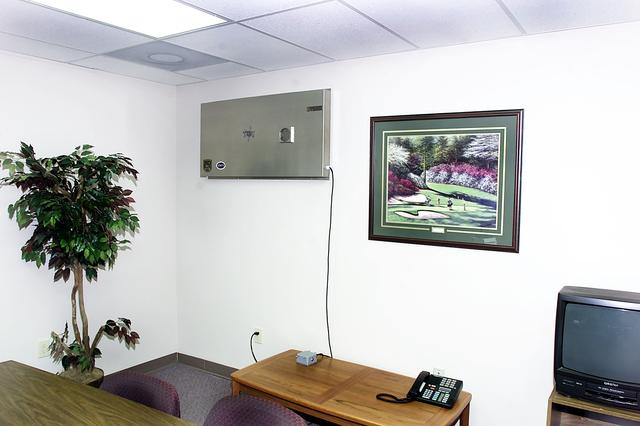
AiroCide Ti02, an anthrax-killing air scrubber manufactured by KES Science and Technology Inc., in Kernesaw, Georgia, looks like a square metal box when it is installed on an office wall. Its fans draw in airborne spores and airflow forces…
Benefit from NASA
NASA researcher A.J. Jaffe prepares the NASA Airborne Instrumentation for Real-world Video of Urban Environments (AIRVUE) sensor pod for testing at NASA’s Kennedy Space Center in Cape Canaveral, Florida in April 2024. The AIRVUE pod will be…
Airborne Instrumentation for Real-world Video of Urban Environments (AIRVUE) Sensor Pod on NASA’s Kennedy Space Center’s Helicopter
Materials engineer Thomas Lipscomb tests a 3D printer on July 28, 2022, at Swamp Works at NASA’s Kennedy Space Center in Florida, as part of the Relevant Environment Additive Construction Technology (REACT) project. Among the key objectives…
REACT Demonstration
The Exploration Research and Technology Programs at NASA’s Kennedy Space Center in Florida hosted a two-day workshop, Aug. 6 and 7, 2019, focusing on robotics and automation in space crop production. Participants from around the world and m…
Robotics and Automation and Space Crop Production Workshop
A team of engineers and researchers prepares a vacuum chamber in the Granular Mechanics and Regolith Operations (GMRO) lab inside NASA Kennedy Space Center’s Swamp Works for testing 3D printing, as part of the Relevant Environment Additive…
Relevant Environment Additive Construction Technology (REACT) Va
Joseliz Perez, a NASA intern at Kennedy Space Center in Florida, prepares a vacuum chamber for testing 3D printing inside the Granular Mechanics and Regolith Operations (GMRO) lab at the spaceport’s Swamp Works on April 5, 2022. The testing…
Relevant Environment Additive Construction Technology (REACT) Va
Chemist Nilab Azim, left, and Nathan Gelino, principal investigator with NASA’s Exploration Research and Technology programs, test a 3D printer on July 28, 2022, at Swamp Works at the agency’s Kennedy Space Center in Florida, as part of the…
REACT Demonstration
Chemist Nilab Azim, left, and Nathan Gelino, principal investigator with NASA’s Exploration Research and Technology programs, test a 3D printer on July 28, 2022, at Swamp Works at the agency’s Kennedy Space Center in Florida, as part of the…
REACT Demonstration
ISS040-E-091969 (13 Aug. 2014) --- Surrounded by stowage containers, European Space Agency astronaut Alexander Gerst, Expedition 40 flight engineer, is pictured in the newly-attached "Georges Lemaitre" Automated Transfer Vehicle-5 (ATV-5) o…
ATV Ingress
ISS040-E-092581 (12 Aug. 2014) --- A portion of the International Space Station?s Zvezda Service Module with the newly attached "Georges Lemaitre" Automated Transfer Vehicle-5 (ATV-5) is featured in this image photographed by an Expedition…
Supermoon setting behind ATV
ISS040-E-089798 (8 Aug. 2014) --- The “Georges Lemaitre” Automated Transfer Vehicle (ATV-5), photographed by an Expedition 40 crew member, flies directly under the International Space Station at a distance of about 3.7 miles to test sensors…
ATV Fly-Under
ISS040-E-091919 (13 Aug. 2014) --- European Space Agency astronaut Alexander Gerst, Expedition 40 flight engineer, prepares to remove the docking mechanism to gain access to the hatch of the newly attached "Georges Lemaitre" Automated Trans…
ATV Ingress
LAQUIETA HUEY WITH IMAGE ANALYSIS SYSTEM FOR AUTOMATED PARTICLE COUNTING.
1200270
NASA Dryden's Automated Aerial Refueling (AAR) project evaluated the capability of an F/A-18A aircraft as an in-flight refueling tanker with the objective of developing analytical models for an automated aerial refueling system for unmanned…
EC03-0293-03
ISS040-E-091688 (12 Aug. 2014) --- In the Zvezda Service Module, European Space Agency astronaut Alexander Gerst (left) and Russian cosmonaut Alexander Skvortsov, both Expedition 40 flight engineers, monitor the approach and docking of ESA?…
ATV docking ops
ISS040-E-089627 (7 Aug. 2014) --- In the International Space Station?s Zvezda Service Module, European Space Agency astronaut Alexander Gerst (foreground) and Russian cosmonaut Alexander Skvortsov, both Expedition 40 flight engineers, parti…
last ATV docking OBT
NASA Dryden's Automated Aerial Refueling (AAR) project evaluated the capability of an F/A-18A aircraft as an in-flight refueling tanker with the objective of developing analytical models for an automated aerial refueling system for unmanned…
EC03-0293-06
NASA researcher James Cowart adds the top back onto the NASA Airborne Instrumentation for Real-world Video of Urban Environments (AIRVUE) sensor pod at NASA’s Armstrong Flight Research Center in Edwards, California in late February 2024. Th…
Airborne Instrumentation for Real-world Video of Urban Environments (AIRVUE) Sensor Pod Build at NASA Armstrong 
A team at NASA’s Kennedy Space Center in Florida test a 3D printer inside a vacuum chamber at the Granular Mechanics and Regolith Operations (GMRO) lab inside the spaceport’s Swamp Works, as part of the Relevant Environment Additive Constru…
Relevant Environment Additive Construction Technology (REACT) Va
Engineer Matt Nugent prepares a vacuum chamber for testing 3D printing inside the Granular Mechanics and Regolith Operations (GMRO) lab at NASA Kennedy Space Center’s Swamp Works in Florida on April 5, 2022. The testing is part of the Relev…
Relevant Environment Additive Construction Technology (REACT) Va
A team at NASA’s Kennedy Space Center in Florida tests a 3D printer on July 28, 2022, at the Florida spaceport’s Swamp Works, as part of the Relevant Environment Additive Construction Technology (REACT) project. Among the key objectives of…
REACT Demonstration
A team of engineers and researchers prepares a vacuum chamber in the Granular Mechanics and Regolith Operations (GMRO) lab inside NASA Kennedy Space Center’s Swamp Works for testing 3D printing, as part of the Relevant Environment Additive…
Relevant Environment Additive Construction Technology (REACT) Va
NASA Internships, Fellowships, and Scholarships (NIFS) intern Leonel Herrera tests a 3D printer on July 28, 2022, at Swamp Works at NASA’s Kennedy Space Center in Florida, as part of the Relevant Environment Additive Construction Technology…
REACT Demonstration
Participants listen to presentations during a two-day workshop, Aug. 6 and 7, 2019, focusing on robotics and automation in space crop production. The workshop was hosted by the Exploration Research and Technology Programs at NASA’s Kennedy…
Robotics and Automation and Space Crop Production Workshop
A team at NASA’s Kennedy Space Center in Florida poses with a Zero Launch Mass 3D printer on July 28, 2022, at the Florida spaceport’s Swamp Works, as part of the Relevant Environment Additive Construction Technology (REACT) project. Shown…
REACT Demonstration
Thomas Lipscomb, a materials engineer at NASA’s Kennedy Space Center in Florida, prepares a vacuum chamber for testing 3D printing inside the Granular Mechanics and Regolith Operations (GMRO) lab at the spaceport’s Swamp Works on April 5, 2…
Relevant Environment Additive Construction Technology (REACT) Va