AS16-122-19580 (16-27 April 1972) --- This vertical view shows the King Crater on the lunar surface. It was exposed with color positive film in a hand-held 70mm camera onboard the Command and Service Modules during the Apollo 16 mission's 9…
Apollo 16 Mission Image - Post-TEI view of the King Crater near latitude 5.5N, longitude 120.5E.
AS16-120-19273 (April 1972) --- King Crater as photographed from the Apollo 16 spacecraft in lunar orbit.
Apollo 16 Mission image - Partly filled crater north of King.
AS16-120-19228 (16-27 April 1972) --- Strongly textured terrain north of the lunar farside King Crater which is centered near 120.5 degrees east longitude and 5.5 degrees north latitude. This near vertical oblique view eastward was photogra…
Apollo 16 Mission image - View of the north rim of the King Crater.
AS16-118-18964 (16-27 April 1972) --- This lunar farside oblique view from the Apollo 16 spacecraft in lunar orbit shows the Leonov Crater, just to the left and above the principal point of the photograph. Just beyond the horizon lies the M…
Apollo 16 Mission image - View of the Leonov Crater
S71-58148 (1 Dec. 1971) --- Astronaut Thomas K. Mattingly II, command module pilot of the planned Apollo 16 lunar landing mission, participates in extravehicular activity (EVA) simulations in the water facility tank in Building 5 at the Man…
Astronaut Thomas Mattingly participates in EVA simulation
Huntsville’s Jack Giles, Alabama State Senator (left), and Dr. Rocco Petrone, Marshall Space Flight Center Director (Middle), speak with Astronaut Owen Garriott who is inside the Apollo 16 Command Module on display at the Alabama Space and…
Around Marshall
MSFC DIRECTOR ROBERT LIGHTFOOT SPEAKS AFTER THE DEDICATION OF THE APOLLO 16 CAPSULE ON DISPLAY AT THE U.S. SPACE AND ROCKET CENTER.
1100068
The second manned lunar landing mission, Apollo 12, launched from launch pad 39-A at Kennedy Space Center in Florida on November 14, 1969 via a Saturn V launch vehicle. The Saturn V vehicle was developed by the Marshall Space Flight Center…
Saturn Apollo Program
Apollo 16 astronaut Charlie Duke, the 10th person to walk on the moon who spent 71 hours on the lunar surface, talks during a panel discussion, Monday, July 20, 2009, hosted by Nick Clooney at the Newseum in Washington as part of the commem…
Apollo 40th Newseum Panel Discussion
The sixth marned lunar landing mission, the Apollo 16 (SA-511), carrying three astronauts: Mission commander John W. Young, Command Module pilot Thomas K. Mattingly II, and Lunar Module pilot Charles M. Duke, lifted off on April 16, 1972. T…
Saturn Apollo Program
Veteran journalist Nick Clooney, seated left back to camera, moderated a panel discussion with Apollo 11 astronaut Buzz Aldrin, far right, Charlie Duke of Apollo 16, John Grunsfeld, of the recent Hubble mission, not seen and Goddard Space F…
Apollo 40th Newseum Panel Discussion
AS16-106-17413 (23 April 1972) --- Astronaut John W. Young, commander of the Apollo 16 lunar landing mission, looks over a large boulder at Station No.13 during the third Apollo 16 extravehicular activity (EVA) at the Descartes landing site…
Astronaut John Young looks over a boulder at Station no. 13 during EVA
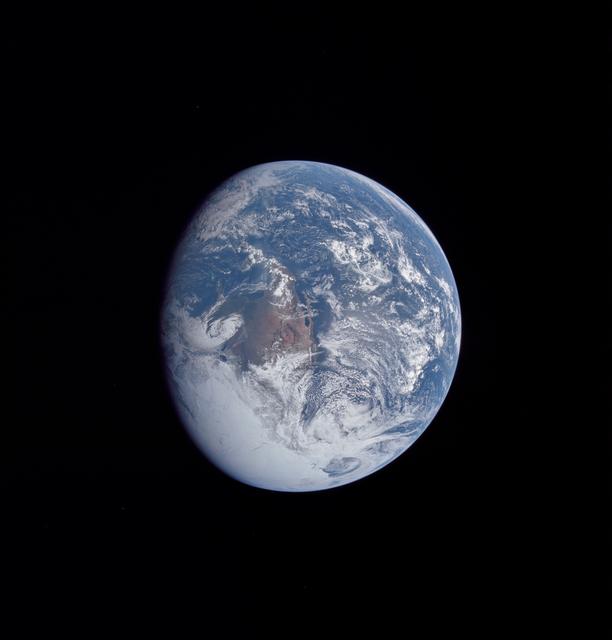
AS16-118-18885 (16 April 1972) --- A good view of Earth photographed about one and one-half hours after trans-lunar injection on April 16, 1972. Although there is much cloud cover, the United States in large part, most of Mexico and some pa…
Apollo 16 view of the earth from translunar injection
AS16-121-19407 (April 1972) --- An oblique view of a rim of Guyot Crater on the lunar farside, as photographed from the Apollo 16 spacecraft in lunar orbit. The coordinates of the center of Guyot Crater are 116.5 degrees east longitude and…
Oblique view of rim of Guyot crater on lunar farside as seen by Apollo 16
AS16-113-18282 (23 April 1972) --- The Apollo Command and Service Modules (CSM) "Casper" approaches the Lunar Module (LM) "Orion", from which this photograph was made. The two spacecraft are about to make their final rendezvous of the missi…
View of the Apollo 16 Command/Service Module from the Lunar module in orbit
AS16-122-19527 (23 April 1972) --- The Apollo 16 Lunar Module (LM) ascent stage, with astronauts John W. Young and Charles M. Duke Jr. aboard, returns from the lunar surface to rejoin the Command and Service Modules (CSM) in lunar orbit. As…
Apollo 16 Mission image - View of the Schubert B Crater during LM Rendezvous.
AS16-113-18289 (16-27 April 1972) --- Earth rises over the lunar horizon, with the Apollo 16 Command and Services Modules (CSM) to the left of Earth. This photograph was taken from the Lunar Module (LM) "Orion" before the two Apollo 16 spac…
Apollo 16 Mission image - Earth rises over the lunar horizon, with the Apollo 16 Command and Services Modules (CSM) to the left of the Earth.
AS16-119-19161 (16-27 April 1972) --- The prominent rille feature running through the area is Herigonius I. The coordinates for the center of the area pictured are 14.7 degrees south latitude and 36.4 degrees west longitude. The photo was t…
as16-119-19161
AS16-114-18421 (16-27 April 1972) --- This picture of the lunar surface was photographed by astronaut John W. Young during Apollo 16's first extravehicular activity (EVA) at EVA Station No 1. The instrument near the small crater's edge (for…
Apollo 16 Mission image - Panoramic view of Station 1
S71-56246 (November 1971) --- The Apollo 16 crew patch is dominated by an eagle perched atop a red, white and blue shield a superimposed on a lunar scene, surrounded by a blue circle of 16 stars with the crew's surnames completing the botto…
Apollo 16 insignia
The Apollo 16 crew patch is dominated by an eagle perched atop a red, white, and blue shield superimposed on a lunar surface scene. Similar to that on the NASA agency shield and insignia, there is a gold symbol of flight outlined in blue ac…
Saturn Apollo Program
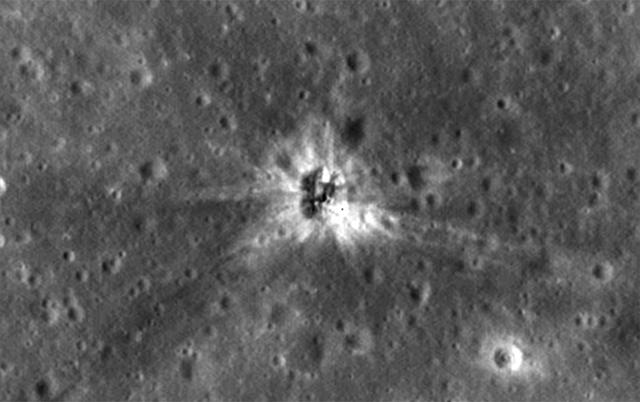
After decades of uncertainty, the Apollo 16 S-IVB impact site on the lunar surface has been identified. S-IVBs were portions of the Saturn V rockets that brought astronauts to the moon. The site was identified in imagery from the high-resol…
LRO Finds Apollo 16 Booster Rocket Impact Site
The Lunar Roving Vehicle (LRV) was designed to transport astronauts and materials on the Moon. An LRV was used on each of the last three Apollo missions; Apollo 15, Apollo 16, and Apollo 17, in 1971 and 1972, to permit the crew to travel se…
Saturn Apollo Program
Apollo 16 astronaut Charlie Duke, the 10th person to walk on the moon who spent 71 hours on the lunar surface, talks during a panel discussion, Monday, July 20, 2009, hosted by Nick Clooney at the Newseum in Washington as part of the commem…
Apollo 40th Newseum Panel Discussion
The sixth manned lunar landing mission, the Apollo 16 (SA-511), carrying three astronauts: Mission Commander John W. Young, Command Module pilot Thomas K. Mattingly II, and Lunar Module pilot Charles M. Duke, lifted off on April 16, 1972. T…
Saturn Apollo Program
Apollo astronaut Alan Bean, center, laughs at a comment made by Apollo astronaut Charles Duke, right, as Apollo astronaut Buzz Aldrin, left, looks on during a live television interview on Monday, July 20, 2009, at NASA Headquarters in Washi…
Apollo 40th Anniversary Morning Television
Veteran journalist Nick Clooney, seated left back to camera, moderated a panel discussion with Apollo 11 astronaut Buzz Aldrin, far right, Charlie Duke of Apollo 16, John Grunsfeld, of the recent Hubble mission, not seen, and Goddard Space…
Apollo 40th Newseum Panel Discussion
A closeup view or "mug shot" of Apollo 16 lunar sample no. 68815, a dislodged fragment from a parent boulder roughly four feet high and five feet long encountered at Station 8. The crew tried in vain to overturn the parent boulder. A fillet…
View of Apollo 16 lunar sample no. 68815
AS16-113-18347 (21 April 1972) --- A partial view of the Apollo 16 Apollo Lunar Surface Experiments Package (ALSEP) in deployed configuration on the lunar surface as photographed during the mission's first extravehicular activity (EVA), on…
Partial view of the deployed Apollo Lunar Surface Experiments Package
AS16-118-18873 (16 April 1972) --- A good view of Earth photographed shortly after trans-lunar injection of April 16, 1972. Although there is much cloud cover (over Canada and the oceans), the United States in large part, most of Mexico and…
Apollo 16 view of the earth from translunar injection
AS16-114-18388 (21 April 1972) --- Astronaut John W. Young, commander of the Apollo 16 lunar landing mission, stands at the Apollo Lunar Surface Experiments Package (ALSEP) deployment site during the first Apollo 16 extravehicular activity…
Astronaut John Young stands at ALSEP deployment site during first EVA
AS16-118-18947 (16-27 April 1972) --- A 250mm view looking north by westward across lunar farside highland terrain, as photographed from the Apollo 16 spacecraft in lunar orbit. The frame is centered at approximately 158 degrees east longit…
Apollo 16 Mission image - View of the Van Gent and Nagaoka Craters
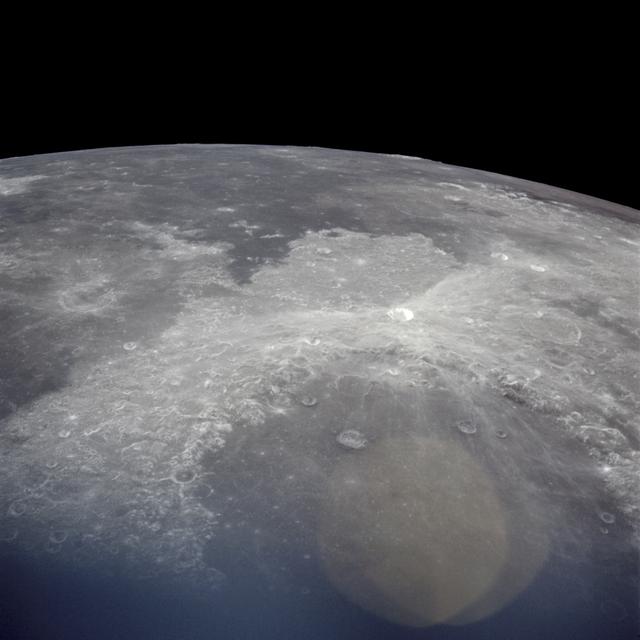
AS16-121-19438 (April 1972) --- An oblique view of a portion of the lunar nearside as photographed from the Apollo 16 spacecraft in lunar orbit, looking across the Sea of Crises southwesterly into the Sea of Tranquility. The conspicuous, br…
Apollo 16 Mission image - View of the Seas of Serenity, Crisis and Tranquility.
AS16-120-19242 (16-27 April 1972) --- This 70mm handheld camera's view of the moon, photographed during the Apollo 16 mission's lunar orbit, features Crater Bullialdus, located at approximately 20 degrees south latitude and 20.8 west longit…
Apollo 16 Mission image - 70mm handheld camera view of the moon featuring the Bullialdus Crater.
THE APOLLO 16 CAPSULE SITS ON DISPLAY IN THE FOREGROUND OF AN EVENT AT THE DAVIDSON CENTER.
1100071
This is the Apollo 16 lunar landing mission crew portrait. Pictured from left to right are: Thomas K. Mattingly II, Command Module pilot; John W. Young, Mission Commander; and Charles M. Duke Jr., Lunar Module pilot. Launched from the Kenne…
Saturn Apollo Program
This view of the back side of the Moon was captured by the Apollo 16 mission crew. The sixth manned lunar landing mission, the Apollo 16 (SA-511), carrying three astronauts: Mission Commander John W. Young, Command Module pilot Thomas K. Ma…
Saturn Apollo Program
MSFC DIRECTOR ROBERT LIGHTFOOT SPEAKS WITH THE APOLLO 16 CAPSULE AS A BACKDROP AT THE U.S. SPACE AND ROCKET CENTER.
1100073
The Lunar Roving Vehicle (LRV) was designed by Marshall Space Flight Center to transport astronauts and materials on the Moon. An LRV was used on each of the last three Apollo missions; Apollo 15, Apollo 16, and Apollo 17, in 1971 and 1972,…
Saturn Apollo Program
This montage depicts the flight crew patches for the manned Apollo 7 thru Apollo 17 missions.  The Apollo 7 through 10 missions were basically manned test flights that paved the way for lunar landing missions. Primary objectives met include…
Saturn Apollo Program
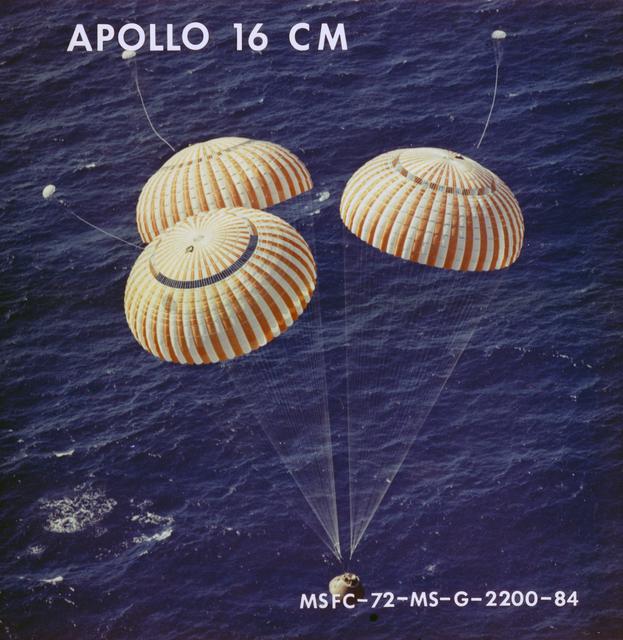
The Apollo 16 Command Module splashed down in the Pacific Ocean on April 27, 1972 after an 11-day moon exploration mission. The 3-man crew is shown here aboard the rescue ship, USS Horton. From left to right are: Mission Commander John W. Y…
n/a
The Apollo 16 Command Module splashed down in the Pacific Ocean on April 27, 1972 after an 11-day moon exploration mission. The sixth manned lunar landing mission, the Apollo 16 (SA-511), carrying three astronauts: Mission Commander John W.…
Saturn Apollo Program
Apollo 11 astronaut Buzz Aldrin, the second man to walk on the Moon, seated left, responds to a question during a live television interview on Monday, July 20, 2009, at NASA Headquarters in Washington as Apollo 12 astronaut Alan Bean and Ap…
Apollo 40th Anniversary Morning Television
AS16-113-18334 (21 April 1972) --- View of the Lunar Module (LM) "Orion" parked on the lunar surface. During their post mission press conference, the Apollo 16 crewmembers called attention to the steerable S-band antenna, which was "frozen"…
View of the Apollo 16 Lunar Module on the lunar surface
AS16-118-18880 (16 April 1972) --- A good view of Earth photographed about one hour after trans-lunar injection on April 16, 1972. Although there is much cloud cover, the United States in large part, most of Mexico and some of Central Ameri…
Apollo 16 view of the earth from translunar injection
AS16-117-18728 (23 April 1972) --- Astronaut Charles M. Duke Jr., lunar module pilot, exposed this view of the huge "Shadow Rock" with his 70mm Hasselblad camera during the mission's third and final extravehicular activity (EVA), on April 2…
View of "Shadow Rock" taken during third extravehicular activity
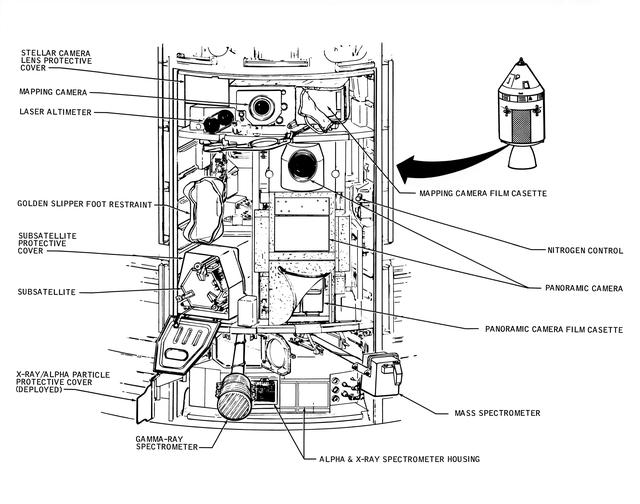
A line drawing illustrating the layout of the Scietific Instrument Module (SIM) of the Apollo 16 Service Module. Shown here is the location in the SIM bay of the equipment for each orbital experiment. Arrows point to various components of t…
Line drawing of layout of Scietific Instrument Module of Apollo 16
AS16-116-18649 (23 April 1972) --- Astronaut Charles M. Duke Jr., lunar module pilot of the Apollo 16 lunar landing mission, examines closely the surface of a large boulder at North Ray Crater during the third Apollo 16 extravehicular activ…
Astronaut Charles Duke examines surface of boulder at North Ray crater