David Bushman, unmanned aerial vehicle (UAV) mission manager in NASA Dryden's Airborne Science Program, explains the capabilities of the Altus UAV to Charles Hudgins of NASA Langley's Chemistry and Dynamics Branch.
Dryden's David Bushman explains the capabilities of the Altus UAV to NASA Langley's Charles Hudgins
The airborne Lunar Spectral Irradiance (air-LUSI) instrument is moved across the hangar floor by robotic engineer Alexander McCafferty-Leroux ,from right to left, co-investigator Dr. John Woodward, NIST astronomer Dr. Susana Deustua, air-LU…
Team moves air-LUSI instrument
Martin Hench, flight systems engineer, checks the communications system onboard the G-IV aircraft as it prepares to depart NASA’s Armstrong Flight Research Center in Edwards, California, on March 18, 2025. As the newest member of NASA Armst…
Headline: NASA G-IV Prepares for Flight
The G-IV aircraft lifts off from NASA’s Armstrong Flight Research Center in Edwards, California, on March 18, 2025. As the newest member of NASA Armstrong’s airborne science fleet, the G-IV was sent to Avenger Aerospace Solutions in Carters…
Headline: G-IV Takes Flight
The ER-2 ground crew Wissam Habbal, left, and Dr. Kevin Turpie, airborne Lunar Spectral Irradiance (air-LUSI) principal investigator, guide delicate fiber optic and electric cabling into place while uploading the air-LUSI instrument onto th…
ER-2 Crew Installs air-LUSI Moongazing Instrument
The DC-8 is shown overhead during its final flight from NASA’s Armstrong Flight Research Center Building 703 in Palmdale, California, before it retires to Idaho State University in Pocatello, Idaho. The DC-8 will provide real-world experien…
NASA’s DC-8 Conducts Final Flight
The DC-8 flies for the last time from NASA’s Armstrong Flight Research Center Building 703 in Palmdale, California, to Idaho State University in Pocatello, Idaho. The DC-8 will provide real-world experience to train future aircraft technici…
NASA’s DC-8 Conducts Final Flight
The DC-8 flies low for the last time over NASA’s Armstrong Flight Research Center in Edwards, California, before it retires to Idaho State University in Pocatello, Idaho. The DC-8 will provide real-world experience to train future aircraft…
NASA Bids Farewell to DC-8
DC-8 aircraft conducts test flights at Building 703 in Palmdale, CA.
The DC-8 aircraft is prepared for its last mission, ASIA-AQ (Airborne and Satellite Investigation of Asian Air Quality), that will collect detailed air quality data over s…
NASA’s DC-8 Aircraft is Prepared for an International Air Quality Research Mission
The DC-8 flies for the last time from NASA’s Armstrong Flight Research Center Building 703 in Palmdale, California, before it retires to Idaho State University in Pocatello, Idaho. The DC-8 will provide real-world experience to train future…
NASA’s DC-8 Flies for Last Time
NASA Armstrong’s Student Airborne Research Program celebrates 15 years of success in 2023.  An eight-week summer internship program, SARP offers upper-level undergraduate students the opportunity to acquire hands-on research experience as p…
SARP 2023
NASA Armstrong’s Student Airborne Research Program celebrates 15 years of success in 2023.  An eight-week summer internship program, SARP offers upper-level undergraduate students the opportunity to acquire hands-on research experience as p…
SARP 2023
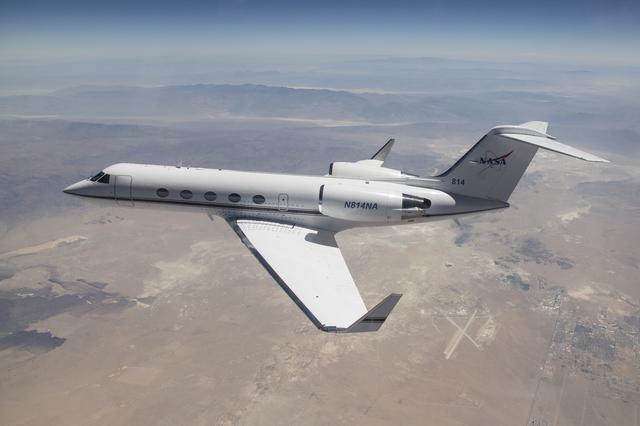
In a series of baseline flights beginning on June 24, 2024, the G-IV aircraft flew over the Antelope Valley to analyze aircraft performance. To accommodate a new radar instrument developed by JPL, NASA’s Airborne Science Program has selecte…
The G-IV joins NASA’s Armstrong Flight Research Center’s fleet of airborne science aircraft 
NASA Armstrong’s ER-2 aircraft is uploaded with instruments for its ALOFT mission.  The ER-2 will fly at high altitudes above the Floridian coastline to collect data about the energetic characteristics and behavior of lightning and thunderc…
ALOFT instrument upload
NASA Armstrong’s ER-2 aircraft deploys for its ALOFT mission.  The ER-2 will fly at high altitudes above the Floridian coastline to collect data about the energetic characteristics and behavior of lightning and thunderclouds.  A NASA pilot…
NASA’s ER-2 aircraft deploys for ALOFT mission
NASA Armstrong’s ER-2 aircraft is uploaded with instruments for its ALOFT mission.  The ER-2 will fly at high altitudes above the Floridian coastline to collect data about the energetic characteristics and behavior of lightning and thunderc…
ALOFT instrument upload
Dr. John Woodward, of the National Institute of Standards and Technology and co-investigator on the airborne Lunar Spectral Irradiance (air-LUSI) mission,  prepares the instrument for upload onto the ER-2 aircraft in March 2025 at NASA’s Ar…
ER-2 Crew Installs air-LUSI Moongazing Instrument
The ER-2 conducted over 80 flight hours in service of the Plankton, Aerosol, Cloud, ocean Ecosystem Postlaunch Airborne eXperiment (PACE-PAX) mission. The ER-2 is uniquely qualified to conduct the high-altitude scientific flights that this…
ER-2 prepares for takeoff for airborne science mission, PACE-PAX
Sam Habbal (quality inspector), Darick Alvarez (aircraft mechanic), and Juan Alvarez (crew chief) work on the network “canoe” on top of the ER-2 aircraft, which provides network communication with the pilot onboard. Experts like these susta…
ER-2 aircraft experts ensure safe instrument installation for PACE-PAX mission
NASA’s B200 King Air aircraft – based at NASA’s Armstrong Flight Research Center in Edwards, California – ascends to support a prescribed burn in Geneva State Forest, about 100 miles south of Montgomery, Alabama, on March 17, 2025. The effo…
NASA’s B200 Takes Flight for Wildfire Mission
Scientists Ryan Boyd (left) and Vladislav Sevostianov (right) attend to the Optical Payload for Lasercomm Science (OPALS) instrument on the exterior the DC-8 aircraft at Building 703 in Palmdale, CA.
The DC-8 aircraft is prepared for its la…
NASA’s DC-8 Aircraft is Prepared for an International Air Quality Research Mission
Kirsten Boogaard, Deputy Project Manager for the DC-8 aircraft, leads and manages project planning, integration and resources for airborne science missions since 2020
Deputy Project Manager for the DC-8, Kirsten Boogaard, is a hands-on leader at NASA Armstrong Flight Research Center
The DC-8 flies low over the Antelope Valley during its final flight before it is retired from NASA’s Armstrong Flight Research Center Building 703 in Palmdale, California, to Idaho State University in Pocatello, Idaho. The DC-8 will provide…
NASA’s DC-8 Conducts Final Flight Over Antelope Valley
DC-8 aircraft conducts test flights at Building 703 in Palmdale, CA. The DC-8 aircraft is prepared for its last mission, ASIA-AQ (Airborne and Satellite Investigation of Asian Air Quality), that will collect detailed air quality data over s…
NASA’s DC-8 Aircraft is Prepared for an International Air Quality Research Mission
Alan Hills fills liquid nitrogen in the Trace Organic Gas Analyzer (TOGA) instrument onboard the DC-8 aircraft at Building 703 in Palmdale, CA. This instrument measures volatile organic compounds (VOCs) in the atmosphere.
The DC-8 aircraft…
NASA’s DC-8 Aircraft is Prepared for an International Air Quality Research Mission
Aerospace engineer and research pilot Tracy Phelps signs the ceiling inside the DC-8 aircraft. Phelps piloted the aircraft’s final flight before it is retired from NASA’s Armstrong Flight Research Center Building 703 in Palmdale, California…
Pilot Signs Goodbye to NASA’s Historic DC-8 Aircraft
NASA Armstrong’s Student Airborne Research Program celebrates 15 years of success in 2023.  An eight-week summer internship program, SARP offers upper-level undergraduate students the opportunity to acquire hands-on research experience as p…
SARP 2023
NASA Armstrong’s Student Airborne Research Program celebrates 15 years of success in 2023.  An eight-week summer internship program, SARP offers upper-level undergraduate students the opportunity to acquire hands-on research experience as p…
SARP 2023
NASA Armstrong’s Student Airborne Research Program celebrates 15 years of success in 2023.  An eight-week summer internship program, SARP offers upper-level undergraduate students the opportunity to acquire hands-on research experience as p…
SARP 2023
NASA Armstrong’s ER-2 aircraft is uploaded with instruments for its ALOFT mission.  The ER-2 will fly at high altitudes above the Floridian coastline to collect data about the energetic characteristics and behavior of lightning and thunderc…
ALOFT instrument upload
NASA Armstrong’s ER-2 aircraft deploys for its ALOFT mission.  The ER-2 will fly at high altitudes above the Floridian coastline to collect data about the energetic characteristics and behavior of lightning and thunderclouds.  A NASA pilot…
NASA’s ER-2 aircraft deploys for ALOFT mission
NASA Armstrong’s ER-2 aircraft deploys for its ALOFT mission.  The ER-2 will fly at high altitudes above the Floridian coastline to collect data about the energetic characteristics and behavior of lightning and thunderclouds.  A NASA pilot…
NASA’s ER-2 aircraft deploys for ALOFT mission
Francisco Rodriguez (aircraft mechanic) services liquid oxygen or LOX on the ER-2 during the Geological Earth Mapping Experiment (GEMx) research project. Experts like Rodriguez sustain a high standard of safety on airborne science aircraft…
ER-2 aircraft expert handles liquid oxygen for airborne science mission
The ER-2 aircraft is parked in a hangar at NASA’s Armstrong Flight Research Center in Edwards, California, in March 2025. The plane is prepared for takeoff to support the airborne Lunar Spectral Irradiance, or air-LUSI, mission.
ER-2 Conducts Night Flights for air-LUSI Mission
Jose “Manny” Rodriguez, technical engineer at NASA’s Armstrong Flight Research Center in Edwards, California, secures a trunk onboard the G-IV aircraft on March 18, 2025. As the newest member of NASA Armstrong’s airborne science fleet, the…
NASA G-IV Prepares for Flight
NASA’s B200 King Air aircraft – based at NASA’s Armstrong Flight Research Center in Edwards, California – ascends to support a prescribed burn in Geneva State Forest, about 100 miles south of Montgomery, Alabama, on March 17, 2025. The effo…
NASA’s B200 Takes Flight for Wildfire Mission
The DC-8 flies low for the last time over NASA’s Armstrong Flight Research Center in Edwards, California, before it retires to Idaho State University in Pocatello, Idaho. The DC-8 will provide real-world experience to train future aircraft…
NASA Bids Farewell to DC-8
Isac Mata, engineering technician at NASA’s Armstrong Flight Research Center, attends to the interior of the DC-8 aircraft at Building 703 in Palmdale, CA. The DC-8 aircraft is prepared for its last mission, ASIA-AQ (Airborne and Satellite…
NASA’s DC-8 Aircraft is Prepared for an International Air Quality Research Mission
The DC-8 ascents during its final flight before it is retired from NASA’s Armstrong Flight Research Center Building 703 in Palmdale, California, to Idaho State University in Pocatello, Idaho. The DC-8 will provide real-world experience to t…
NASA’s DC-8 Flies Under Clear Skies During Final Flight
The DC-8 flies for the last time from NASA’s Armstrong Flight Research Center Building 703 in Palmdale, California, before it retires to Idaho State University in Pocatello, Idaho. The DC-8 will provide real-world experience to train future…
NASA’s DC-8 Conducts Final Flight
Kat Ball, Chemical Engineering Ph.D candidate at Caltech, attends to the Chemical Ionization Mass Spectrometer (CIMS) rack onboard the DC-8 aircraft at Building 703 in Palmdale, CA.
The DC-8 aircraft is prepared for its last mission, ASIA-A…
NASA’s DC-8 Aircraft is Prepared for an International Air Quality Research Mission
Avionics lead Kelly Jellison wipes the windshield of the DC-8 aircraft prior to its final flight before it is retired from NASA’s Armstrong Flight Research Center Building 703 in Palmdale, California, to Idaho State University in Pocatello,…
NASA’s DC-8 Aircraft Prepares for Final Flight
NASA Armstrong’s Student Airborne Research Program celebrates 15 years of success in 2023.  An eight-week summer internship program, SARP offers upper-level undergraduate students the opportunity to acquire hands-on research experience as p…
SARP 2023
NASA Armstrong’s Student Airborne Research Program celebrates 15 years of success in 2023.  An eight-week summer internship program, SARP offers upper-level undergraduate students the opportunity to acquire hands-on research experience as p…
SARP 2023
NASA Armstrong’s Student Airborne Research Program celebrates 15 years of success in 2023.  An eight-week summer internship program, SARP offers upper-level undergraduate students the opportunity to acquire hands-on research experience as p…
SARP 2023
Personnel viewing AirSAR hardware while touring the outside of NASA's DC-8 during a stop-off on the AirSAR 2004 Mesoamerica campaign, L-R: Fernando Gutierrez, Costa Rican Minister of Science and Technology(MICIT); NASA Administrator Sean O'…
Personnel viewing AirSAR hardware while touring the outside of NASA's DC-8 during a stop-off on the AirSAR 2004 Mesoamerica campaign
NASA Armstrong’s ER-2 aircraft is uploaded with instruments for its ALOFT mission.  The ER-2 will fly at high altitudes above the Floridian coastline to collect data about the energetic characteristics and behavior of lightning and thunderc…
ALOFT instrument upload
NASA Armstrong’s ER-2 aircraft is uploaded with instruments for its ALOFT mission.  The ER-2 will fly at high altitudes above the Floridian coastline to collect data about the energetic characteristics and behavior of lightning and thunderc…
ALOFT instrument upload