
Astronomers are using the NASA/ESA Hubble Space Telescope to study auroras — stunning light shows in a planet’s atmosphere — on the poles of the largest planet in the solar system, Jupiter. This observation program is supported by measureme…

Geomagnetic Storms Sometimes during the solar magnetic events, solar explosions hurl clouds of magnetized particles into space. Traveling more than a million miles per hour, these coronal mass ejections, or CMEs, made up of hot material cal…

The faint glow of an aurora is seen over Launch Complex 39B at NASA’s Kennedy Space Center in Florida on Tuesday, Nov. 11, 2025. Auroras are created by energetic electrons, which rain down from Earth’s magnetic bubble and interact with part…

KENNEDY SPACE CENTER, FLA. -- At Astrotech Space Operations in Titusville, Fla., one of the probes of the THEMIS spacecraft is revealed after the crate and cover were removed. THEMIS, which stands for Time History of Events and Macroscal…

KENNEDY SPACE CENTER, FLA. -- The truck carrying the THEMIS spacecraft arrives at Astrotech Space Operations in Titusville, Fla. THEMIS, which stands for Time History of Events and Macroscale Interactions during Substorms, comprises fiv…

Caption: A NASA-funded sounding rocket launches into an aurora in the early morning of March 3, 2014, over Venetie, Alaska. The GREECE mission studies how certain structures – classic curls like swirls of cream in coffee -- form in the auro…

Caption: A NASA-funded sounding rocket launches into an aurora in the early morning of March 3, 2014, over Venetie, Alaska. The GREECE mission studies how certain structures – classic curls like swirls of cream in coffee -- form in the auro…

KENNEDY SPACE CENTER, FLA. -- At Astrotech Space Operations in Titusville, Fla., one of the probes of the THEMIS spacecraft is revealed after the crate and cover were removed. THEMIS, which stands for Time History of Events and Macroscal…

KENNEDY SPACE CENTER, FLA. -- At Astrotech Space Operations in Titusville, Fla., an overhead crane is in position to lift the crate from one of the components of the recently arrived THEMIS spacecraft. THEMIS, which stands for Time Histor…

A test rocket is launched the night of Feb. 17 from the Poker Flat Research Range in Alaska. Test rockets are launched as part of the countdown to test out the radar tracking systems. NASA is launching five sounding rockets from the Poker…

Astronomers are using the NASA/ESA Hubble Space Telescope to study auroras — stunning light shows in a planet’s atmosphere — on the poles of the largest planet in the solar system, Jupiter. This observation program is supported by measureme…

This is a composite image of Uranus by Voyager 2 and two different observations made by Hubble — one for the ring and one for the auroras. Ever since Voyager 2 beamed home spectacular images of the planets in the 1980s, planet-lovers have…

Overnight on October 4-5, 2012, a mass of energetic particles from the atmosphere of the Sun were flung out into space, a phenomenon known as a coronal mass ejection. Three days later, the storm from the Sun stirred up the magnetic field ar…
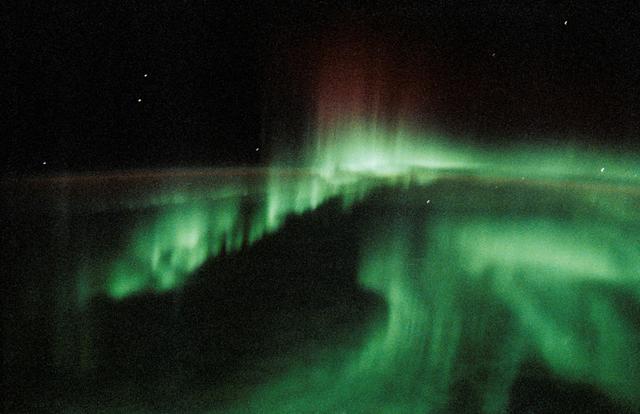
STS047-20-015 (12-20 Sept. 1992) --- This 35mm frame represents one of the more spectacular views of Aurora Australis, photographed by the crew. The crew observed and photographed a great deal of auroral activity from the Earth-orbiting Spa…

This composite image presents the three most visible elements of space weather: a storm from the Sun, aurora as seen from space, and aurora as seen from the Earth. The solar storm is a corona mass ejection (CME) composite from EIT 304Å sup…

Red and Green colors predominate in this view of the Aurora Australis photographed from the Space Shuttle Discovery (STS-39) in May 1991 at the peak of the last geomagnetic maximum. The payload bay and tail of the shuttle can be seen on the…

This photograph of aurora borealis, northern aurora, was taken during the Spacelab-J (SL-J) mission (STS-47). People who live in the northernmost areas like Alaska or work in the southernmost regions like Antarctica often see colorful light…

KENNEDY SPACE CENTER, FLA. -- At Astrotech Space Operations in Titusville, Fla., a worker removes the protective cover from one of the components of the recently arrived THEMIS spacecraft. THEMIS, which stands for Time History of Events a…

KENNEDY SPACE CENTER, FLA. -- Workers at Astrotech Space Operations in Titusville, Fla., wipe down the crates containing the probes of the THEMIS spacecraft. THEMIS, which stands for Time History of Events and Macroscale Interactions du…

KENNEDY SPACE CENTER, FLA. -- One of several crates containing the components of the THEMIS spacecraft is offloaded from a truck at Astrotech Space Operations in Titusville, Fla. THEMIS, which stands for Time History of Events and Macrosc…

62-MA7-169 (1962) --- John Glenn congratulates Scott Carpenter (left) on his three-orbit mission aboard the Aurora 7 spacecraft. Photo credit: NASA
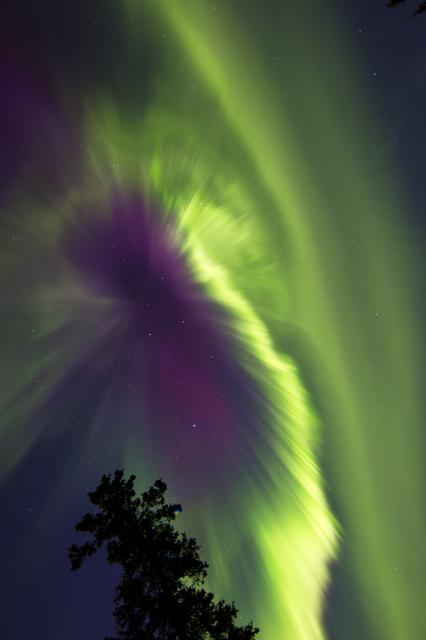
An aurora in Whitehorse Yukon Canada that appeared in the sky in the early hours of Oct. 1, 2012 due to the effects of a coronal mass ejection (CME) that erupted from the sun three days earlier. Image Courtesy of Joseph Bradley to read m…

The faint glow of an aurora is seen over Launch Complex 39B at NASA’s Kennedy Space Center in Florida on Tuesday, Nov. 11, 2025. Auroras are created by energetic electrons, which rain down from Earth’s magnetic bubble and interact with part…

Caption: A NASA-funded sounding rocket launches into an aurora in the early morning of March 3, 2014, over Venetie, Alaska. The GREECE mission studies how certain structures – classic curls like swirls of cream in coffee -- form in the auro…

Using the “day-night band” (DNB) of the Visible Infrared Imaging Radiometer Suite (VIIRS), the Suomi National Polar-orbiting Partnership (Suomi NPP) satellite acquired this view of the aurora borealis on March 18, 2015. The northern lights…
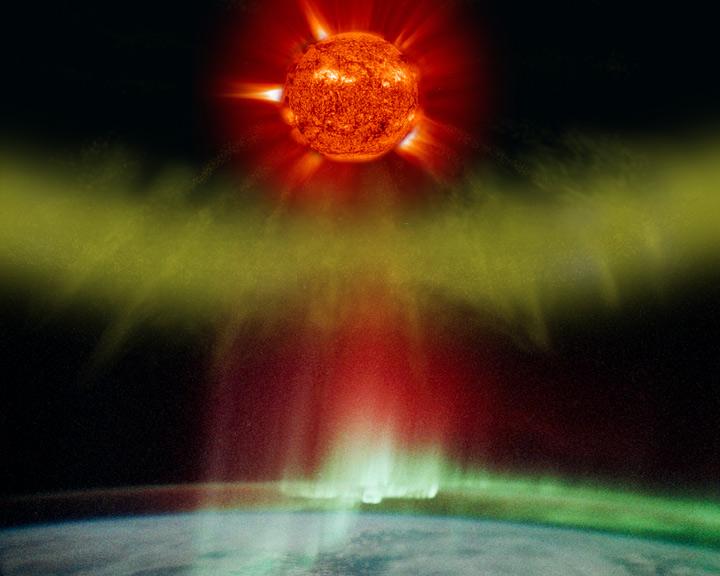
Illustration of a CME particle cloud blasted from the sun impacting Earth and creating aurora (in actual photo of aurora as taken by an astronaut on the space station). Credit: NASA/GSFC/SOHO/ESA To learn more go to the SOHO website: <a…

This is the first image of Saturn's ultraviolet aurora taken by the Space Telescope Imaging Spectrograph (STIS) on board the Hubble Space Telescope (HST) in October 1998, when Saturn was a distance of 810 million miles (1.3 billion kilomete…

Auroras are caused when high-energy electrons pour down from the Earth's magnetosphere and collide with atoms. Red aurora, as captured here by a still digital camera aboard the International Space Station (ISS), occurs from 200 km to as hig…
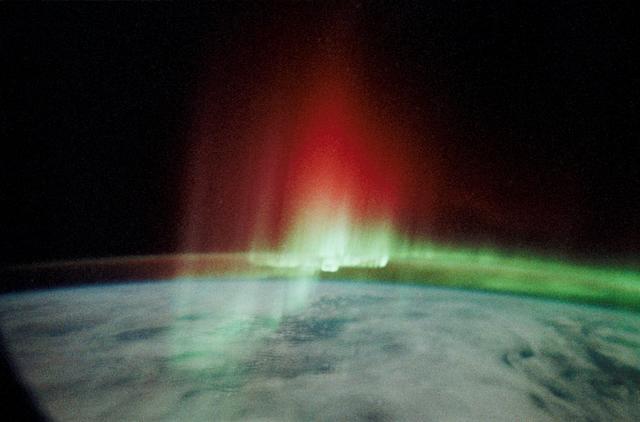
STS039-23-036 (28 April-6 May 1991) --- A 35mm frame of the Aurora Australis, also known as the Southern Lights, photographed from the Space Shuttle Discovery's flight deck by one of its seven crew members. One of the mission objectives was…

STS039-342-026 (28 April-6 May 1991) --- This view of the Aurora Australis, or Southern Lights, shows a band of airglow above the limb of Earth. Photo experts at NASA studying the mission photography identify the airglow as being in the 80…

ISS039-E-009160 (2 April 2014) --- This nighttime view featuring the aurora borealis, the moon and Moscow was photographed by an Expedition 39 crew member on the International Space Station. A thin green line of the aurora borealis crosses…

This photograph of aurora borealis, northern aurora, was taken during the Spacelab-J (SL-J) mission (STS-47). People who live in the northernmost areas like Alaska or work in the southernmost regions like Antarctica often see colorful light…
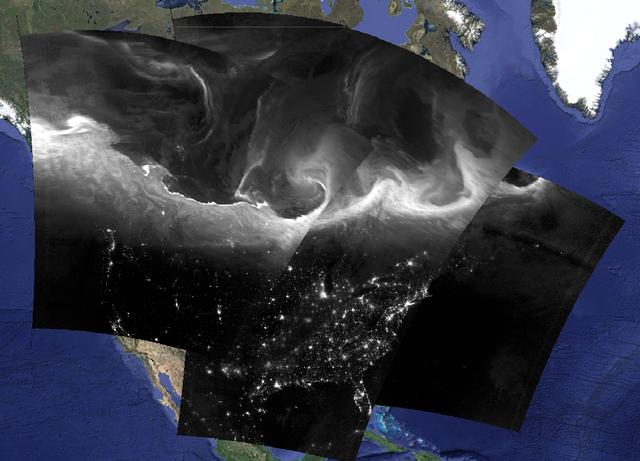
This is a composite image of Suomi NPP VIIRS Day/Night Band images show the bright and complex signature of the aurora borealis across southern Canada and the northern United States during the nighttime hours of September 8, 2015. Credit:…

KENNEDY SPACE CENTER, FLA. -- Workers at Astrotech Space Operations in Titusville, Fla., wipe down the crates containing the probes of the THEMIS spacecraft. THEMIS, which stands for Time History of Events and Macroscale Interactions du…

KENNEDY SPACE CENTER, FLA. -- With workers standing by at Astrotech Space Operations in Titusville, Fla., an overhead crane lifts the crate from one of the components of the recently arrived THEMIS spacecraft. THEMIS, which stands for Tim…

Caption: A NASA-funded sounding rocket launches into an aurora in the early morning of March 3, 2014, over Venetie, Alaska. The GREECE mission studies how certain structures – classic curls like swirls of cream in coffee -- form in the auro…

Caption: A NASA-funded sounding rocket launches into an aurora in the early morning of March 3, 2014, over Venetie, Alaska. The GREECE mission studies how certain structures – classic curls like swirls of cream in coffee -- form in the auro…

The faint glow of an aurora is seen over Launch Complex 39B at NASA’s Kennedy Space Center in Florida on Tuesday, Nov. 11, 2025. Auroras are created by energetic electrons, which rain down from Earth’s magnetic bubble and interact with part…

ISS048e056981 (0813/2016) --- Sparkling aurora colors of magenta and green color the sky's while the International Space Station orbits above the planet every 90 minutes. SpaceX’s Dragon resupply vehicle is seen docked to the Earth-facing p…

KENNEDY SPACE CENTER, FLA. -- One of several crates containing the components of the THEMIS spacecraft is moved into Astrotech Space Operations in Titusville, Fla. THEMIS, which stands for Time History of Events and Macroscale Interacti…

This artist's concept shows an auroral display on a brown dwarf. If you could see an aurora on a brown dwarf, it would be a million times brighter than an aurora on Earth. Credits: Chuck Carter and Gregg Hallinan/Caltech --- Mysterious o…
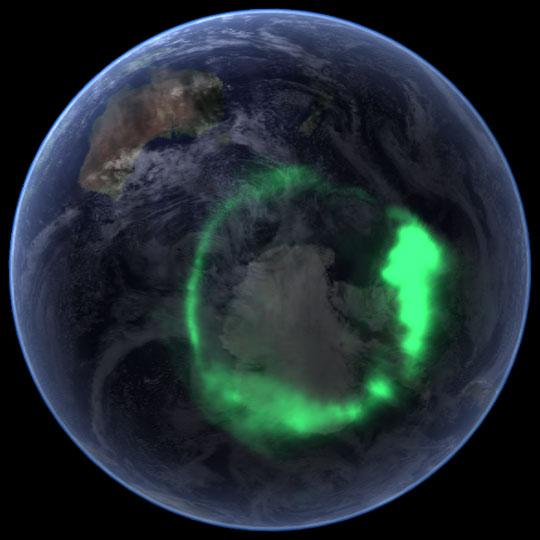
NASA file image acquired September 11, 2005 <b>To view a video of this event go here: <a href="http://www.flickr.com/photos/gsfc/6257608714">www.flickr.com/photos/gsfc/6257608714</a></b> From space, the aurora is a crown of light that cir…

The NASA-funded Ground-to-Rocket Electron-Electrodynamics Correlative Experiment, or GREECE, wants to understand aurora. Specifically, it will study classic auroral curls that swirl through the sky like cream in a cup of coffee. The GRE…

The NASA-funded Ground-to-Rocket Electron-Electrodynamics Correlative Experiment, or GREECE, wants to understand aurora. Specifically, it will study classic auroral curls that swirl through the sky like cream in a cup of coffee. The GRE…
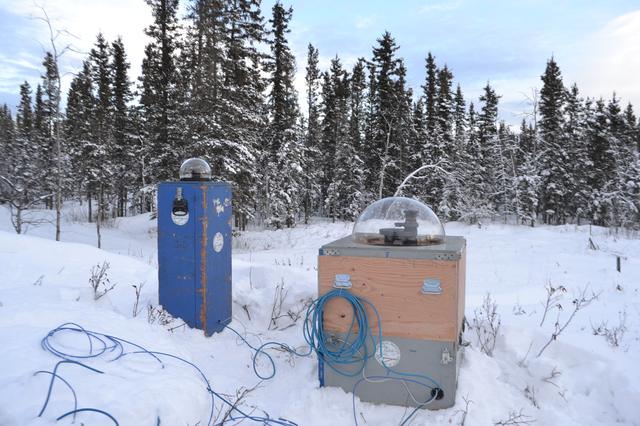
The NASA-funded Ground-to-Rocket Electron-Electrodynamics Correlative Experiment, or GREECE, wants to understand aurora. Specifically, it will study classic auroral curls that swirl through the sky like cream in a cup of coffee. The GRE…

STS039-23-020 (28 April-6 May 1991) --- A 35mm frame of the Aurora Australis, also known as the Southern Lights, photographed from Space Shuttle Discovery's flight deck by one of its seven crew members. One of the mission objectives was to…

STS039-25-006 (28 April-6 May 1991) --- A 35mm frame of the Aurora Australis, also known as the Southern Lights, photographed from the Space Shuttle Discovery's flight deck by one of its seven crew members. One of the mission objectives was…

STS039-377-013 (28 April-6 May 1991) --- Moonlight saturates the high speed film used for auroral photography. Moon glint is visible in the open ocean and the cloud patterns are well illuminated. This frame was taken with a handheld 35mm…