
On October 27, 1961, the Marshall Space Flight Center (MSFC) and the Nation marked a high point in the 3-year-old Saturn development program when the first Saturn vehicle flew a flawless 215-mile ballistic trajectory from Cape Canaveral, Fl…

This photograph depicts the F-1 engine firing in the Marshall Space Flight Center’s F-1 Engine Static Test Stand. Construction of the S-IC Static test stand complex began in 1961 in the west test area of MSFC, and was completed in 1964. It…

A new thrust measurement system is lifted onto the A-1 Test Stand deck at NASA's John C. Stennis Space Center in preparation for its installation. The new system is a state-of-the-art upgrade for the testing structure, which is being prepar…

The June 8, 2012, test of the J-2X powerpack on the A-1 Test Stand at NASA's Stennis Space Center set a new record of test duration, lasting 1,150 seconds, almost 20 full minutes. It was the longest-duration test firing ever conducted in th…

Just two weeks after setting a record with a long-duration test of the J-2X rocket engine powerpack assembly, NASA engineers at Stennis Space Center exceeded it. On July 24, 2012, engineers surpassed the earlier 1,150-second record with a 1…

Engineers at NASA's Stennis Space Center conducted a test of the J-2X engine powerpack Feb. 15, 2012, the first in a series of key tests in development of the next-generation rocket.

At its founding, the Marshall Space Flight Center (MSFC) inherited the Army’s Jupiter and Redstone test stands, but much larger facilities were needed for the giant stages of the Saturn V. From 1960 to 1964, the existing stands were remodel…

At its founding, the Marshall Space Flight Center (MSFC) inherited the Army’s Jupiter and Redstone test stands, but much larger facilities were needed for the giant stages of the Saturn V. From 1960 to 1964, the existing stands were remodel…

At its founding, the Marshall Space Flight Center (MSFC) inherited the Army’s Jupiter and Redstone test stands, but much larger facilities were needed for the giant stages of the Saturn V. From 1960 to 1964, the existing stands were remodel…

At its founding, the Marshall Space Flight Center (MSFC) inherited the Army’s Jupiter and Redstone test stands, but much larger facilities were needed for the giant stages of the Saturn V. From 1960 to 1964, the existing stands were remodel…

NASA John C. Stennis Space Center employee Dustan Ladner (left) assists tanker driver David Velasco in transferring RP-1 fuel to a 20,000-gallon underground tank at the E-1 Test Stand during a March 30 delivery. The rocket propellant will b…

The Saturn Project was approved on January 18, 1960, as a program of the highest national priority. The formal test program to prove out the clustered-booster concept was well underway at Redstone Arsenal. This photograph depicts a mockup o…

An Aerojet AJ26 rocket engine is hoisted for installation at Stennis Space Center's E-1 Test Stand on July 19. Stennis operators have been preparing the E-1 stand for testing AJ26 engines since April 2009. Modifications included constructio…

Operators at NASA's John C. Stennis Space Center are completing modifications to the E-1 Test Stand to begin testing Aerojet AJ26 rocket engines in early summer of 2010. Modifications include construction of a 27-foot-deep flame deflector t…
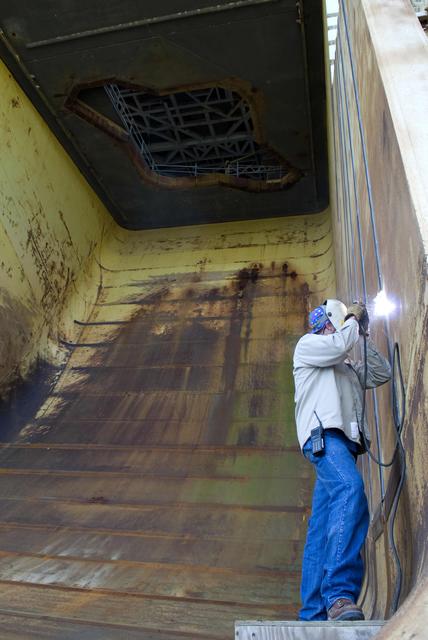
Welder Jackie Ladner of Jacobs FOSC makes repairs to the flame bucket on the A-1 Test Stand.

Two large-engine tests were conducted simultaneously for the first time at Stennis Space Center on Aug. 16. A plume on the left indicates a test on the facility's E-1 Test Stand. On the right, a finger of fire indicates a test under way on…

Two large-engine tests were conducted simultaneously for the first time at Stennis Space Center on Aug. 16. A plume on the left indicates a test on the facility's E-1 Test Stand. On the right, a finger of fire indicates a test under way on…
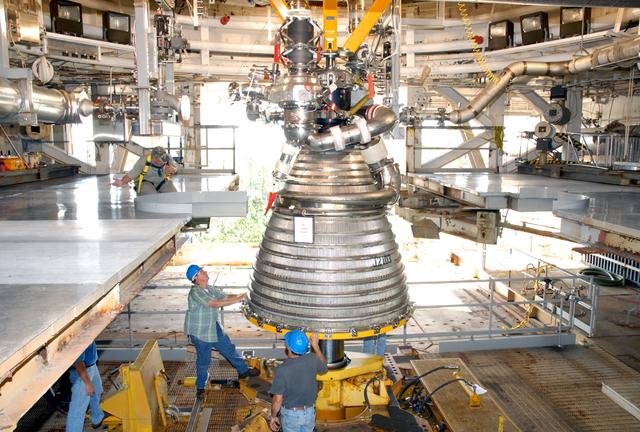
Core components of the J-2X engine being designed for NASA's Constellation Program recently were installed on the A-1 Test Stand at NASA's Stennis Space Center near Bay St. Louis, Miss. Tests of the components, known as Powerpack 1A, will b…
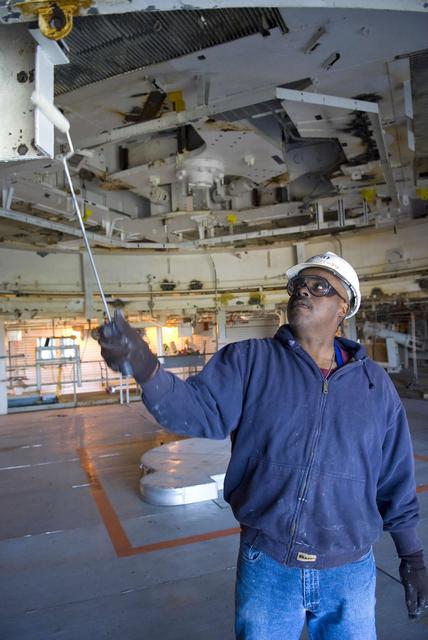
Douglas Haralson of Jacobs FOSC applies paint on the engine deck of the A-1 Test Stand.

This photograph depicts a test firing of an F-1 engine at the F-1 engine test stand in the west test area of the Marshall Space Flight Center. This engine produced 1,500,000 pounds of thrust using liquid oxygen and RP-1, which is a derivati…

NASA conducted a 340-second test of the J-2X engine powerpack at Stennis Space Center on May 10, 2012, marking another step in development of the next-generation rocket engine. The powerpack is a system of components on the top portion of t…

An RS-25 engine is fired at sunset on Nov. 15 on the A-1 test stand at Stennis Space Center. The 650-second duration test represents the time three such engines would need to fire to burn up propellant and power the rocket into orbit, even…

At its founding, the Marshall Space Flight Center (MSFC) inherited the Army’s Jupiter and Redstone test stands, but much larger facilities were needed for the giant stages of the Saturn V. From 1960 to 1964, the existing stands were remodel…

At its founding, the Marshall Space Flight Center (MSFC) inherited the Army’s Jupiter and Redstone test stands, but much larger facilities were needed for the giant stages of the Saturn V. From 1960 to 1964, the existing stands were remodel…

At its founding, the Marshall Space Flight Center (MSFC) inherited the Army’s Jupiter and Redstone test stands, but much larger facilities were needed for the giant stages of the Saturn V. From 1960 to 1964, the existing stands were remodel…

Crews at NASA’s Stennis Space Center remove an RS-25 rocket engine from the A-1 test stand on Nov. 1, 2021, following a series of successful tests.

The test laboratory of the Marshall Space Flight Center (MSFC) tested the F-1 engine, the most powerful rocket engine ever fired at MSFC. The engine was tested on the newly modified Saturn IB static test stand that had been used for three y…

Workers at the Marshall Space Flight Center (MSFC) hoist S-IB-1, the first flight version of the Saturn IB launch vehicle's first stage (S-IB stage), into the Saturn IB static test stand on March 15, 1965. Developed by the MSFC and built by…

This close-up photo was taken during testing of a Space Shuttle Main Engine on the A-1 Test Stand at Stennis Space Center near Bay St. Louis, Miss. The test was conducted June 19, 2003.

Legislators from across Mississippi visited Stennis Space Center on May 7, 2012, touring various facilities, including the A-1 Test Stand, and learning about work under way at the facility. The legislators also toured the INFINITY at NASA S…

An Aerojet AJ26 rocket engine is hoisted for installation at Stennis Space Center's E-1 Test Stand on July 19. Stennis operators have been preparing the E-1 stand for testing AJ26 engines since April 2009. Modifications included constructio…

Team members check the progress of a liquid nitrogen cold shock test on the A-1 Test Stand at Stennis Space Center on Sept. 15. The cold shock test is used to confirm the test stand's support system can withstand test conditions, when super…

Stennis Space Center employees maneuver a new thrust measurement system in preparation for its installation on the A-1 Test Stand on March 3. The system was fabricated by Thrust Measurement Systems in Illinois and represents a state-of-the-…

Employees at NASA's John C. Stennis Space Center work to maneuver a structural steam beam into place on the A-1 Test Stand on Jan. 13. The beam was one of several needed to form the thrust takeout structure that will support a new thrust me…

Employees maneuver a vertical engine installer into place on the A-1 Test Stand at Stennis Space Center on Sept. 23. Installation of the equipment was a milestone event as the historic stand underwent modifications for testing the powerpack…

NASA removed J-2X engine No. 10001 from the A-2 Test Stand at Stennis Space Center in early October. Opening of the test stand clamshell flooring allowed a clear view of the next-generation engine and stub nozzle, which is being built to he…

At its founding, the Marshall Space Flight Center (MSFC) inherited the Army’s Jupiter and Redstone test stands, but much larger facilities were needed for the giant stages of the Saturn V. From 1960 to 1964, the existing stands were remodel…

At its founding, the Marshall Space Flight Center (MSFC) inherited the Army’s Jupiter and Redstone test stands, but much larger facilities were needed for the giant stages of the Saturn V. From 1960 to 1964, the existing stands were remodel…

At its founding, the Marshall Space Flight Center (MSFC) inherited the Army’s Jupiter and Redstone test stands, but much larger facilities were needed for the giant stages of the Saturn V. From 1960 to 1964, the existing stands were remodel…

At its founding, the Marshall Space Flight Center (MSFC) inherited the Army’s Jupiter and Redstone test stands, but much larger facilities were needed for the giant stages of the Saturn V. From 1960 to 1964, the existing stands were remodel…

At its founding, the Marshall Space Flight Center (MSFC) inherited the Army’s Jupiter and Redstone test stands, but much larger facilities were needed for the giant stages of the Saturn V. From 1960 to 1964, the existing stands were remodel…

Marshall Space Flight Center's F-1 Engine Test Stand is shown in this picture. Constructed in 1963, the test stand is a vertical engine firing test stand, 239 feet in elevation and 4,600 square feet in area at the base, and was designed to…

At its founding, the Marshall Space Flight Center (MSFC) inherited the Army’s Jupiter and Redstone test stands, but much larger facilities were needed for the giant stages of the Saturn V. From 1960 to 1964, the existing stands were remodel…

The test laboratory of the Marshall Space Flight Center (MSFC) tested the F-1 engine, the most powerful rocket engine ever fired at MSFC. The engine was tested on the newly modified Saturn IB Static Test Stand which had been used for three…

Operators at NASA's John C. Stennis Space Center are completing modifications to the E-1 Test Stand to begin testing Aerojet AJ26 rocket engines in early summer of 2010. Modifications include construction of a 27-foot-deep flame deflector t…

S-IB-1, the first flight version of the Saturn IB launch vehicle's first stage (S-IB stage), undergoes a full-duration static firing in Saturn IB static test stand at the Marshall Space Flight Center (MSFC) on April 13, 1965. Developed by t…
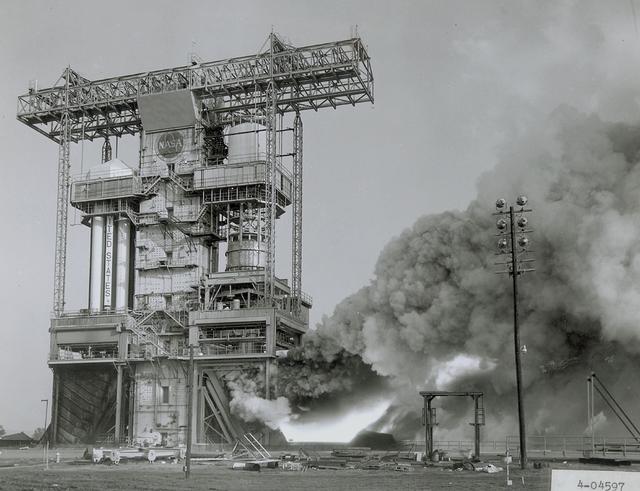
The flame and exhaust from the test firing of an F-1 engine blast out from the Saturn S-IB Static Test Stand in the east test area of the Marshall Space Flight Center. A Cluster of five F-1 engines, located in the S-IC (first) stage of the…

S-IB-1, the first flight version of the Saturn IB launch vehicle's first stage (S-IB stage), sat in the Marshall Space Flight Center (MSFC) Saturn IB static test stand on March 15, 1965. Developed by the MSFC and built by the Chrysler Corpo…